Key Takeaways for Navigating Money in Japan
Before you dive into the details of your Japanese adventure, here is a quick snapshot of how money works across the country. Keep these five core rules in mind, and you will navigate every transaction like a local.
- Tipping Is Out: Never leave extra cash on the table. Tipping does not exist in Japan, and doing it can cause genuine confusion or awkwardness.
- Cash Is Still Essential: Despite modern changes, paper money and coins are vital for small shops, temples, street food, and train lockers. Always carry a wallet with room for coins.
- Plastic is Growing: Big hotels, department stores, and convenience stores happily take international credit cards. Look for the standard payment logos at the register.
- Tap and Go with Transit Cards: Digital transit passes like Suica or Pasmo are your secret weapons. You can load them with cash and tap them to pay for trains, vending machines, and quick snacks.
- Know Your ATMs: International bank cards work best at 7-Eleven and Japan Post ATMs. Most neighborhood bank machines will reject overseas cards.
Imagine walking into a cozy, wood-paneled restaurant in the heart of Tokyo. You just finished a steaming bowl of perfect ramen, and you feel incredibly satisfied. The service was fast, the chef smiled as he handed you the bowl, and the entire experience was flawless. Naturally, your instinct is to leave a generous pile of cash on the table to say thank you.
Do not do it.
If you leave extra money behind, the waiter will likely sprint down the street after you, breathless and worried, just to return the coins you forgot.
Money works differently in Japan. It is a unique blend of ancient etiquette, a deep love for crisp paper bills, and rapid high-tech updates. Navigating payments here can feel like a puzzle if you are used to tapping your phone for absolutely everything. This comprehensive guide will walk you through the world of Japanese yen, show you exactly when to use plastic, and explain why your wallet is about to get much heavier with coins.
The Golden Rule: The Absolute No-Tipping Policy
To understand money in Japan, you have to understand the culture around service. In many Western countries, tipping is a way to reward a worker for doing a great job, or it is a necessary part of their take-home pay. In Japan, exceptional service is already included in the price. It is called omotenashi, which translates to wholehearted hospitality.
Why Tipping Causes Confusion
When you leave extra money on a table or try to hand a bill to a taxi driver, you are not being generous in their eyes. Instead, you are introducing a strange social error. The staff will assume you made a mistake. They might think you miscalculated your change, or that you dropped your money by accident.
In some cases, offering a tip can even feel slightly insulting, as if you are implying that the employer does not pay their staff a fair wage. The staff takes immense pride in their work regardless of bonuses. The best way to say thank you is not with cash, but with a polite phrase. As you leave, simply say “Gochisousama deshita” (which means “Thank you for the feast”) or a simple “Arigatou gozaimasu” (Thank you very much). A warm smile and a polite bow mean infinitely more than a handful of coins.
The Rare Exceptions: Ryokans and Tour Guides
Are there any moments where extra money changes hands? Yes, but it happens under very strict cultural rules, and it is never called a tip.
If you stay at a high-end ryokan (a traditional Japanese inn) where a dedicated personal attendant serves multi-course meals directly to your room, you might offer a small monetary gift called tiishugi. However, you must never hand raw cash over. The money must be clean, crisp, and placed inside a special decorative envelope called a shugi-bukuro. You hand it to the attendant at the very beginning of your stay, not the end, as a token of appreciation for the care they will provide.
Similarly, if you hire a private, bilingual tour guide for a full day, they understand Western customs but still do not expect tips. If you want to show extra appreciation, offering to buy them lunch during the tour or gifting them a small, beautifully packaged souvenir from your hometown is the perfect gesture.
Cash is King: Why Paper and Coins Still Rule
You might have heard that Japan is a futuristic wonderland full of robots and bullet trains. While that is true, Japan is also deeply traditional, and that tradition extends to physical currency. For decades, Japan has been a cash-centric society. While things are shifting toward digital options, carrying paper money and coins is completely non-negotiable for travelers.
The Safety Factor
One reason cash remains popular is that Japan has an incredibly low crime rate. People feel perfectly safe walking around with tens of thousands of yen in their pockets. It is common to see someone pull out a thick wallet full of bills to pay for a simple lunch. Because theft is rare, businesses do not worry about keeping large amounts of cash on hand, and consumers do not fear being targeted.
Small Businesses and Hidden Gems
If you plan to spend your entire vacation in major tourist zones, huge malls, and luxury hotels, you might get by with a credit card. But the real magic of Japan lies in the tiny side streets.
Think of small family-run izakayas (Japanese pubs), traditional street food stalls at festivals, old-fashioned public baths, and beautiful rural temples. These spots almost exclusively deal in cash. If you wander off the beaten path to explore a quiet mountain village or buy a handmade souvenir from an elderly artisan, your shiny platinum credit card will be useless.
Embracing the Coin Culture
When you use cash in Japan, you will quickly notice that your coin pouch fills up fast. The currency is the Japanese Yen (indicated by the symbol ¥). While Western countries often use paper bills for small values like one, five, or ten dollars, Japan uses coins all the way up to five hundred yen.
Guide to Japanese Coins
- 1 Yen Coin: Made of pure aluminum. It is incredibly light and actually floats on water. Keep these for exact change at convenience stores.
- 5 Yen Coin: Made of brass with a hole in the center. It is considered lucky because its name, go-en, sounds like the Japanese word for good fortune. People love saving these to throw into offering boxes at shrines.
- 10 Yen Coin: A heavy bronze coin. You will use these constantly for vending machines and payphones.
- 50 Yen Coin: Made of cupronickel with a hole in the middle, helping you distinguish it easily from the 10-yen coin.
- 100 Yen Coin: The workhorse of Japanese pocket money. This is the exact coin you need for arcade games, capsule toy machines, and public laundromats.
- 500 Yen Coin: One of the highest-value coins in the world. It is large, gold-colored, and holds significant buying power. A single 500-yen coin can easily buy you a full convenience-store lunch.
Because you will handle so many coins, buy a dedicated coin purse before your trip or pick one up at a local shop on your first day. Trying to dig through a deep, dark backpack pocket for a tiny 1-yen coin while a line forms behind you is an easy way to feel stressed.
Paper Bills: Understanding Your Banknotes
Japanese paper currency is beautiful, clean, and surprisingly durable. The banknotes come in four major denominations: 1,000 yen, 2,000 yen, 5,000 yen, and 10,000 yen. Japan introduced newly designed banknotes recently, featuring advanced holographic features to prevent counterfeiting, but you will still see older versions in circulation. Both are perfectly valid.
The Everyday Bills
The 1,000-yen bill is the most common note you will handle. It is worth roughly ten US dollars depending on exchange rates, making it the perfect bill for casual meals, entry tickets to gardens, and quick shopping trips.
The 5,000-yen bill is less common but highly useful for mid-range dinners or buying train tickets.
The 10,000-yen bill is the largest denomination. Do not be afraid to hand a crisp 10,000-yen bill to a cashier to pay for a tiny item. In many countries, breaking a hundred-dollar bill at a small shop causes frustration. In Japan, cashiers will gladly accept a large bill for a small purchase and count out your change with extreme precision and courtesy.
The Mystery 2,000-Yen Bill
You might occasionally receive a 2,000-yen bill. These were printed to celebrate the turn of the millennium and the G8 summit in Okinawa. They are quite rare nowadays, and many modern vending machines or automated ticket gates will not accept them. If you get one, it is a fun collector item, but it is best to spend it at a manned cash register where a human can accept it without issue.
Credit Cards: Where and When to Swipe
While cash remains vital, the landscape for credit cards has changed dramatically over the last few years. The Japanese government has pushed hard to increase cashless payments, meaning you can use your foreign credit cards far more easily than travelers could a decade ago.
Major Acceptable Card Networks
Visa and Mastercard are universally recognized across Japan wherever credit cards are accepted. American Express and Discover are also widely taken, especially in hotels and high-end restaurants, thanks to partnerships with JCB, Japan’s homegrown credit card network.
Before you leave home, call your bank or log into your mobile app to check two critical things:
- Foreign Transaction Fees: Some cards charge a two-to-three percent fee on every single purchase made overseas. Over a two-week vacation, this adds up to a massive waste of money. Try to use a card that offers zero foreign transaction fees.
- Travel Notices: Tell your bank you are heading to Japan. If you suddenly switch from buying groceries in your hometown to buying a high-end camera in Tokyo, your bank’s fraud detection system might instantly freeze your account, leaving you stranded at the register.
Best Places for Plastic
You can confidently rely on your credit card in major department stores, global clothing chains, mid-to-high-end restaurants, hotel lobbies, and major theme parks like Tokyo DisneySea or Universal Studios Japan. If you see a digital screen or a row of stickers by the register displaying card logos, you are good to go.
Automated Payment Terminals
When paying with a card at restaurants or shops, you will often interact with an automated payment terminal. The cashier will slide your card into the machine, and you will need to type your four-digit PIN. Tap-to-pay systems are becoming more common, but inserting the chip is still the most reliable method for foreign cards.
IC Cards: The Ultimate Cashless Smart Pass
If you want the absolute easiest way to pay for things without dealing with a mountain of coins or worrying about credit card acceptance, you need an IC card. These are rechargeable, contactless smart cards originally designed for public transit, but they have evolved into a massive electronic payment network.
Meet the IC Family
Depending on where you land in Japan, you will encounter different brands of IC cards. In Tokyo and eastern Japan, the main cards are Suica and Pasmo. In Osaka, Kyoto, and western Japan, you will find Icoca.
The best part? These cards are completely interchangeable. A Suica card bought at a Tokyo airport works perfectly on the Kyoto city bus, the Osaka subway, and at convenience stores nationwide.
Buying and Loading Your Card
You can buy a physical IC card at train stations using the automated ticket machines. The machines have an English button and will guide you through the process. You pay a small, refundable deposit (usually 500 yen) and then choose how much cash to load onto the card.
Keep in mind that physical IC cards must be reloaded using cash only at train station machines or at convenience store registers. You cannot use a foreign credit card to add funds to a physical IC card at a station kiosk.
The Digital Alternative
If you use an iPhone or an Apple Watch, you can skip the plastic entirely. You can add a digital Suica or Pasmo card directly to your Apple Wallet. The massive benefit here is that you can link your digital transit card to your stored credit card and reload it directly from your phone at any time of night, without needing cash.
Note: Sometimes certain Western credit cards fail to process within the Apple Wallet app due to international security protocols. If one card fails, try a different brand, like switching from a Visa to a Mastercard.
Where Can You Spend IC Card Funds?
IC cards are not just for train gates. They are accepted at an astonishing number of locations across the country. You can tap your card to buy drinks from millions of roadside vending machines, pay for coin lockers at train stations, purchase daily snacks at convenience stores, and pay for your meal at fast-food chains. Look for the small contactless reader with the IC logo at the register, tap your card or phone, listen for the satisfying beep, and your payment is complete.
Navigating Vending Machines and Ticket Kiosks
Japan loves automation, and you will interact with machines to buy food and tickets daily. Understanding how these machines handle money will save you a lot of time and confusion.
The Famous Food Vending Machines
When you walk into a casual dining spot, such as a fast-casual bowl restaurant or a local ramen shop, you often will not order from a waiter. Instead, you will see a large ticket vending machine near the entrance. You insert your money first, press the buttons for the dishes you want, collect your paper tickets, and hand them to the chef behind the counter.
Most of these traditional machines are cash-only. They love 1,000-yen bills and 100-yen coins. Newer machines in major cities now feature touchscreens with English translation modes and accept IC cards or credit cards, but always ensure you have paper bills ready just in case.
Buying Shinkansen and Local Train Tickets
For local subways, you will use station touchscreens to buy paper tickets or load your IC card. The process is simple: look at the giant map above the machines to find your destination, see the price listed next to the station name, insert your cash, and select that specific fare on the screen.
For the Shinkansen (the iconic bullet train), the ticket machines are much larger and accept international credit cards. You will select your route, choosing between reserved or unreserved seating, and insert your credit card into the slot. You will be required to type your four-digit PIN to finalize the purchase.
Withdrawing Cash: Finding the Right ATMs
At some point during your trip, your cash reserves will run low. When this happens, do not wander into a random Japanese bank hoping their lobby ATM will accept your card. Most domestic Japanese bank ATMs do not connect to global networks like Plus, Cirrus, or Visa Electron, and they will simply spit your card back out with an error message.
Your Best Friends: Convenience Stores
To get cash easily, head straight to a convenience store. They are open twenty-four hours a day, seven days a week, and their machines are completely compatible with international bank cards.
- 7-Eleven (Seven Bank): These are the gold standard for travelers. They accept almost every international debit and credit card, feature clean multilingual menus, and charge very low transaction fees.
- FamilyMart and Lawson (E-Net ATMs): These are also highly reliable and work well with foreign cards.
The Japan Post Option
Another foolproof option is the postal system. Japanese post offices, known as Japan Post, have a massive network of ATMs. Look for the green and red logos. These machines work perfectly with foreign debit cards during regular business hours, though they may close late at night or during major national holidays.
ATM Fees and Limits
When withdrawing cash, the machine will usually offer you a choice: be charged in your home currency or be charged in Japanese yen. Always choose Japanese yen. If you choose your home currency, the ATM company applies its own conversion rate, which is almost always much worse than the standard rate your home bank provides.
Additionally, be aware that most ATMs have a single-withdrawal limit, usually around 50,000 to 100,000 yen per transaction.
Convenience Stores: The Financial Hubs of Japan
In Japan, convenience stores—locally known as konbini—are not just places to grab a quick snack. They are high-tech neighborhood lifesavers that play a massive role in how you handle money during your vacation. The big three chains are 7-Eleven, Lawson, and FamilyMart.
Payment Versatility
Convenience stores are the absolute most flexible payment environments in the country. At a single register, you can pay using cash, credit cards, IC cards, or mobile payment apps like PayPay. If you have a pocket full of annoying 1-yen and 5-yen coins, the konbini is the perfect place to dump them into the automated coin slots at the counter to clear out your wallet.
Paying for Bookings and Tickets
Konbinis feature multi-purpose terminal machines that look like large printers. You can use these machines to buy tickets for theme parks, concerts, museum admissions (like the famous Studio Ghibli Museum), and long-distance overnight buses.
Once you print out the payment slip from the machine, you walk over to the cashier and pay for it right there on the spot using your preferred method, including your credit card or cash. It eliminates the need to navigate confusing Japanese websites with foreign billing addresses.
Money Etiquette: The Art of the Transaction
In Japan, the way you hand over money is just as important as the money itself. Transactions are treated with a high level of respect, and following local etiquette will make your interactions smooth and pleasant.
The Money Tray
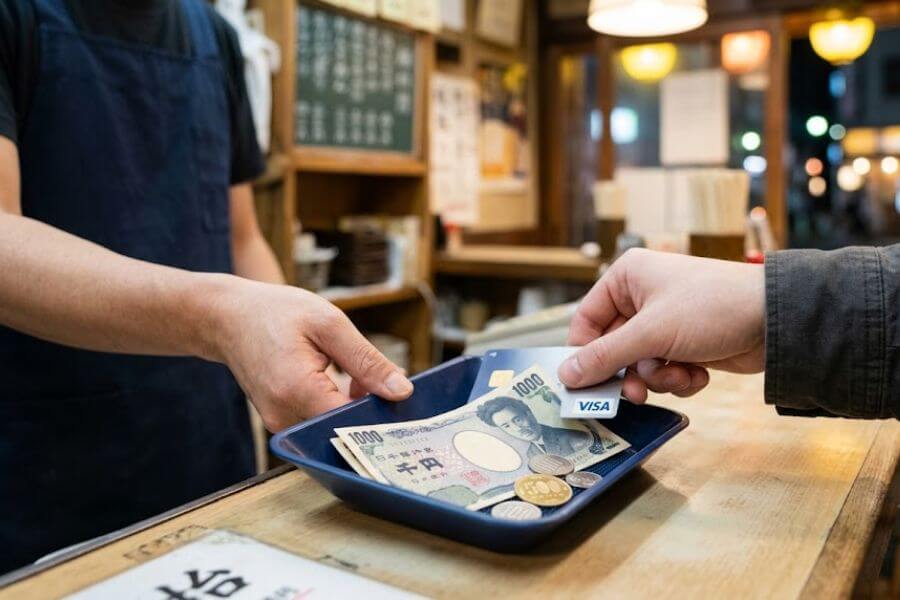
When you step up to a cash register, look for a small tray on the counter. It is usually made of blue plastic, leather, or wood. Always place your cash, coins, or credit card inside this tray rather than handing them directly to the cashier.
This custom ensures that coins do not drop and roll away, and it gives the cashier a clear view to count the money accurately. If you hand cash directly to a worker, they will politely take it with both hands, but using the tray is the preferred cultural standard.
Handling Bills with Respect
Try to keep your paper money looking neat. Avoid crumpling your bills into tight balls or shoving them carelessly into your pockets. When cashiers give you change, you will notice they present the bills to you beautifully aligned, facing the same direction, and will count them out loud in front of you. They will then place the coins gently on top of the bills or hand them to you separately to keep things organized.
The Two-Handed Delivery
If there is no tray available, or if you are handing a card directly to a worker, hold the item with both hands. This simple gesture shows that you respect the person across from you and value the transaction. It takes half a second but leaves a wonderful impression.
Taxis, Trains, and Buses: Transit Payment Methods
Getting around Japan is a joy thanks to the world-class transit systems, but each mode of transport handles payments a little differently.
Navigating Local Buses
Buses can be intimidating for first-time visitors because the payment system changes depending on the city. In Kyoto, you pay a flat fare when exiting the bus. In other regions, you enter through the back door, pull a small paper slip from a machine showing your zone number, and check the electronic screen at the front of the bus to see how your fare increases as the bus moves.
The easiest workaround is your IC card. Simply tap your card on the reader when you step onto the bus, and tap it again when you exit. The system calculates the math instantly. If you must use cash, the fare box next to the driver cannot accept large bills, but it features a built-in change machine that breaks 1,000-yen bills into exact coins before you pay.
Taxis: High-Tech and Hands-Off
Japanese taxis are spotlessly clean, and the rear doors open automatically via a lever pulled by the driver. Do not pull the door open or slam it shut yourself.
When it comes to payment, almost all modern city taxis accept credit cards, IC cards, and mobile quick-response codes. Look at the passenger window or the screen on the back of the headrest to see acceptable payment logos. If you are traveling through rural areas, taxis may still be cash-only, so always ask “Kureditto kaado wa tsukaemasu ka?” (Can I use a credit card?) before you get in.
Tax-Free Shopping: How to Save Big on Purchases
If you love shopping, Japan offers an incredible tax-free program for foreign tourists. The standard consumption tax is ten percent, and saving that amount on high-ticket items like electronics, designer clothing, or skincare products adds up quickly.
What Qualifies for Tax-Free?
To get the tax deduction, you must be a temporary visitor holding a tourist visa stamp in your physical passport. You must spend a minimum of 5,000 yen (excluding tax) at a single store on the same day.
Items are divided into two main categories:
- General Goods: Clothing, shoes, cameras, bags, and electronics. You can use these items during your stay in Japan.
- Consumables: Cosmetics, food, alcohol, and medicine. These items will be packed into a specially sealed plastic bag. You must not open this bag while you are inside Japan. If you break the seal and use the products before leaving the country, you may be forced to pay the ten percent tax back at the airport customs desk.
The Tax-Free Process at the Counter
When you shop at a designated tax-free store (look for the “Tax-Free” emblems on the shop windows), present your physical passport to the cashier at the time of purchase. Digital copies or photos of your passport on your smartphone will not be accepted.
The shop will either subtract the ten percent tax right at the cash register so you pay the lower price immediately, or they will direct you to a dedicated tax-refund desk inside the building where they calculate your purchases and hand you your tax refund back in cash.
Budgeting and Emergency Planning
To ensure your trip runs smoothly, plan your funds out wisely. It is smart to use a hybrid system: pay for your big accommodations and train passes ahead of time online using your credit card, and carry a steady supply of cash for day-to-day exploring.
How Much Cash Should You Carry?
A good baseline rule of thumb is to keep roughly 5,000 to 10,000 yen in cash per person in your wallet for each day of exploration. This easily covers casual dining, temple admission fees, vending machine drinks, and emergency taxi rides if you accidentally miss your final train home late at night.
What to Do If You Lose Your Money
If you accidentally lose your wallet or leave your cash purse on a train, do not panic. Because of Japan’s exceptional safety culture, there is an incredibly high probability you will get it back untouched.
Head straight to the nearest neighborhood police box, known as a koban. The police officers are highly efficient and will fill out a lost-property report. If you left the item on a train, go to the station master office at the nearest stop. Station staff log lost items with incredible speed, down to the exact train car and seat number where the item was discovered.
Comparison Table: Payment Methods at a Glance
To give you a clear roadmap of how to pay for things throughout your journey, here is a quick breakdown showing which payment method works best across common travel scenarios.
| Scenario / Location | Cash Acceptance | Credit Card Acceptance | IC Card Acceptance | Recommended Payment Method |
| Major Hotels | Yes | Yes | No | Credit Card |
| Convenience Stores | Yes | Yes | Yes | IC Card or Phone |
| Street Food Stalls | Yes | No | No | Cash |
| Temples and Shrines | Yes | No | No | Cash |
| Bullet Trains | Yes | Yes | No | Credit Card |
| Local Subways | Yes | No | Yes | IC Card |
| Vending Machines | Yes | No | Yes | IC Card |
| High-End Restaurants | Yes | Yes | No | Credit Card |
| Capsule Toy Machines | Yes | No | No | Cash (100-Yen Coins) |
Frequently Asked Questions
Can I tip a hotel bellhop or a porter who helps with my heavy bags?
No, you should not tip hotel staff, including bellhops, porters, or room cleaners. If a staff member helps carry your heavy luggage up to your room, simply say thank you with a polite bow and a warm verbal expression. Leaving money on the desk or attempting to slide bills into their hands will create an uncomfortable situation where the employee will feel obligated to politely refuse the money.
What should I do with my leftover coins at the very end of my trip?
Leftover coins cannot be exchanged back into your home currency at airport foreign-exchange booths, so it is best to spend them before you board your flight. The absolute best way to clear out your coins is at airport convenience stores or duty-free shops right before you go through security. Alternatively, you can use your leftover coins to buy final treats from the departure-lounge vending machines, or use them to reload your digital IC card if you plan to return to Japan in the future.
Can I use my foreign credit card at standard Japanese neighborhood bank ATMs?
Generally, no. Standard domestic bank ATMs found inside local Japanese banks often do not connect to global networks and will reject overseas debit and credit cards. To avoid this frustration, stick exclusively to ATMs located inside convenience stores like 7-Eleven, Lawson, and FamilyMart, or use the green ATMs located inside major branches of Japan Post.
Is Apple Pay widely accepted across retail stores in Japan?
Apple Pay works very well in Japan, but its functionality depends on what is linked to your phone. If you have a digital transit card like Suica loaded into your Apple Wallet, you can use it to tap and pay at millions of registers, transit gates, and vending machines nationwide. However, standard contactless credit cards loaded onto Apple Pay are only accepted at major international retailers that explicitly display the contactless payment wave symbol at the counter.
What happens if I accidentally open a sealed tax-free bag while inside the country?
If you open a sealed tax-free consumables bag while you are still inside Japan, you are technically breaking the law regarding tax exemption. When you arrive at the airport to depart, customs officials have the right to inspect your purchases. If they see the tamper-evident seal is broken or if items are missing from the bag, you will be required to pay the ten percent consumption tax back right there on the spot. Keep the bag completely sealed until you clear international customs at the airport.