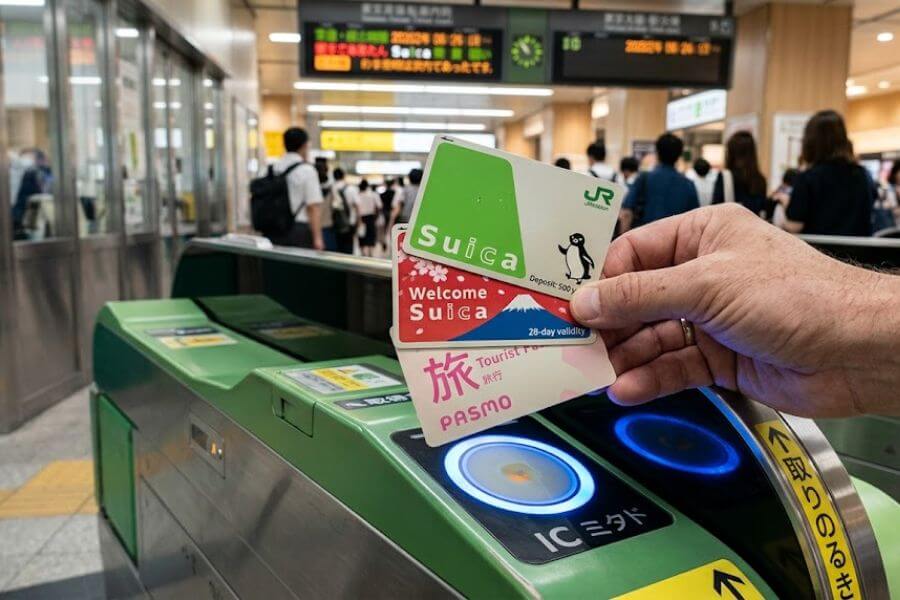
To explore Japan like a local, you need one of these magic travel keys, known as an IC card. These pocket-sized smart cards store digital money that pays for your train rides, bus fares, convenience store snacks, and vending machine drinks with a simple tap.
But as you look up the rules for your 2026 trip, you might feel a little puzzled. You will see names like Suica, Pasmo, and Welcome Suica floating around online. You might read old articles from a few years ago talking about chip shortages and suspended sales, or you might hear about brand-new cards hitting the stations.
Do not worry. Choosing the perfect option is much simpler than it seems. This ultimate guide will clear up the confusion and help you choose the best transit card for your big Japanese adventure.
The Big Three Options for Travelers
When you arrive in the Tokyo metropolitan area, you will be introduced to three primary types of transit cards. While they all serve the exact same main purpose, they have completely different rules regarding who can buy them, how long they last, and where you can find them. Let us break down each card so you know exactly what to expect.
The Regular Suica Card
The classic, bright green plastic card featuring a cute little penguin is the traditional favorite. For a long time, these regular cards were very hard to find because of global computer chip supply issues that paused their sales. Fortunately, regular cards are back on the shelves, but they come with a specific setup process.
When you buy a regular physical Suica card, you must pay a 500 yen deposit, which is about three to four American dollars. This deposit is locked inside the card and cannot be used for train rides. To get that deposit money back, you have to return the physical card to a specific train office at the very end of your vacation.
The best feature of a regular card is its long life. It stays active for a massive ten years. If you plan to return to Japan in a few years, you can toss this card into your drawer at home and pull it out for your next trip without buying a new one.
The Welcome Suica Card
Because regular plastic cards were hard to get for a while, the railway companies created a special version just for international visitors. This is the Welcome Suica card, and it looks beautiful. It features a bright red background decorated with white cherry blossoms, making it an amazing souvenir to show your friends back home.
The best part about this option is that there is absolutely no deposit fee. Every single yen you spend when you buy the card goes straight into your spending balance. If you pay 2000 yen at the airport vending machine, you get exactly 2000 yen to spend immediately on your travel.
However, there is a major catch that you must remember. The Welcome Suica card has a strict 28-day expiration date. The very minute those 28 days pass, the card stops working forever. Even worse, the train companies will not give you a refund for any money left over on the card. You must spend every last yen before you head back to the airport, or that leftover cash is gone for good.
The Tourist Pasmo Card
This option is a brand-new arrival for international visitors. If you read older travel guides, you might see references to an older version called the Pasmo Passport. That older version was completely stopped, and in its place, the train networks launched the Tourist Pasmo card.
This card is designed to celebrate Japanese culture, featuring a beautiful arrangement of traditional kanji characters related to travel and sightseeing. The large character for travel sits right in the middle of the card, making it another beautiful keepsake for your travel memory box.
Just like its rival, the Tourist Pasmo card lasts for exactly 28 days and requires no initial cash deposit. It also has a strict no-refund policy on your leftover balance.
The main difference lies in how much it costs to start. At Narita Airport, you can buy it for a flat rate of 2000 yen. If you buy it at Haneda Airport, you have much more flexibility, with starting prices ranging anywhere from 1000 yen all the way up to 10,000 yen depending on how much travel cash you want to load up on day one.
How the Network Works Across Japan
A common misunderstanding among first-time visitors is that you need to buy five different cards if you plan to visit five different cities. People worry that a card bought in Tokyo will fail when they try to ride a subway line in Kyoto or Osaka. Let us look at how the entire country connects through one unified system.
One Card to Rule Them All
Years ago, different transit systems in Japan operated on separate networks. Today, the entire country uses a giant, interconnected system. Even though the Suica card is issued by the massive JR East railway company and the Pasmo cards are issued by a group of private subway and bus companies, they are completely interchangeable.
Think of it like using different brands of smartphones that can all call the exact same phone numbers. If a train station gate has an IC card reader emblem on it, it will accept any of these cards.
You can buy a Welcome Suica card the second you step off your plane in Tokyo, use it to ride the local Tokyo metro lines, pack your bags, take a bullet train to Osaka, and use that exact same card to ride the Osaka city subways. It works flawlessly across regional borders.
The Regional Equivalents
If your flight lands directly in a different region of Japan outside of Tokyo, you will encounter local versions of these cards. For example, if you land at the international airport in Osaka or Kyoto, you will find a card called ICOCA, which features a friendly blue platypus mascot.
If you land further north in Hokkaido, you will see a card called Kitaca, which features a flying squirrel.
You do not need to hunt down a Tokyo card if you start your journey in these regions. An ICOCA card bought in Osaka will work perfectly on the Tokyo subways when you travel north later in your vacation. The core rule is to simply buy whatever card is available at your starting location and use it confidently across the country.
Physical Cards vs Digital Phone Cards
Technology has moved fast, and physical plastic cards are no longer your only choice. Many travelers now carry their transit keys right inside their smartphones. Let us weigh the benefits and drawbacks of going digital compared to staying classic with plastic.
Going Digital with Apple Wallet
If you carry an iPhone, you have a incredibly powerful option right in your pocket. You can open up your built-in Apple Wallet app, hit the addition symbol, select transit cards, and search for Suica or Pasmo. Within a few short taps, a digital card installs directly onto your smartphone screen.
This digital route offers unmatched convenience. You do not have to wait in massive airport lines after a exhausting ten-hour flight. Even better, you can add money to your digital card at any time of day using the credit cards already saved inside your phone wallet.
There is a small technical detail to keep in mind, though. Some international credit cards, especially certain foreign Visa cards, occasionally block these digital top-up payments due to security filters. Using a Mastercard or an American Express card inside your Apple Wallet usually solves this issue instantly.
The Android Smartphone Catch
If you use an Android phone that you purchased outside of Japan, you face a major structural barrier. Japanese transit gates rely on a highly specialized, ultra-fast contactless technology called Osaifu-Keitai, which translates to a pocket wallet phone.
While almost all modern Android phones have contactless chips for regular store payments, only phones manufactured specifically for the Japanese domestic market have the special internal chip required to trigger the train gates.
Therefore, if you brought your trusty Android phone from your home country, you will not be able to download a digital transit card. You must choose one of the physical plastic options instead.
The Physical Plastic Experience
While digital phones sound futuristic, physical cards offer deep reliability. A plastic card never runs out of battery power. If your smartphone battery dies after a long afternoon of taking videos of beautiful shrines, a digital transit card will leave you stranded at the train gate until you can charge your device. A plastic card is always ready to tap.
Physical cards are also far better for families traveling with younger children. Because every single traveler needs their own individual card to pass through the train gates, you cannot tap your phone twice to let your child through. Giving each child their own colorful plastic card to keep in their pocket makes the journey simple and fun for them.
Where to Buy and Load Your Cards
Knowing where to look will save you hours of wandering around massive station hallways. Let us look at the exact spots where you can secure your card and keep it filled with cash.
Finding Vending Machines at the Airport
The absolute easiest place to get your hands on a tourist card is immediately after you clear customs at the airport arrivals hall. If you arrive at Narita Airport or Haneda Airport, follow the clear overhead signs pointing toward the local train lines.
Near the entrance of the train gates, you will spot bright red or blue vending machines specifically labeled for international visitors. These machines feature large touchscreen menus that can be changed to English, Spanish, Chinese, and Korean.
If you want a regular card, you will need to look for the classic green JR East ticket machines or visit the service offices inside major city hubs like Tokyo Station, Shibuya Station, or Shinjuku Station.
The Golden Rule of Topping Up
Loading money onto your transit card is known locally as charging. In Japan, cash is still highly valued, and this reflects heavily in how physical transit cards operate.
You cannot use a foreign credit card at a station ticket machine to add money to a physical plastic card. You must use physical yen bills.
Thankfully, finding a place to add money is incredibly simple. Every single train station in Japan features rows of ticket machines where you can slide your card into a slot, select your desired amount, and feed in paper yen notes. The machines accept 1000, 5000, and 10,000 yen bills, and they give back exact change instantly.
Charging at Convenience Stores
If you are nowhere near a train station and your balance is running low, you can step into any convenience store across the nation. Outlets like 7-Eleven, Lawson, and FamilyMart can handle tops-ups directly at the front register.
Walk up to the cashier, present your plastic card, and say the word charge. The worker will understand immediately. They will ask you to select how much money you want to add on their touchscreen monitor, you hand them your physical cash bills, and you tap your card on the counter sensor to complete the transaction.
Where Else Can You Tap Your Card?
These cards are far more than just train tickets. They function as a universal digital wallet that can buy items at thousands of locations across the country. Let us explore the various ways you can use your balance.
Surviving the Snack Run
The most common place to use your card balance outside of the train system is inside the iconic convenience stores. When you grab a quick breakfast of rice balls or an afternoon ice cream treat, you do not need to pull out a heavy pouch of coins.
When you stand at the checkout counter, look for the small electronic pad next to the register. Tell the cashier you want to pay using an IC card, wait for the pad to light up, and tap your card. A quick melody will play, confirming your purchase is complete.
Unlocking Station Storage Lockers
If you check out of your hotel early in the morning but your flight does not leave until late at night, you will want to drop your heavy luggage somewhere safe. Major train stations are packed with walls of secure storage coin lockers.
Modern lockers do not use traditional metal keys. Instead, they feature a central computer screen. You pack your heavy bags into an empty locker, close the door, and use your transit card to pay at the screen.
The system links your specific card number to that locker door. When you return hours later to pick up your bags, you simply tap the exact same card against the screen, and your locker door pops open automatically.
Grabbing Drinks on the Go
Japan is world-famous for its massive army of colorful beverage vending machines, which stand on almost every single street corner. If you get thirsty while exploring a quiet neighborhood, look closely at the machine face.
Most modern vending machines feature a digital screen and a card scanning pad right below the coin slot. You press the physical button under the delicious drink you want, tap your card on the glowing pad, and your cold beverage drops into the pickup slot instantly.
Comparing the Three Options
To help you visualize the choices clearly, here is a breakdown comparing the exact features of each major card available to you.
| Feature | Regular Suica Card | Welcome Suica Card | Tourist Pasmo Card |
| Initial Deposit Cost | 500 Yen (Refundable) | 0 Yen | 0 Yen |
| Card Expiration Time | 10 Years | 28 Days | 28 Days |
| Refunds on Leftover Cash | Available at JR Offices | Not Available | Not Available |
| Main Target Audience | Long-term visitors or returning travelers | Short-term tourists | Short-term tourists |
| Where to Keep It | Can be taken home or reused later | Keep as a lovely cherry blossom souvenir | Keep as a beautiful kanji souvenir |
| Where It Works | Nationwide train, bus, and store networks | Nationwide train, bus, and store networks | Nationwide train, bus, and store networks |
Final Strategy for Making Your Choice
Now that you know the inside secrets of each option, you can create a clear game plan for your arrival. Your choice boils down to your smartphone type and your personal travel goals.
If you carry an iPhone, the digital option is usually the most seamless route. You can set it up before you leave your home country, bypass the airport lines completely, and top up your funds using your phone apps while sitting comfortably on the train.
If you use an Android phone or simply love the feeling of holding a real physical object, choose a tourist card like the Welcome Suica or Tourist Pasmo when you arrive at the airport terminal. They require no upfront deposits, function perfectly across every major city, and transform into a beautiful piece of art that you can display on your desk at home to remember your incredible journey.
Frequently Asked Questions
What happens if the money on my Welcome Suica or Tourist Pasmo card runs out while I am trying to exit a train station?
This is a very common situation and there is no need to panic. If your card does not have enough funds to cover the cost of your train ride, the electronic gate will close with a gentle beep, showing a red light.
Right next to the exit gates, you will see yellow machines called Fare Adjustment machines. Walk up to one of these monitors, slide your card into the slot, and the screen will show you the exact amount of yen you owe to finish the journey. Slide in the required cash, collect your card, and you can walk right through the exit gate.
Can my friends and I share a single card if we stay together throughout the entire trip?
No, you cannot share a single card for train travel. The computer systems inside the station gates need to track exactly where each individual traveler enters and exits the railway lines to calculate correct fares.
If you tap your card to pass through a gate, that card is marked as active inside the system. If you try to hand it backward over the fence to your friend, the gate will reject the card immediately. Every single member of your family or travel group must carry their own separate card.
Can I use these Tokyo transit cards to pay for the high-speed Shinkansen bullet trains?
Generally, you cannot use basic card balances to ride long-distance bullet trains. The standard cards are designed for local commuter lines, subways, and inner-city buses.
Bullet trains require specialized long-distance tickets and seat reservations that cost significantly more money. You should buy those specific bullet train tickets separately at designated station ticket windows, official websites, or large green terminal machines.
What should I do if I lose my physical tourist transit card during my vacation?
Because tourist cards do not require you to register your personal name or identification details when you buy them at the airport machines, they function just like cash bills. If you drop your card on a busy street corner, anyone can pick it up and spend the balance at a convenience store.
The train companies cannot lock or transfer balances for unregistered tourist cards. Keep your card stored safely inside a secure wallet or a lanyard pouch so it stays safe throughout your daily explorations.