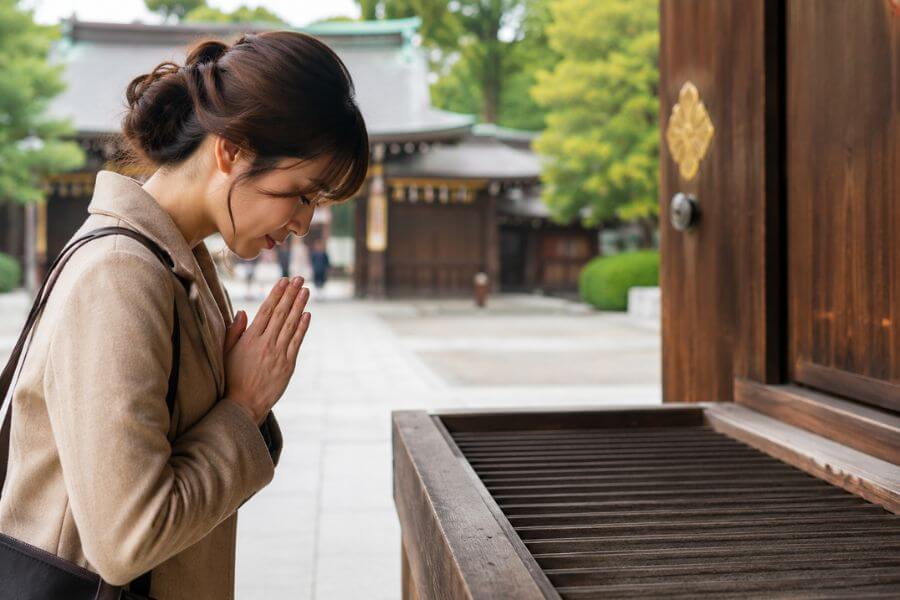
Key Takeaways
- Always remove your shoes when entering a traditional space, like a home, a temple, or a special inn. Look for a change in the floor level to know where to step out of your shoes.
- Bowing is the standard way to greet people, say thank you, and say sorry. A simple nod of the head works for daily interactions in shops.
- Keep your voice low on public transportation. You should never talk on your cell phone while riding a train or a bus.
- Do not eat or drink while you are walking down the street. Find a place to sit or stand still, finish your food, and then continue your journey.
- Tipping is not a practice in Japan. If you leave money on the table at a restaurant, the staff will think you forgot your change and they will chase after you to return it.
- Carry a small plastic bag with you for your garbage. Public trash cans are very rare, so you will need to carry your trash back to your hotel.
- Never stick your chopsticks straight up in your bowl of rice. This action looks like a funeral ritual and will make people around you feel very uncomfortable.
- Cover your tattoos when you visit a public bath or a hot spring. Many places do not allow tattoos, though some will let you enter if you use a waterproof bandage to hide them.
- Stand on the correct side of the escalator. In Tokyo, you stand on the left side. In Osaka, you stand on the right side. Watch what the local people are doing and follow their lead.
- Bring cash with you. While credit cards are becoming more common, many small shops, rural areas, and local restaurants only accept physical money.
Welcome to a Beautiful Journey
Planning a trip to Japan is an exciting adventure. You are about to visit a country filled with stunning mountains, bright city lights, ancient temples, and some of the best food you will ever taste. But Japan is also a place that runs on respect, order, and deep traditions. When you visit, you will notice that everything moves in a smooth and peaceful way. The trains arrive exactly on time. The streets are perfectly clean. The people are incredibly polite and helpful to visitors.
This peaceful way of life does not happen by magic. It happens because everyone follows a shared set of rules. In Japanese culture, harmony is very important. This concept is called “Wa.” It means that the needs of the group are more important than the needs of one person. People try their best not to bother others. They want everyone around them to feel comfortable and safe. As a visitor, you are not expected to know every single rule perfectly. Local people know you are a traveler and they are very forgiving. However, if you learn the basic manners before you go, you will show them that you respect their culture. This will open doors for you. People will smile more warmly. They will go out of their way to help you. You will have a much richer and deeper experience during your travels.
This guide is built to walk you through every part of your trip. We will look at how to act on the train, how to eat your noodles, how to visit a shrine, and how to relax in a hot spring. Take your time reading through these sections. You will find that these rules are actually very logical. They make sense when you realize they are all about showing kindness and respect to the people sharing the space with you.
The Art of Bowing and Greetings
When you meet someone in your home country, you might shake their hand, give them a hug, or just smile and say hello. In Japan, the bow is the most common way to interact with others. You will see people bowing everywhere you go. They bow to say good morning. They bow to say thank you. They bow to say sorry. They even bow while talking on the telephone, out of pure habit.
How to Bow Properly
If you want to bow correctly, you need to pay attention to your posture. Stand up straight. Keep your legs together. If you are a man, leave your hands resting straight down at your sides. If you are a woman, you can rest your hands gracefully on the front of your legs, with one hand resting on top of the other. Keep your back straight. Do not curve your shoulders or bend your neck down. The bending motion should come entirely from your waist. Keep your eyes looking down toward the floor as you bow. Staring into someone’s eyes while you bow is considered rude, like you do not trust them.
Different Types of Bows
Not all bows are the same. The angle of your bow changes depending on who you are talking to and what you are trying to say.
- The Casual Nod: This is a very slight bend, maybe just fifteen degrees. You use this when you greet a friend, when you buy something at a convenience store, or when you want to quickly thank someone for holding a door.
- The Respectful Bow: This is a thirty degree bend. You will use this bow when you meet someone for the first time, when you greet an older person, or in normal business situations. You hold this bow for about two seconds before standing back up.
- The Deep Bow: This is a forty-five degree bend. This bow is used for deep respect or deep apologies. If you make a huge mistake, or if you are thanking someone who did something incredibly kind for you, you use this deep bow. You hold it for a longer time, maybe three or four seconds.
As a traveler, you will mostly use the casual nod. If a shop owner bows to you when you enter their store, you can just smile and nod your head slightly in return. You do not need to drop everything and do a deep forty-five degree bow. Just a simple nod shows that you acknowledge their greeting.
Shaking Hands in Japan
Because Japan sees many foreign visitors and business people, many Japanese people are familiar with shaking hands. Sometimes, a local person will reach out to shake your hand to make you feel comfortable. If they offer their hand, it is perfectly fine to shake it. Sometimes, people will shake hands and bow at the exact same time. This can feel a little awkward, and you might bump heads if you are not careful. Just step back a little bit, smile, and follow their lead.
Summary of Greeting Manners
| Greeting Action | When to Use It | What It Means |
| 15 Degree Bow | Shops, passing by people, casual thank yous | Casual greeting, quick thanks |
| 30 Degree Bow | Meeting new people, hotel staff | Respectful greeting |
| 45 Degree Bow | Serious apologies, meeting someone very important | Deep respect, deep sorrow |
| Handshake | When offered by the other person | International friendship |
Taking Off Your Shoes
One of the most important rules you will encounter in Japan involves your shoes. The Japanese consider the outside world to be dirty, and the inside of a home or a special building to be clean. To keep the dirt out, everyone must take off their outdoor shoes before stepping inside.
The Entrance Area
When you walk into a Japanese home, a traditional inn, a temple, or even some traditional restaurants, you will enter a small space called a “genkan.” The genkan is the entrance area. You will notice that the floor of the genkan is level with the ground outside, but the rest of the building is raised up a few inches. This step up is the dividing line between the dirty outside and the clean inside.
You must take off your shoes in the lower genkan area. Do not step onto the raised floor with your shoes on, not even with one foot. Once your shoes are off, step up in your socks. After you step up, turn around and place your shoes neatly together. Point the toes of your shoes toward the door. This shows good manners and makes it very smooth for you to slip your shoes back on when it is time to leave.
Wearing Slippers
Usually, the host will provide a pair of indoor slippers for you to wear. You put these slippers on as soon as you step up from the genkan. You will wear these slippers as you walk through the hallways and wooden floors of the building.
However, there is a very strict rule about tatami mats. Tatami mats are traditional flooring made of woven straw. They are very delicate and very expensive to replace. You must never wear slippers on tatami mats. When you come to a room with a tatami mat floor, you will see a small border at the doorway. Take your slippers off and leave them outside the room. You must walk on tatami mats in your socks or bare feet. Because you will be taking your shoes off often, it is a smart idea to wear clean socks without any holes in them.
The Bathroom Slippers
This is a rule that catches many travelers by surprise. When you go to use the toilet in a home or a traditional inn, you will find a different pair of slippers sitting just inside the bathroom door. The bathroom is considered a dirty area, even if it looks perfectly clean. You must take off your normal house slippers and leave them outside the bathroom door. Step into the bathroom and put on the special bathroom slippers.
When you are finished using the toilet, you must remember to take the bathroom slippers off before you step back into the hallway. Put your regular house slippers back on. If you forget this step and walk into the dining room wearing the bathroom slippers, everyone will notice and it will be quite embarrassing. Always look down at your feet before you leave the bathroom.
Shoe and Slipper Comparison
| Floor Type | What to Wear | What to Avoid |
| Outside Streets | Your outdoor shoes | Walking barefoot |
| The Genkan Entrance | Your outdoor shoes | Leaving shoes messy |
| Wooden Hallways Inside | House slippers | Outdoor shoes |
| Tatami Mat Rooms | Socks or bare feet | Slippers or outdoor shoes |
| The Toilet Room | Bathroom slippers only | House slippers |
Riding the Trains and Subways
Japan has one of the best public transportation networks in the entire world. The trains are clean, safe, and they always run exactly on schedule. If a train is supposed to leave at two minutes past the hour, the doors will close at that exact second. To keep this massive system running perfectly, millions of people follow very specific rules of behavior.
Waiting on the Platform
When you reach the train platform, you cannot just stand anywhere. Look down at the ground. You will see painted lines or markers showing you exactly where the train doors will open. You will also see lines showing you where to stand to form a queue. Join the line and wait patiently. Do not cut in front of other people.
When the train arrives and the doors open, do not rush inside. You must stand to the side and let all the arriving passengers get off the train first. Wait until the doorway is completely clear before you step inside. This keeps the flow of traffic moving quickly. If you try to push your way in while people are trying to exit, you will cause a huge traffic jam.
Inside the Train Car
Once you are on the train, the main rule is to be quiet. People use their train rides to read, sleep, or relax before a long day of work. You should keep your voice very low if you are talking to your travel partner. Never talk on your cell phone. If your phone rings, silence it immediately. It is considered extremely rude to have a phone conversation on a local train or subway. You can send text messages or play games on your phone quietly, but make sure your device is on silent mode.
If you are carrying a large backpack, you must take it off your back. You can hold it in your hands down by your legs, put it on the luggage rack above the seats, or wear it on your front like a baby carrier. If you leave it on your back, you will hit other people when the train moves or when you turn around. Space is very limited, and taking off your backpack shows that you care about the personal space of the people standing next to you.
Priority Seats
Every train car has a section of priority seats. These seats are usually near the doors and are marked with special signs and different colored fabric. These seats are reserved for older people, pregnant women, people with disabilities, and people traveling with small children. You can sit in these seats if the train is empty, but you must stand up and offer your seat the moment someone who needs it gets on the train. Also, you must turn off your cell phone completely if the train is crowded and you are standing near the priority seats, because the phone signals might interfere with medical devices like pacemakers.
Eating and Drinking on Trains
For normal city subways and short commuter trains, eating and drinking is a bad idea. A quick sip from a water bottle is fine if you are very thirsty, but you should not eat snacks, sandwiches, or smelly foods. The trains get crowded, and spilling your food would cause a big problem.
However, if you are riding the Shinkansen, which is the famous bullet train that travels between cities, eating is totally normal and expected. You can buy special boxed lunches called “Ekiben” at the station and eat them comfortably at your seat on the bullet train. The bullet train seats have little tray tables just like an airplane.
Train Manners Summary
| Situation | Good Manners | Bad Manners |
| Boarding the train | Wait in line, let people exit first | Pushing your way inside |
| Using your phone | Silent mode, texting only | Talking on a voice call |
| Carrying a backpack | Putting it on the floor or a rack | Leaving it on your back |
| Priority seats | Giving them to people who need them | Refusing to stand up |
| Local subway rides | No eating, very quiet talking | Eating meals, talking loudly |
| Bullet train rides | Eating a boxed lunch is fine | Leaving your trash behind |
Walking on the Streets
Walking around Japanese cities is a wonderful experience. You will find small hidden shops, beautiful vending machines on every corner, and stunning architecture. But just like on the trains, there are rules for walking in public.
Which Side to Walk On
As a general rule, people stick to one side of the walkway to let others pass. This also applies to riding escalators. However, the correct side changes depending on the city. In Tokyo, you stand on the left side of the escalator and walk on the right. In Osaka, the rule is the exact opposite. You stand on the right side and walk on the left. The best thing you can do is just look at the people in front of you. Follow the crowd. If everyone is standing on the left, you stand on the left.
Eating While Walking
In many countries, it is very normal to grab a sandwich or a slice of pizza and eat it while you are walking down the street to your next destination. In Japan, this is considered bad manners. Eating while walking is messy. You might drop food on the clean sidewalks, or you might bump into someone and spill a drink on their clothes.
When you buy street food, like a delicious stick of grilled chicken or a sweet rice dumpling, the shop owner will expect you to eat it near their stall. Find a quiet spot next to the shop, stand still, and enjoy your food. When you are finished, you can hand your trash right back to the shop owner to throw away. If you buy a drink from a vending machine, stand next to the machine, drink your beverage, and put the empty bottle in the recycling bin right there.
Where Did All the Trash Cans Go?
One of the biggest surprises for travelers is the lack of public trash cans. You can walk for miles in a big city like Tokyo and never see a single garbage bin. Many years ago, the government removed public trash bins for security reasons. Instead of making the city dirty, this rule actually made the city perfectly clean.
Everyone in Japan takes their own trash home with them. You should prepare for this by carrying a small plastic bag in your pocket or your day bag. When you have trash, like a used tissue or a candy wrapper, put it in your little bag. Carry it with you for the rest of the day. When you return to your hotel room at night, you can empty your bag into the hotel trash can.
You will see small bins next to the drink vending machines. Please look closely at the holes on these bins. The holes are small and round. These bins are strictly for recycling empty plastic bottles and aluminum cans. Do not shove regular trash, paper cups, or food wrappers into these recycling bins.
Smoking Rules Outside
You cannot just light up a cigarette while walking down the street. Most cities have strict laws against smoking outdoors in public spaces. You could be fined a lot of money if a police officer catches you smoking while walking. If you need to smoke, you must find a designated smoking area. These areas are usually marked with signs and have large ashtrays. You can find them near major train stations, outside large shopping malls, and sometimes in parks.
Street Manners Comparison
| Rule | Common American Custom | Japanese Custom |
| Eating snacks | Eating while walking is totally fine | Stand still, eat, then keep walking |
| Throwing away trash | Public bins on every street corner | Carry a bag, take trash home |
| Smoking outdoors | Usually allowed on open sidewalks | Only allowed in marked smoking boxes |
| Blowing your nose | Doing it loudly in public is normal | Better to do it privately in a restroom |
Dining and Restaurant Rules
Eating Japanese food is a highlight of any trip. Whether you are eating a bowl of cheap noodles standing up, or dining at an expensive sushi restaurant, the manners remain very similar. The rules of dining show respect for the chef, respect for the food, and respect for your dining partners.
Entering the Restaurant
When you push open the door to a restaurant, you will almost always hear a loud, energetic greeting from the staff. They will shout “Irasshaimase!” which means “Welcome to our shop!” You do not need to shout it back. You do not even need to say thank you. Just smile, hold up your fingers to show how many people are in your group, and wait for them to show you to a table.
Using the Hot Towel
Once you sit down, the waiter will bring you a rolled-up wet towel. This is called an “oshibori.” In the hot summer months, the towel will be freezing cold to help you cool down. In the winter months, the towel will be steaming hot to warm you up.
Unroll the towel and use it to wipe your hands clean before the meal begins. This is an important hygiene step. However, you must only use this towel for your hands. Do not wipe your face with it. Do not wipe your neck. Do not wipe up spills on the table. After you have cleaned your hands, carefully fold the towel back up and place it on the small tray it came on. Leave it there for the rest of the meal.
Saying Thanks Before and After
Before you take your first bite of food, it is polite to put your hands together in a prayer position and say “Itadakimasu.” This phrase loosely translates to “I humbly receive this food.” It is a way of showing gratitude to the plants and animals that gave their lives for the meal, to the farmers who grew the ingredients, and to the chef who cooked it.
When you are completely finished eating, you place your hands together again and say “Gochisousama deshita.” This means “That was a feast.” It tells the chef that you loved the food and that you are very thankful for their hard work.
How to Use Chopsticks Correctly
Chopsticks are the primary eating utensils in Japan. Using them properly is very important. There are many rules about what you should never do with your chopsticks. Most of these rules exist because certain actions look like rituals performed at Buddhist funerals.
- Do not point with them: Never use your chopsticks to point at another person across the table, or to point at a specific dish of food. Keep them pointed down.
- Do not stab your food: Chopsticks are meant for pinching and lifting food. Do not spear a piece of meat or a vegetable like you are using a fork.
- Never stick them upright in rice: This is the most important rule. Never stick your chopsticks straight down into a bowl of white rice so they stand up in the air. This looks exactly like the incense sticks burned at a funeral. It will deeply shock the people around you.
- Never pass food to another pair of chopsticks: If you want to share food with your friend, put the food on a small plate and hand the plate to them. Never pass a piece of food directly from your chopsticks to their chopsticks. Passing things from bone to bone using chopsticks is part of a funeral ceremony.
- Use the chopstick rest: When you are not eating, or when you are talking, put your chopsticks down. Do not lay them across the top of your bowl. Instead, rest the tips on the small ceramic chopstick rest provided, called a “hashioki.” If the restaurant gave you disposable wooden chopsticks in a paper wrapper, you can fold the paper wrapper into a little triangle and use that as a rest.
Slurping Your Noodles
If you order a bowl of hot ramen, udon, or soba noodles, you will notice a lot of noise in the restaurant. People will be slurping their noodles very loudly. If you try to eat your noodles quietly, the chef might think you do not like the food.
Slurping is considered good manners for two reasons. First, slurping pulls cool air into your mouth along with the very hot noodles, preventing you from burning your tongue. Second, it brings the aroma of the rich broth into your nose, making the food taste much better. So, do not be shy. Lean over your bowl and slurp your noodles just like the locals do.
Drinking and Pouring for Friends
If you go out drinking at an izakaya, which is a Japanese style pub, there is a special rule for pouring drinks. You should never pour your own drink. It is considered slightly selfish. Instead, you pour beer or sake into your friend’s glass, and you wait for your friend to pour beer or sake into your glass. Keep an eye on your friend’s glass. When it is getting close to empty, pick up the bottle and refill it for them. They will do the exact same thing for you.
Before you take your first sip, wait until everyone has a full glass. Everyone will raise their glasses together and shout “Kanpai!” which means “Cheers!” After that, you can drink.
Paying the Bill and Why You Do Not Tip
When you are ready to leave, you might look around for your waiter. In many casual restaurants, the waiter will not bring the bill to your table at the end of the meal. Instead, they will leave a small clipboard with your bill on it at your table when they deliver the food. You pick up this clipboard and take it with you to the cash register near the front door.
If you are at a restaurant where you do need to call the waiter over, do not snap your fingers or whistle. You can simply say “Sumimasen,” which means “Excuse me,” in a clear voice, and raise your hand slightly.
Now for the most important money rule: Do not leave a tip. There is absolutely no tipping culture in Japan. Excellent service is considered a normal part of doing business. If you leave an extra dollar or two on the table, the waiter will be very confused. They will think you accidentally forgot your money. They might literally run out the door and down the street to catch you and hand you your coins back. You just pay the exact amount written on the bill. It is a wonderful system because the price you see on the menu is the actual price you pay.
Dining Manners Summary Table
| Dining Action | Proper Etiquette | What to Avoid |
| Hand Towel (Oshibori) | Wiping hands before meal | Wiping face, neck, or table |
| Before Eating | Saying “Itadakimasu” | Starting without acknowledging food |
| Chopstick Resting | Placing on the ceramic rest | Sticking upright in a rice bowl |
| Sharing Food | Putting on a small plate to pass | Passing from chopsticks to chopsticks |
| Eating Noodles | Slurping loudly to cool them | Eating completely silently |
| Pouring Drinks | Pouring for friends, friends pour for you | Pouring your own glass |
| Tipping Waiters | Paying exact amount at register | Leaving extra coins on the table |
Visiting Shrines and Temples
Japan is filled with thousands of historic shrines and temples. Shrines belong to the Shinto religion, which is the native religion of Japan that worships nature spirits. Temples belong to Buddhism, which came to Japan from mainland Asia many centuries ago. Both places are deeply sacred, and visitors are very welcome as long as they show respect.
Shrines Versus Temples
It is helpful to know which one you are visiting. A Shinto shrine almost always has a large “Torii” gate at the entrance. These gates are usually painted bright orange or red, and they look like two tall pillars with a curved crossbar on top. A Buddhist temple usually has a large, heavy wooden gate with a roof on top, and often features a statue of Buddha inside.
Entering Through the Gate
When you arrive at a Shinto shrine, stop before you walk under the Torii gate. Give one short, respectful bow toward the main building before you step through. When you walk on the path leading up to the shrine, try to walk slightly to the left or the right side of the path. The direct center of the path is reserved for the gods to walk on.
Washing Your Hands Before Praying
Before you approach the main building to pray, you must purify yourself. You will find a small water pavilion near the entrance. It is a stone basin filled with clean, flowing water, and there will be several wooden or metal dippers resting on the top.
Here is the step by step purification process:
- Pick up a dipper with your right hand. Scoop up a full cup of water.
- Pour a little bit of water over your left hand to wash it.
- Switch the dipper to your left hand. Pour a little bit of water over your right hand.
- Switch the dipper back to your right hand. Pour a small amount of water into your cupped left hand.
- Bring your left hand to your mouth and use that water to rinse your mouth. Spit the water gently into the drain area below the basin. Do not swallow the water. Never put the dipper directly to your lips.
- Wash your left hand one more time.
- Finally, hold the dipper vertically so the remaining water runs down the handle, cleaning it for the next person. Place the dipper back where you found it face down.
How to Pray and Show Respect
When you walk up to the main hall of a Shinto shrine, you might see a large wooden box with slats on top, and a thick rope hanging from a bell.
Here is the correct sequence for offering a prayer:
- Toss a coin into the wooden offering box. A five yen coin is considered the luckiest coin to use because the Japanese word for five yen, “go-en,” sounds just like the word for good luck or good connections. But any coin is totally fine.
- If there is a bell, grab the thick rope and give it a firm shake to ring the bell. This wakes up the gods to let them know you are there.
- Take a step back.
- Bow deeply two times.
- Clap your hands loudly two times. Keep your hands pressed together in front of your chest after the second clap.
- Close your eyes and say a silent prayer or just offer your silent respect.
- Drop your hands and bow deeply one final time.
If you are at a Buddhist temple, the process is slightly different. You still toss a coin into the box, but you do not clap your hands. Clapping is only for Shinto shrines. At a temple, you simply bow, bring your hands together silently in prayer, and then bow again.
Photography Rules at Holy Sites
Many shrines and temples are incredibly beautiful, and you will want to take photos. Usually, taking pictures of the outside of the buildings and the gardens is completely acceptable. However, you must look for warning signs near the main altars. Many places strictly forbid taking photos of the inner sanctum where the sacred objects are kept. If you see a sign with a camera crossed out, put your phone away. Never use a flash during a ceremony or if monks are praying nearby, as it is very distracting.
Shrine and Temple Comparison Table
| Feature | Shinto Shrine | Buddhist Temple |
| Entrance Gate | Torii gate (often red/orange) | Heavy wooden gate with a roof |
| Purification Water | Yes, wash hands and mouth | Yes, sometimes incense smoke too |
| Praying Action | Toss coin, ring bell, 2 bows, 2 claps, 1 bow | Toss coin, 1 bow, pray silently (NO claps), 1 bow |
| Walking the Path | Walk on the sides, center is for gods | General walking is fine |
Relaxing in a Hot Spring or Bath
Because Japan has so many volcanoes, the country is filled with natural hot springs called “onsen.” Bathing in an onsen is a deeply relaxing, cultural experience. It is a time to wash away the stress of travel. Public bathhouses, called “sento,” are also very popular in cities. Whether you are using a natural hot spring or a public city bath, the manners are extremely strict to ensure the water stays perfectly clean for everyone.
The Rules About Tattoos
Before you plan an onsen visit, you must understand the tattoo rules. In Japan, tattoos have a long historical association with organized crime syndicates. Because of this, many public pools, gyms, and hot springs outright ban anyone with a tattoo from entering. This rule applies to everyone, including foreign travelers with harmless flower or butterfly tattoos.
If you have small tattoos, you can buy flesh colored waterproof bandages at a pharmacy and cover them up before you go to the bath. If your tattoos are covered, you will be allowed in. If you have full sleeves or very large tattoos, you might need to search for special “tattoo friendly” onsens online. Another great option is to book a hotel room that has a private hot spring bath attached to the balcony. Then you can bathe without worrying about the rules.
Preparing in the Changing Room
When you enter the bathhouse, you will take off your shoes at the entrance and step into the changing room. Men and women bathe separately. You must take off all of your clothes. Bathing suits are strictly forbidden. You cannot wear a swimsuit into a traditional onsen.
Put your clothes, your towel, and your phone into a locker or a basket. The only thing you are allowed to take into the actual bathing room is a tiny, thin washcloth that the hotel provides.
Washing Your Body First
When you open the door to the humid bathing area, do not run straight to the hot water. The golden rule of the Japanese bath is that you must be perfectly, absolutely clean before you step into the shared water.
You will see a row of small stools and shower wands along the wall. Sit down on a stool. Use the soap and shampoo provided to wash your entire body thoroughly. Scrub yourself well. Make sure you rinse every single bubble of soap off your body. The water in the main tub is only for soaking and relaxing, not for cleaning.
Enjoying the Hot Water
Once you are rinsed completely clean, you can slowly step into the hot bath. The water can be extremely hot, so take your time.
What do you do with your small washcloth? You cannot let it touch the bathwater. People usually fold the small towel and balance it on top of their head while they soak. If it falls into the water by accident, wring it out completely outside the tub.
Do not swim in the water. Do not splash. Keep your voice to a quiet whisper if you are talking to a friend. This is a place of zen and quiet relaxation. When you are done soaking, you can quickly shower off again, or just towel dry. Be sure to use your small washcloth to dry your body as much as possible before you step back into the dry changing room so you do not drip water all over the floor.
Bathing Etiquette Summary
| Bathing Rule | Why It Exists | What You Must Do |
| No Swimsuits | Keep synthetic fibers out of water | Bathe completely naked |
| Wash Before Soaking | Keep the shared bathwater pure | Scrub with soap and rinse fully at shower station |
| Towel on Head | Keep dirt from towel out of water | Balance towel on head or leave on side of tub |
| No Tattoos | Historic association with crime | Cover small ones, or find private baths |
| Dry Before Exiting | Keep changing room safe and dry | Wipe down body with small towel before leaving wet area |
Staying in a Traditional Inn
A “Ryokan” is a traditional Japanese inn. Staying in one is like stepping back in time. The floors are made of tatami mats, the doors slide open, and you sleep on a comfortable mattress on the floor. The hospitality, known as “omotenashi,” is world class.
Greeting the Host
When you arrive at the ryokan, you will usually be greeted by a host wearing a traditional kimono. You will take off your shoes in the genkan, as we discussed earlier, and put on the provided slippers. The staff might take your luggage for you and guide you to your room. They will show you where to place your shoes, where the bathrooms are, and explain the schedule for dinner and breakfast. Pay close attention and bow respectfully to thank them.
Wearing the Yukata
Inside your room, you will find a light cotton robe called a “yukata.” You are encouraged to change out of your street clothes and into this yukata. You can wear the yukata anywhere inside the ryokan. You can wear it to dinner, you can wear it to the hot spring, and you can even wear it for a walk down the street outside the inn.
There is one critical rule for wearing a yukata. You must wrap the left side over the right side. Close the robe, take the left panel, and cross it over the right panel, then tie it with the belt. If you wrap the right side over the left side, it symbolizes dressing a dead body for a funeral. Check yourself in the mirror to make sure the left side is on the outside.
Sleeping on the Floor
Your room will have a low table in the center when you arrive. You might wonder where the bed is. While you are eating dinner in the dining room, the ryokan staff will enter your room, move the table, and lay out your “futon.” A futon in Japan is not a cheap wooden couch; it is a thick, luxurious, padded mattress placed directly on the tatami mat floor.
In the morning, leave the futon exactly where it is. You do not need to fold it up or put it away in the closet. The staff will take care of cleaning the room and putting the bedding away while you are eating breakfast.
Paying for Things and Shopping
Shopping in Japan is incredibly fun, from the high fashion stores of Tokyo to the small craft shops in Kyoto. Handling money requires a specific type of politeness.
Using the Little Plastic Tray
When you go to pay for an item at a convenience store, a restaurant, or a souvenir shop, you will see a small plastic or leather tray resting on the counter next to the cash register.
Do not hand your money directly to the cashier’s hand. Instead, place your cash or your credit card neatly onto the small tray. The cashier will pick the money up from the tray, count it, and then place your change and your receipt back onto the tray for you to pick up. This system avoids awkward hand touches and makes sure the money is clearly visible so no mistakes are made.
If you are paying with large bills, place them down gently. If you are paying with coins, try not to slam a handful of change down loudly. Just be polite and gentle.
Trying on Clothes in a Store
If you are shopping for clothes and you want to try a shirt on, you cannot just walk into the fitting room. You must ask the store clerk first. Just hold up the clothing and point to the fitting room, and they will gladly show you inside.
Before you step into the fitting room, look down. You will probably need to take off your shoes. Most fitting rooms have a raised floor or a carpet, which means it is a shoe-free zone. Leave your shoes outside the curtain.
If you are trying on a shirt or a sweater, the clerk might hand you a thin white paper bag that looks like a mask. This is a face cover. You put this bag over your head before you pull the shirt on. This prevents your makeup or facial oils from staining the new clothes. It looks a little bit silly, but it is a brilliant way to keep the store’s products looking brand new.
Shopping Manners Summary
| Situation | Correct Etiquette | Incorrect Action |
| Handing over money | Put bills and coins on the small tray | Handing money directly to the cashier |
| Receiving change | Pick it up from the small tray | Reaching out to grab it from cashier |
| Entering fitting room | Ask clerk, remove shoes if raised floor | Walking right in with dirty shoes on |
| Trying on shirts | Use the paper face cover provided | Smearing makeup on the collar |
Frequently Asked Questions
Do I need to speak Japanese perfectly to travel there?
No, you do not need to be perfectly fluent to have a wonderful trip. While knowing a few basic words like “Arigatou” (Thank you) and “Sumimasen” (Excuse me) will make people smile, most signs in the major train stations and city centers are written in English. Many younger people and hotel workers speak enough English to help you. If you get stuck, you can always use a translation app on your phone. People are incredibly patient and will try their best to understand you through gestures and smiles.
What happens if I make a manners mistake by accident?
Do not panic. Japanese people are very understanding of foreign visitors. They know that their rules are complicated and different from the rest of the world. If you forget to take your shoes off for a second, or if you accidentally stick your chopsticks in your rice, someone might gently correct you, or they might just ignore it so you do not feel embarrassed. If you realize you made a mistake, just smile, apologize slightly, fix the behavior, and move on. Nobody will be angry with you as long as you are trying your best to be respectful.
Can I blow my nose in public?
It is generally considered quite rude to blow your nose loudly in public places like trains, restaurants, or busy streets. Sniffling is actually considered much more polite than blowing your nose. If you have a terrible cold and you really need to clear your nose, the best thing to do is find a public restroom, go into a stall, and blow your nose quietly in private. If you absolutely must do it in public, turn away from other people and try to wipe your nose as silently as possible with a tissue.
Is it okay to take photos of random people on the street?
Japan has very strict laws regarding privacy. It is considered extremely rude, and in some cases illegal, to take clear photographs of strangers without their permission. If you are taking a wide photograph of a famous street crossing or a crowded temple, it is understood that people will be in the background. But you should never point your camera directly into the face of a stranger, especially children, or the Geisha walking in Kyoto. Always ask for permission if you want a portrait of someone. If they cross their arms in an ‘X’ shape, that means no.
How do I call a waiter to my table if they do not come over?
Unlike in some Western countries where a waiter will constantly check on your table to see if you need anything, Japanese waiters will leave you alone to enjoy your meal in peace. They will not interrupt your conversation. When you are ready to order, or if you need a refill of water, you must call them over. Many modern restaurants have a small electronic button on the table. You just press the button and a waiter will come running. If there is no button, just make eye contact, raise your hand slightly, and say “Sumimasen” in a clear voice. They will respond immediately.
Can I drink the tap water safely?
Yes, the tap water in Japan is completely safe to drink anywhere in the country. It is clean, heavily purified, and tastes very good, especially in mountainous regions. You do not need to buy bottled water every day. You can safely fill up your reusable water bottle from the sink in your hotel bathroom.
Are public restrooms clean, and do they have toilet paper?
Public restrooms in train stations, department stores, and parks are incredibly clean. Japan takes great pride in hygiene. Most modern toilets are highly advanced, with heated seats and buttons that play music to cover up any embarrassing sounds. They almost always have toilet paper. However, many public restrooms do not have paper towels or hand dryers by the sinks. Local people carry a small cotton handkerchief in their pockets or purses to dry their hands after washing. You might want to buy a small towel at a convenience store to carry with you for this exact reason.