Key Takeaways
- The Three Size Categories: Bags under 160 centimeters (about 62 inches) total dimensions need no reservation. Bags between 161 and 250 centimeters (63 to 98 inches) require a special seat booking. Oversized bags above 250 centimeters are completely banned.
- The Rules Only Apply to Specific Lines: You must follow these exact reservation steps on the Tokaido, Sanyo, Kyushu, and Nishi-Kyushu lines. Other lines have different, less strict practices.
- Free Bookings If Done Early: If you book your seat with a luggage space in advance, it costs zero extra yen. If you forget and board with an oversized bag, you must pay a 1,000 yen cash penalty immediately on the train.
- The Storage Spaces: Your reserved bag goes into a specific area. This is either the dead space directly behind the last row of seats in the car, or a secure lockbox compartment near the deck doors.
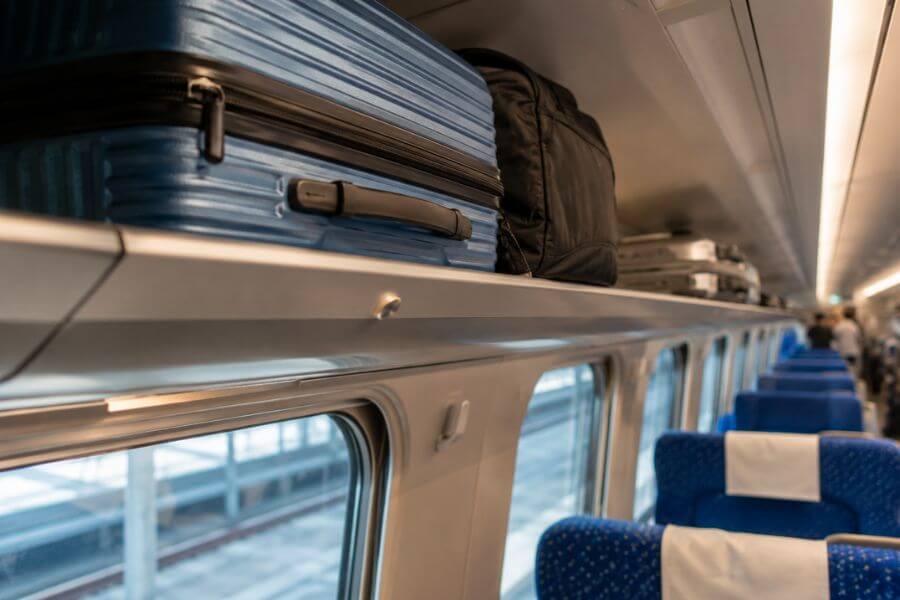
- Small Items Go Overhead: Backpacks, small carry-on suitcases, and duffel bags do not need any reservations. They easily fit onto the open storage racks directly above your passenger seat.
Welcome to the World of Japanese Bullet Trains
Imagine you just landed in Japan. You feel the cool breeze, you hear the melodic chimes of the train station, and you see the beautiful, sleek nose of a bullet train waiting for you on the tracks. This famous train is called the Shinkansen. It is incredibly fast, always on time, and amazingly smooth. It connects big cities like Tokyo, Kyoto, and Osaka in just a few short hours.
For many travelers, riding this train is the absolute best part of their entire vacation. You can sit back, eat a delicious lunch box, and watch Mount Fuji roll past your window. It feels like magic.
But before you drag your heavy suitcases through the ticket gates, you need to know about some important guidelines. A few years ago, the railway companies introduced strict rules for large pieces of baggage. If you bring a massive suitcase without checking the rules first, you might face some stressful problems. You could get a surprise fine, or you might even be stopped from boarding the train completely.
This detailed guide will teach you every single thing you need to know about managing your bags on the bullet train. You will learn how to measure your gear, how to make a booking, and how to enjoy a perfectly smooth ride across Japan. Let us get started.
Why Did Japan Create These Luggage Guidelines?
For many decades, travelers could bring almost any size of bag onto the Shinkansen without thinking twice. You just walked onto the train, found a spot, and sat down. So, what changed? Why did the train companies decide to create these new systems? The answer comes down to three main things: comfort, speed, and safety.
Japan is one of the most popular travel spots in the whole world. Every single year, millions of international visitors arrive with giant suitcases. At the same time, local business people and families use the Shinkansen every day to commute. When too many people try to squeeze massive bags into a single train car, the aisles get blocked. This makes it very hard for people to walk to the restroom or for the food cart to move down the aisle.
Speed is another huge reason. The Shinkansen is famous because it stops at stations for only a tiny amount of time. Sometimes, the train only stays at a platform for 60 seconds. People need to get off and get on incredibly fast. If someone is struggling to lift a 70-pound bag down a narrow aisle, it slows everybody down. This can cause the train to run late, which ruins the perfect schedule of the entire country.
Finally, we must talk about safety. Bullet trains move at speeds of up to 320 kilometers per hour (around 200 miles per hour). If the train needs to slow down suddenly, an unsecured, heavy suitcase sitting in an aisle could slide down the car like a bowling ball. It could seriously hurt a passenger. By forcing people to reserve specific spots for giant bags, the railway ensures that every single piece of luggage is locked down safely.
The Four Major Train Lines That Use This System
It is very important to realize that these rules do not apply to every single train track in Japan. They only apply to a specific set of tracks that run through the central and southern parts of the country. If you are traveling along the most popular tourist route, you will definitely encounter these lines.
The first line is the Tokaido Shinkansen. This is the busiest route in Japan. It connects Tokyo Station to Shin-Yokohama, Nagoya, and Kyoto, before ending at Shin-Osaka Station. If you are planning to see the classic sights of Tokyo and Kyoto, this is the exact train line you will use.
Next is the Sanyo Shinkansen. This line picks up right where the Tokaido line ends. It starts at Shin-Osaka and moves west through Kobe, Himeji, Hiroshima, and finishes at Hakata Station in Fukuoka City. Many trains run continuously from Tokyo all the way to Hiroshima, combining both the Tokaido and Sanyo tracks into one long journey.
The third line is the Kyushu Shinkansen. This route stays completely on the southern island of Kyushu. It runs from Hakata Station down to Kumamoto and Kagoshima-Chuo. It is a beautiful route that takes you deep into the volcanic scenery of southern Japan.
The fourth line is the Nishi-Kyushu Shinkansen. This is a shorter, newer line that connects Takeo-Onsen to the historic city of Nagasaki.
If you travel on any of these four specific paths, you must follow the baggage reservation laws. If you travel on northern lines, such as the tracks going to Tohoku, Hokkaido, or Kanazawa, these specific reservation rules do not exist yet. On those northern lines, you can still use the rear storage spaces on a first-come, first-served basis.
How to Measure Your Suitcase Correctly
Now that you know where the rules apply, let us talk about how to check your own gear. The train companies do not look at the weight of your bag to determine if it needs a reservation. Instead, they look entirely at the physical size. They use a single number called the total dimensions.
To find the total dimensions of your bag, you need a simple tape measure. You must measure three different parts of your suitcase:
- The total height, from the very bottom of the wheels to the top of the handle.
- The total width, across the widest part of the front side.
- The total depth, from the front wall to the back wall of the bag.
Once you have these three numbers in centimeters or inches, you simply add them together. For example, if your bag is 70 centimeters tall, 50 centimeters wide, and 30 centimeters deep, your total dimensions are 70 plus 50 plus 30, which equals 150 centimeters.
Always remember to include the wheels, the side handles, and any bulging outer pockets in your measurements. The station staff will look at the absolute largest points of the bag. If your suitcase is close to the limit, it is always smarter to be safe and assume it belongs in the larger category.
Understanding the Three Baggage Size Categories
To make things easy to understand, the railway system divides all bags into three distinct categories based on the total dimensions you just calculated. Every piece of luggage fits into one of these buckets.
The Small and Medium Bag Category
This category includes any bag with total dimensions up to 160 centimeters (which is roughly 62.9 inches). This covers the vast majority of standard travel gear. Most backpacks, weekend duffel bags, and medium-sized rolling suitcases fit comfortably into this range.
If your bag is in this category, you do not need to make any special reservation. You can simply purchase a regular train ticket, walk onto the car, and keep your bag with you. You can place it on the overhead rack above your head or set it down in front of your knees if you have enough legroom.
The Oversized Baggage Category
This is the main category you need to watch out for. It includes any bag with total dimensions between 161 centimeters and 250 centimeters (roughly 63 inches to 98.4 inches). These are typically very large checked suitcases, massive gear bags, or extra-large plastic storage bins.
If your bag falls into this specific window, you are required by law to make a reservation for an oversized baggage seat. You cannot simply walk onto the train and put this bag wherever you want. You must secure a designated spot for it before you pass through the station gates.
The Banned Baggage Category
This category is for monster-sized items. If your bag has total dimensions that add up to more than 250 centimeters (98.4 inches), it is completely prohibited on the Shinkansen.
The train doors are simply too narrow, and the corners are too sharp for items of this scale. If you attempt to bring a bag this large into the station, the ticket agents will turn you away. You will have to find a professional delivery service to ship your luggage to your next hotel instead.
Weight Limits and Total Bag Counts
While size is the primary focus of the train staff, there are also general guidelines regarding the total weight and the number of items you can bring. These boundaries ensure that one single person does not take up all the space in a train car.
Every passenger is allowed to bring a maximum of two pieces of baggage onto the train. This count does not include tiny personal items like a small purse, a camera bag, or a small plastic bag filled with snacks and drinks. Your two main bags could be two medium suitcases, or one large suitcase and one backpack.
Additionally, each individual bag must weigh 30 kilograms or less. In pounds, that is about 66 pounds. This weight limit is actually quite generous, as most international airlines limit checked bags to 23 kilograms (50 pounds) before charging expensive fees. As long as you can lift your own bag without help, you will likely be completely fine under this weight rule.
Size Category Reference Table
To help you visualize these sizes quickly, let us look at a simple breakdown of the dimensions, the rules, and the cost for each tier.
| Category | Total Dimensions | Reservation Needed? | Extra Fee? |
| Small / Medium | 160 cm or less | No reservation | Free |
| Oversized | 161 cm to 250 cm | Yes, required | Free if booked, 1,000 yen fine at train |
| Prohibited | Over 250 cm | Cannot bring on train | Not allowed |
Where Exactly Does Your Large Bag Go?
If you book an oversized baggage seat, you might wonder where your bag actually sits during the trip. It does not stay in your lap, and it does not block the walk space. The train cars have two primary types of designated storage zones.
The Storage Area Behind the Seats
The most common storage space is located at the very back of the passenger compartment. In every train car, there is a small gap of empty space between the very last row of seats and the back wall of the room. This space is called the Baggage Area Behind the Seats.
When you reserve this option, you are assigned to sit in that exact last row. Your suitcase will go right behind your own seat back. This is incredibly convenient because you can easily look over your shoulder during the ride to check on your bag. It stays completely safe and out of the way of other travelers.
The Secure Storage Compartments
The second option is a newer addition to the newer trains. These are called Baggage Compartments. Instead of being inside the seating room, these are located in the deck area, which is the small hallway between the different train cars where the restrooms are found.
These compartments look like large shelving units with double doors. They are equipped with advanced locking systems. Some use a physical key, while others use a digital bar-code scanner that connects to your smartphone or your IC transit card (like a Suica or Pasmo card). When you reserve a spot here, you get a specific shelf assignment. You can lock your bag away securely, go to your seat anywhere in the car, and relax without worrying about someone picking up your bag by mistake.
Step-by-Step Guide: Booking Your Storage Spot
Booking your oversized baggage seat is not difficult at all, but you do need to know the right buttons to press. You can do this in a few different ways depending on how you like to buy your travel tickets.
Using the Automated Ticket Machines
Every Shinkansen station has a row of green or blue touchscreen ticket machines. These machines are wonderful because they have a language button at the top of the screen. You can change the entire display to English with one tap.
First, select the option to purchase a Shinkansen ticket or to reserve a seat if you already hold a rail pass. Next, enter your starting station, your destination, and your preferred departure time. The machine will display a list of available trains.
Once you choose a specific train time, the screen will ask you what type of seat you want. Look closely for a button that says “Seat with an Oversized Baggage Area” or “Seat with an Oversized Baggage Compartment.” You must tap this specific button. The machine will then show you a map of the train car with the available seats in the last row. Pick your favorite seat, complete the payment, and the machine will print your paper tickets.
Booking at the Ticket Office
If you feel nervous about using a computer screen, you can talk to a real person. Every major station has a ticket office called the Midori-no-Madoguchi (which translates to the Green Window). You can identify it by its bright green logo showing a person reclining in a train seat.
Walk up to the counter and tell the agent where you want to go. You can simply say, “I have a large suitcase, so I need an oversized baggage seat, please.” The agents are very friendly and accustomed to helping international guests. They will find the correct train, book the spot for you, and hand you your tickets.
Booking Online Before You Arrive
If you like to plan everything weeks in advance, you can use the official booking websites on your computer or phone. The main website for the Tokyo-to-Osaka route is called SmartEX. There is also a website called JR-West Reservation Service for trains in western Japan.
When you use these websites, the process is very similar to buying an airline ticket. You pick your route, look at the seating chart, and select the specific seats labeled with the baggage symbol. This is the best method if you are traveling during busy holiday seasons, as these special seats can sell out quickly.
What Happens If You Forget to Make a Reservation?
We all make mistakes when we travel. You might be in a rush, or you might forget the rules on a busy morning. What happens if you walk onto the Shinkansen with a huge 170-centimeter suitcase without booking the special seat?
First, you will not be arrested or kicked off the train in the middle of nowhere. However, the train conductors check every single car once the train starts moving. They know exactly which baggage seats are supposed to be occupied. If they see a giant suitcase sitting in a space that was not reserved, they will locate the owner immediately.
The conductor will ask to see your ticket. They will then explain the policy and charge you an immediate on-board penalty fee of 1,000 yen (which is roughly 7 to 8 US dollars depending on exchange rates). You must pay this fee in cash or with an IC card right there on the spot.
After you pay the fee, the conductor will move your suitcase to a secure storage zone to keep the aisles clear. If the train is completely full and all the baggage areas are taken, this can create a highly stressful situation for you and the staff. To avoid this embarrassment and the extra cost, always take the time to book your spot ahead of time.
Special Rules for Strollers, Bicycles, and Sports Equipment
You might be traveling with items that are not standard square suitcases. Many families travel with baby strollers, and many adventure lovers bring bicycles or snowboards to Japan. How do the rules apply to these unique items?
Baby Strollers and Wheelchairs
The railway companies are very supportive of families traveling with infants and individuals who use wheelchairs. If you have a baby stroller, you do not strictly need to book an oversized baggage seat, even if the stroller folds down to a size larger than 160 centimeters.
However, if you do not book the last row, you will have to fold the stroller up and try to fit it near your feet, which can make your seating area incredibly cramped. Therefore, it is highly recommended that families try to book the oversized baggage seats anyway. It gives you the extra room behind your seat to park the stroller without bothering anyone else.
Bicycles and Folding Bikes
Japan is a paradise for cycling enthusiasts. You can bring your bicycle onto the Shinkansen, but it must follow one strict rule: it cannot be bare. You cannot roll a dusty bicycle onto the clean train platform.
You must disassemble or fold your bicycle and place it entirely inside a dedicated bicycle travel bag, which locals call a Rinko bag. Once the bike is completely zipped inside this bag, it is treated as a piece of regular luggage. You should measure the bag to see if it falls into the oversized category. Usually, a packed bicycle will exceed 160 centimeters, so you will need to book a luggage seat for it.
Skis, Snowboards, and Musical Instruments
If you are heading north to the mountains of Nagano or south to Kyushu with a massive guitar case, you might worry about the length of your sports gear. The train rules have a special exemption for these items.
Skis, snowboards, surfboards, and large musical instruments do not require an oversized baggage reservation, even if they are longer than 160 centimeters. The railway views these as special hobby items. You can bring them on board and place them in the open spaces at the ends of the cars if the spaces are empty. However, you must still ensure they do not block the aisle or prevent other passengers from reclining their seats.
Comparison of Regular Seats vs. Baggage Seats
Let us look at how a regular reserved seat compares to an oversized baggage seat so you can decide which one fits your travel style.
Regular Reserved Seat
- Bag Size Allowed: 160 centimeters or smaller total dimensions.
- Storage Location: Overhead racks above your head or directly at your feet.
- Availability: Very high, hundreds of seats available on every single train.
- Best For: Light packers, backpackers, and business travelers with small carry-on bags.
Oversized Baggage Seat
- Bag Size Allowed: 161 centimeters to 250 centimeters total dimensions.
- Storage Location: Behind the last row of seats or in a locked deck compartment.
- Availability: Limited, usually only a few seats per train car.
- Best For: Heavy packers, long-term tourists, families with strollers, and cyclists.
Smart Tips for Stress-Free Travel with Bags
Managing large bags in a foreign country can feel overwhelming, but a few clever habits can make you look like a seasoned travel pro. Here are some top tips to keep your journey easy and relaxed.
First, try to arrive at the train station at least 20 to 30 minutes before your train departs. Shinkansen stations are huge, and walking from the main entrance to the deep bullet train platforms can take a long time if you are moving slowly with heavy wheels. Giving yourself extra time means you will not have to run up the escalators.
Second, learn how to read your train ticket. Your ticket will show a car number (labeled as Car or 車) and a seat number (like 12-A). When you walk onto the train platform, look down at the ground. There are bright painted numbers on the floor that show exactly where each car door will stop. Stand in line at the correct marker for your car number. This allows you to board the train smoothly the exact second it opens its doors.
Third, pack your small essentials in a separate, tiny shoulder bag. Before you lift your big suitcase into the space behind the seats or lock it in a compartment, grab your passport, your phone wallet, your headphones, and your water bottle. You do not want to be that traveler who has to repeatedly walk to the back of the train to dig through a giant suitcase just to find a phone charger.
Finally, consider using a professional luggage forwarding service. Japan has an incredible network of delivery companies, often called Takuhaibin (with famous logos like a black cat carrying a kitten). For a very affordable price, usually around 2,000 to 3,000 yen per bag, these companies will pick up your massive suitcases directly from your hotel lobby in Tokyo and deliver them straight to your next hotel room in Kyoto by the next morning. This allows you to travel on the Shinkansen completely hands-free with just a light backpack. It is an absolute game-changer for stress-free vacations.
Frequently Asked Questions
Can I use the storage space behind the last row if I did not book that specific seat?
No, you absolutely cannot use that space unless you hold the ticket for the seat directly in front of it. That storage zone is legally reserved for the passengers sitting in that final row. If you place your bag there without a reservation, you are taking away the space that someone else specifically booked for their own trip. The train conductors check this constantly and will ask you to move your bag immediately.
What should I do if all the oversized baggage seats are completely sold out on my train?
If you have a giant suitcase and find that all the baggage seats are fully booked for your desired time, you have three good options. First, you can check the schedule for the next train leaving 15 or 30 minutes later, as trains run very frequently. Second, you can go to the station ticket counter and ask an agent to look for spaces in the Green Car (the first-class section), which often has more open spots. Third, you can choose to send your large bag ahead to your next destination using a hotel luggage forwarding service.
Are there any extra fees to reserve an oversized baggage seat when purchasing my ticket?
No, there is absolutely no additional cost to secure an oversized baggage seat, provided that you make the reservation before you board the train. The price of the ticket is exactly the same as a standard reserved seat. The only time you will ever have to pay extra money is if you fail to make a reservation, bring a giant bag onto the train anyway, and get caught by the conductor, which results in a 1,000 yen cash penalty.
Do these bag size rules apply to local commuter trains or subways in Tokyo and Osaka?
No, these specific luggage limits and reservation requirements are strictly for the high-speed Shinkansen lines. Local metro systems, city buses, and regular regional trains do not have a reservation system for baggage. On local trains, you simply carry your bags with you onto the car. However, to be polite to local commuters, it is best to avoid riding crowded local subways during the morning and evening rush hours when the trains are packed tight with workers.
My bag is exactly 160 centimeters total. Do I need to book an oversized seat just to be safe?
If your suitcase adds up to exactly 160 centimeters, you are technically right on the upper boundary of the regular category. You do not legally require a reservation. You can bring it on board and place it on the overhead racks. However, if the bag is very heavy or if you lack the physical upper-body strength to lift it safely above your head, it is highly recommended to book an oversized baggage seat anyway. Having your bag on the floor behind your seat is much easier than trying to balance a heavy weight above your head on a moving train.