Key Takeaways for Safe Dining in Japan
Traveling to Japan is a dream come true for many people. The beautiful temples, the bright lights of Tokyo, and the incredible food make it a top destination. However, if you live with food allergies or strict dietary restrictions, the thought of eating in a foreign country can feel a bit scary. The good news is that you can absolutely enjoy the culinary wonders of Japan safely. Here is the ultimate quick-guide summary to keep you safe, happy, and well-fed during your Japanese adventure.
- Preparation is Your Best Friend: Always carry a printed, professionally translated food allergy card. Do not rely entirely on phone translation apps, as spotty internet or weak translations can cause serious misunderstandings.
- Hidden Ingredients are Everywhere: Japanese cuisine relies heavily on hidden bases. Dashi, a very common soup stock made from fish flakes or kelp, is found in everything from soy sauce to potato chips. Soy sauce itself contains wheat, which is vital information for anyone with celiac disease.
- Chain Restaurants Offer Safety: Major family restaurants and chain eateries across Japan often provide detailed allergen menus with clear symbols. They are highly reliable places to get a safe meal.
- Convenience Stores are Lifesavers: Spots like 7-Eleven, Lawson, and FamilyMart carry fresh food with clear allergen labeling on the back of the packaging. Learning to recognize specific Japanese characters for your allergens makes shopping here incredibly simple and fast.
- Communication Must Be Crystal Clear: When speaking to restaurant staff, state your allergy as a medical necessity rather than a simple preference. Use direct phrases like “I have an allergy” rather than “I do not like this ingredient.”
Imagine walking down a bustling street in Kyoto, surrounded by the delicious aroma of sizzling savory pancakes, steaming bowls of ramen, and freshly grilled skewers. Your stomach rumbles, but instead of excitement, you feel a familiar knot of worry in your gut. If you have a food allergy or follow a specific diet, eating out in Japan can feel like solving a high-stakes puzzle. Language barriers, unique ingredients, and different cultural understandings of dietary needs can create unexpected hurdles.
But do not let fear hold you back from booking that flight. With the right knowledge, a few handy tools, and a bit of advance planning, you can navigate the Japanese food scene like a seasoned pro. This detailed guide will give you all the tools, phrases, and insider secrets you need to explore Japan safely while enjoying some of the most delicious meals of your life.
Understanding the Food Culture and Dietary Awareness in Japan
To successfully navigate the dining scene in Japan, it helps to understand how the local culture views food allergies and dietary restrictions. Historically, Japan has been a very homogenous country with a traditional diet centered around rice, seafood, vegetables, and soy. Because of this, the concept of modifying standard recipes for individual dietary preferences or medical needs is relatively new compared to Western countries.
In many Western restaurants, asking to swap out ingredients, hold the sauce, or substitute dairy milk for almond milk is a routine request. In Japan, however, chefs take immense pride in the balance and presentation of their dishes. A recipe is often viewed as a complete work of art. Asking to change a dish can sometimes cause confusion or distress to the staff, not because they want to be unhelpful, but because they worry about altering the quality of the food or accidentally serving you something unsafe.
Furthermore, awareness of severe allergies, celiac disease, and lifestyle diets like veganism or vegetarianism is still developing. While major cities like Tokyo, Osaka, and Kyoto are rapidly becoming more accommodating due to the massive influx of global tourists, smaller towns and rural areas may still struggle to comprehend why someone cannot eat fish broth or wheat.
Understanding this cultural context will help you approach dining out with patience, kindness, and clarity. It is not that Japanese restaurants do not want to feed you; they simply want to make sure they do it perfectly and safely, which often means they require very explicit instructions from you.
The Big Seven and Official Allergen Labeling Laws
Japan has strict laws regarding food allergen labeling on packaged goods, which is fantastic news for travelers. The government mandates that manufacturers clearly list specific ingredients that are known to cause severe allergic reactions. These are often referred to as the official allergens, and they are divided into two main categories: mandatory labeling ingredients and highly recommended labeling ingredients.
The Mandatory Seven Ingredients
The Japanese Consumer Affairs Agency requires that seven specific ingredients must always be clearly listed on packaged food items if they are present in the product. If you are allergic to any of these items, your job at the grocery store or convenience store will be much easier, as they are legally required to be disclosed.
- Egg (卵 – Tamago): Found in many baked goods, noodles, dynamic sauces, and as a topping.
- Milk (乳 – Nyu): Includes all dairy products, butter, cream, and milk powders.
- Wheat (小麦 – Komugi): The base for standard soy sauce, deep-fried batters, and most noodles.
- Buckwheat (そば – Soba): Used to make traditional gray-brown soba noodles, which can cause severe reactions.
- Peanut (落花生 – Rakkasei or ピーナッツ – Pinatsu): Less common in traditional cooking but found in snacks and some modern sauces.
- Shrimp (えび – Ebi): Extremely common in seafood dishes, soups, rice crackers, and fried foods.
- Crab (かに – Kani): Used in sushi, soups, hot pots, and various seafood snacks.
The Recommended Twenty-One Ingredients
In addition to the top seven mandatory allergens, the government highly encourages companies to list twenty-one other ingredients on their packaging. While it is not strictly illegal for a company to omit these, the vast majority of reputable food brands in Japan include them on their allergen charts anyway.
- Meat Products: Beef, pork, and chicken are frequently highlighted.
- Seafood and Fish: Abalone, squid, salmon roe, salmon, mackerel, and gelatin.
- Fruits and Vegetables: Apple, banana, kiwi, orange, peach, yam, and soybean.
- Nuts and Seeds: Walnut, almond, sesame, and cashew nuts.,
- Other Items: Matsutake mushrooms and gelatin.
When looking at a food label in Japan, you will often find a neat, grid-like table on the back of the package. The ingredients present in the item will be highlighted, checked, or colored in. If you memorize the specific characters for your allergens, you can quickly scan these tables to see if an item is safe for you to buy.
Hidden Ingredients That Trip Up Travelers
One of the biggest traps for visitors with dietary restrictions in Japan is the presence of hidden ingredients. A dish might look completely safe on the surface, but the sauces, marinades, and stocks used to cook it often contain major allergens. Being aware of these sneaky ingredients will save you a lot of stomachaches and stressful situations.
The Ever-Present Dashi
If there is one ingredient that creates the biggest obstacle for vegetarians, vegans, and people with fish allergies, it is dashi. Dashi is the fundamental soup stock used as the backbone of almost all savory Japanese cooking. It gives dishes that rich, savory flavor known as umami.
Dashi is typically made by simmering bonito flakes, which are dried, fermented fish flakes, along with kombu kelp. Sometimes, it also includes dried shiitake mushrooms or small dried sardines. Because it looks like clear water or a light golden liquid, it is completely invisible in the final dish.
Dashi is used in miso soup, ramen broth, udon and soba noodle soups, tamagoyaki Japanese omelets, agedashi tofu, and nearly every simmering sauce served with tempura or rice bowls. If you ask a restaurant if a dish contains fish, they might say no, thinking you mean a physical piece of fish fillet. They often do not think of dashi as fish because it is just a liquid base. Therefore, you must explicitly ask if the dish uses fish-based dashi.
Soy Sauce and Hidden Wheat
For individuals with celiac disease or severe wheat allergies, standard Japanese soy sauce, known as shoyu, is a major hazard. Many people assume that soy sauce is made entirely from soybeans, but traditional Japanese soy sauce is actually brewed using a mix of equal parts soybeans and crushed wheat grains.
Because soy sauce is used to season almost everything in Japan, wheat is incredibly difficult to avoid. It is in the marinades for teriyaki chicken, the dipping sauces for sushi and tempura, the broth for sukiyaki, and even sprayed onto rice crackers.
To stay safe, individuals who cannot consume wheat should look for tamari soy sauce, which is traditionally made either entirely from soybeans or with trace amounts of wheat that do not trigger reactions for most people, though certified gluten-free tamari is the safest option. You will also want to bring your own small bottle of certified gluten-free soy sauce from home to use at restaurants.
Mirin and Cooking Alcohol
Mirin is a sweet rice wine that is widely used in Japanese cooking to add a subtle sweetness and a beautiful glossy shine to sauces. While mirin itself is generally safe for most allergy sufferers, some cheaper varieties, called mirin-fu chokoriyo or mirin-like seasonings, contain added glucose syrups, corn syrups, or wheat derivatives.
Furthermore, if you avoid alcohol for religious or personal reasons, you should know that both mirin and standard cooking sake are staples in the kitchen. The alcohol content usually burns off during the cooking process, but the flavor and trace amounts remain in the food.
Navigating Specific Allergies in Japan
Different types of food allergies require different levels of alertness when traveling around Japan. Let us break down the most common allergies and explore exactly where the dangers lie and how to find safe alternatives.
Managing a Peanut and Tree Nut Allergy
If you have a severe peanut or tree nut allergy, you are in luck when it comes to traditional Japanese food, but you must still remain cautious around modern and westernized foods.
Unlike in some other Asian culinary traditions, such as Thai, Vietnamese, or Indonesian food, peanuts are rarely used as a staple ingredient or a thickener in traditional Japanese savory cooking. Peanut oil is also not commonly used for deep-frying in standard restaurants; most places prefer canola oil, soybean oil, or sesame oil because they are cheaper and have a lighter flavor.
However, danger zones still exist. Street food vendors selling candied nuts or nut-topped pastries are becoming common in tourist areas. Some trendy ramen shops now use peanut butter or walnut paste to add richness to their broths, particularly in spicy sesame ramen dishes known as tantanmen. Always double-check at ramen shops, and be careful around modern bakeries, westernized cafes, and desserts that feature almond flour, chestnuts, or walnuts.
Managing a Wheat and Gluten Restriction
Eating gluten-free in Japan is undeniably a significant challenge, but it is entirely possible with proper preparation. As mentioned earlier, the main culprit is soy sauce, which coats a vast majority of savory dishes.
Another obvious hazard is anything fried. Tempura, tonkatsu breaded pork cutlets, korokke potato croquettes, and karaage fried chicken all use wheat flour or wheat-based panko breadcrumbs to achieve that signature crispy texture. Noodles like ramen, udon, and yakisoba are also made directly from wheat flour.
To eat safely, look toward foods that are naturally gluten-free. Plain white rice is a safe staple available everywhere. Yakitori, which are grilled chicken skewers, can be ordered with salt flavor, known as shio, instead of the sweet soy sauce glaze, known as tare. Salt-flavored yakitori is usually just chicken and salt grilled over charcoal, making it an excellent, delicious option.
Sashimi, raw sliced fish, is also perfectly safe as long as you dip it in your own brought-from-home gluten-free soy sauce rather than the restaurant’s house sauce. You can also look for one hundred percent buckwheat soba noodles, called juwari soba. Be careful to ask if they use wheat flour as a binder, as many shops mix in up to twenty percent wheat to keep the noodles from breaking.
Managing a Seafood and Shellfish Allergy
Because Japan is an island nation, seafood is deeply woven into the fabric of the local diet. If you have a fish or shellfish allergy, you must exercise the highest level of caution.
The primary risk, as discussed, is fish-based dashi broth, which finds its way into almost every soup, sauce, and stew. Shellfish like shrimp and crab are highly prized and feature prominently in tempura platters, sushi rolls, savory egg custards called chawanmushi, and okonomiyaki savory pancakes. Cross-contamination is a massive risk at sushi restaurants, teppanyaki grills, and tempura shops, where the same knives, cutting boards, oil, and grills are shared between seafood and non-seafood items.
Safe harbors for seafood allergy sufferers include specialized meat restaurants. Look for yakiniku spots, where you grill your own thin slices of beef and pork over a table-top flame. Because you control what touches your specific grill grates, you can easily avoid seafood. Tonkatsu restaurants, which specialize in fried pork cutlets, are also generally safe from fish, though you should verify that shrimp tempura is not fried in the exact same oil vat if your allergy is life-threatening. Gyudon chain shops, which serve quick bowls of beef and onions over rice, are another affordable and convenient option, though you should check their allergen charts to ensure no fish extract is in the simmering sauce.
Managing an Egg and Dairy Allergy
Egg and dairy allergies require distinct strategies in Japan, as one ingredient is far more common in traditional dishes than the other.
Dairy is relatively easy to spot because it is not a traditional component of historic Japanese cooking. You will not find heavy cheese, cream, or butter in traditional items like sushi, ramen, or teriyaki. However, Japan has a world-class pastry, bread, and dessert culture that relies heavily on high-quality milk and butter. Western style breakfast places, westernized cafes, and Yoshoku, which is Japanese style Western food like hamburger steaks and cream stews, are packed with dairy. Watch out for Hokkaido milk bread and soft-serve ice cream stalls, which are tempting but full of dairy.
Eggs, on the other hand, are everywhere in traditional cuisine. They are used to bind fillings, beaten into savory pancakes, fried into thin strips for rice toppings, and served raw or soft-boiled on top of ramen and rice bowls. Mayonnaise is also incredibly popular in Japan; it is drizzled generously over street foods like takoyaki octopus balls and okonomiyaki. If you have an egg allergy, you must always double-check sauces, batters, and baked goods.
Navigation Strategies for Vegetarians and Vegans
If you choose to follow a vegetarian or vegan lifestyle, traveling in Japan requires a mental shift. In many countries, vegetarianism is understood as a lifestyle choice that excludes all meat, poultry, and seafood. In Japan, the lines can sometimes be a bit blurrier.
Many locals perceive a vegetarian diet as one that simply avoids big pieces of meat, like a steak or a pork chop. It is very common for a restaurant worker to assure you that a dish is strictly vegetarian, only for you to discover later that it contains minced pork pieces, bacon bits, or a heavy base of fish-based dashi broth. To them, if the meat is not the star of the show, the dish might still feel vegetarian.
To get a truly vegan or vegetarian meal outside of specialized plant-based restaurants, you need to be incredibly specific with your vocabulary. Do not just say “I am a vegetarian.” Instead, list the exact items you cannot eat. Say, “I do not eat meat, pork, chicken, fish, or seafood, including fish broth.”
Fortunately, the rise of conscious travel has led to an explosion of amazing vegan and vegetarian restaurants in major cities. You can also experience Shojin Ryori, which is the traditional Buddhist temple cuisine. Shojin Ryori is entirely plant-based and made without meat, fish, onions, garlic, or other pungent root vegetables. It is beautifully presented in a series of small lacquer bowls and offers a peaceful, deeply cultural dining experience that is completely safe for vegans.
Essential Japanese Phrases for Dining Out
Communication is your most powerful tool for staying safe while enjoying the incredible foods of Japan. Even if you do not speak fluent Japanese, memorizing a few key phrases or having them written down will show the restaurant staff that you are serious about your dietary requirements.
Declaring an Allergy or Restriction
When you sit down at a restaurant, you want to inform the staff of your needs right away before you order. Here are the most effective phrases to use, presented with their English meanings and simple phonetic pronunciations.
- English: I have an allergy to [Ingredient].
- Japanese: 私は[Ingredient]アレルギーがあります。
- Pronunciation: Watashi wa [Ingredient] arerugi ga arimasu.
- English: Can I eat this without [Ingredient]?
- Japanese: [Ingredient]抜きで食べられますか?
- Pronunciation: [Ingredient] nuki de taberaremasu ka?
- English: Does this contain [Ingredient]?
- Japanese: これに[Ingredient]は入っていますか?
- Pronunciation: Kore ni [Ingredient] wa haitte imasu ka?
Substituting Your Allergen into the Phrases
To use the phrases above, simply insert the appropriate Japanese word for your specific dietary restriction into the bracketed space.
| English Food Word | Japanese Word | Phonetic Pronunciation |
| Egg | 卵 / たまご | Tamago |
| Milk / Dairy | 乳製品 / にゅうせいひん | Nyuseihin |
| Wheat | 小麦 / こむぎ | Komugi |
| Fish | 魚 / さかな | Sakana |
| Shrimp / Prawn | えび / エビ | Ebi |
| Crab | かに / カニ | Kani |
| Peanuts | 落花生 / ピーナッツ | Rakkasei / Pinatsu |
| Tree Nuts | ナッツ類 / ナッツるい | Nattsu rui |
| Soybeans | 大豆 / だいず | Daizu |
| Meat | 肉 / にく | Niku |
| Pork | 豚肉 / ぶたにく | Butaniku |
| Fish Stock (Dashi) | 出汁 / だし | Dashi |
Asking for Help and Showing Gratitude
Being polite and showing appreciation goes a long way in Japan. If a restaurant goes out of its way to accommodate your needs, these phrases will help you show your respect.
- English: Thank you for your help.
- Japanese: ご協力ありがとうございます。
- Pronunciation: Go-kyoryoku arigatou gozaimasu.
- English: It was a delicious meal. (Said after eating)
- Japanese: ごちそうさまでした。
- Pronunciation: Go-chisosama deshita.
The Power of Physical Food Allergy Cards
While translation apps on your smartphone are incredibly impressive and useful for reading signs or menus, you should never rely on them as your sole line of defense against a dangerous allergic reaction. Phones can run out of battery, internet connections can drop in basement restaurants, and automated translation tools can sometimes mix up words, leading to dangerous misunderstandings.
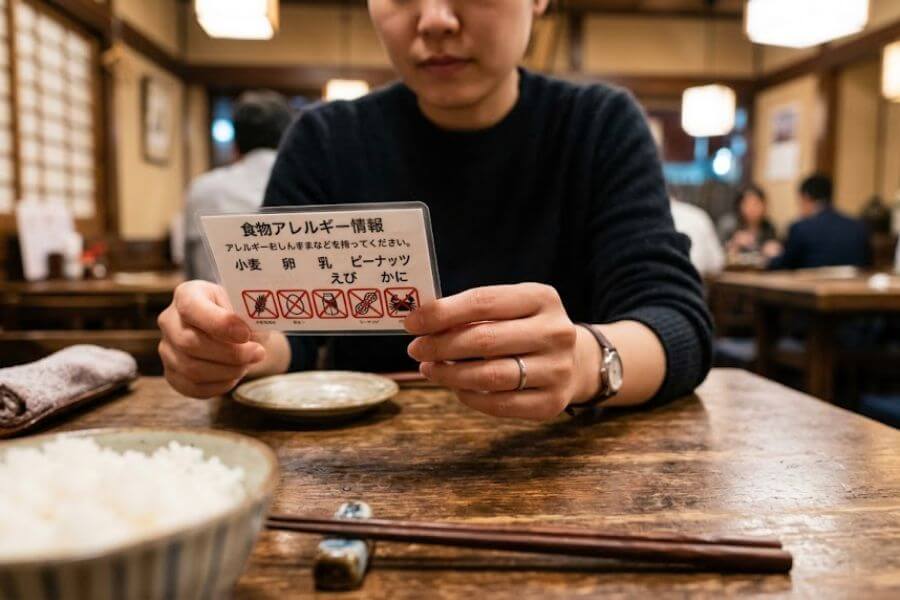
The single best item you can pack for your trip to Japan is a physical, professionally translated food allergy card, often called an equal-eat card or a chef card. This card should be printed on sturdy cardstock and be small enough to fit neatly into your wallet.
A well-designed allergy card should feature several key elements:
- A Clear Medical Warning: A bold statement at the top explaining that you have a severe medical allergy, not just a preference.
- Visual Symbols: Clear icons or pictures of the forbidden foods crossed out with a bright red universal “no” symbol. This allows kitchen staff to understand your needs instantly, even at a quick glance.
- The Japanese Characters: The exact kanji and hiragana characters for your forbidden foods, ensuring there is zero ambiguity.
- A Cross-Contamination Warning: Explicit text explaining that the food cannot be cooked using the same oil, utensils, knives, or grills that touched your allergen.
- An Emergency Request: A sentence asking the staff to kindly tell you if they cannot fulfill your request safely, so you can politely choose to dine elsewhere.
When you arrive at a restaurant, simply hand this physical card to your server and say, “Sumimasen, kore wo mite kudasai,” which means “Excuse me, please look at this.” The server will almost always take the card directly back to the kitchen to show the head chef. This removes the stress of miscommunication and gives the kitchen team the exact information they need to keep you safe.
Safety in Numbers: Relying on Chain and Family Restaurants
When you are tired after a long day of sightseeing and do not want to hunt for a specialized allergy-friendly boutique cafe, Japan’s extensive network of chain restaurants and family restaurants, known locally as famiresu, are fantastic options.
Large corporate restaurant groups in Japan are incredibly methodical and risk-averse. To protect themselves and their customers, they invest massive amounts of resources into creating comprehensive, highly accurate allergen folders and menus. These folders are often kept right at the front counter or are accessible directly on table-top ordering tablets.
Why Family Restaurants are Excellent Choices
Family restaurants are casual, affordable, and incredibly welcoming establishments that serve a massive variety of both Japanese and Western style comfort foods. Examples of popular chains include Gusto, Denny’s Japan, Royal Host, and Jonathan’s.
- Detailed Picture Menus: Their menus are packed with clear photographs of every single dish, making it easy to see exactly what you are getting.
- Laminated Allergen Matrixes: If you ask the staff for the “arerugi menyu,” they will hand you a laminated chart that lists every dish down one side and the top seven to twenty-eight allergens across the top. A simple circle or checkmark indicates exactly which allergens are inside each item.
- Dedicated Low-Allergen Meals: Many of these chains offer special kid-friendly or adult-friendly plates that are prepared completely free of the top seven common allergens. These meals are often made in specialized, sterile facilities, sealed in plastic pouches, and heated up safely in the restaurant kitchen to eliminate any risk of cross-contamination.
Safe Fast-Food and Beef Bowl Chains
If you need a quick, budget-friendly bite to eat, major fast-food and rice bowl chains are highly reliable because their recipes are strictly standardized across the entire country.
Chains like Yoshinoya, Matsuya, and Sukiya specialize in gyudon, which are bowls of thinly sliced beef and onions simmered in a sweet soy broth over rice. Coco Ichibanya, the incredibly famous Japanese curry chain, offers a dedicated allergy-friendly curry sauce on their menu that is made completely without wheat, milk, or eggs, allowing gluten-free and dairy-free travelers to experience authentic Japanese curry safely. Always use the ordering touchscreens at these establishments, as they often have a full English language toggle and built-in allergen filters that gray out unsafe dishes automatically.
Conquering the Japanese Convenience Store (Konbini)
No trip to Japan is complete without exploring the legendary convenience stores, known as konbini. The three major giants, 7-Eleven, Lawson, and FamilyMart, are located on almost every single street corner in the country. They are completely different from convenience stores in the West, as they serve high-quality, fresh, and incredibly delicious food twenty-four hours a day.
For travelers with food restrictions, the konbini is an invaluable resource. It is a place where you can find a quick, safe, and inexpensive meal at any hour of the day or night.
Navigating the Allergen Grids on Packaging
As mandated by Japanese law, packaged foods in convenience stores feature clear allergen declarations. On the back of a bento box, sandwich, or sweet pastry, look for a small rectangular box filled with tiny square grids.
Inside this box, you will see a list of various ingredients written in Japanese characters. The squares representing the ingredients contained within that specific food item will be shaded in, darkened, or marked with a checkmark. If you have a cheat sheet of Japanese characters or use a live camera translation app on your phone, you can decipher these grids in a matter of seconds.
The Ultimate Safe Snack: Onigiri
Onigiri are traditional Japanese rice balls wrapped in crispy nori seaweed, and they are the undisputed kings of the convenience store snack aisle. They are healthy, delicious, filling, and cost very little. More importantly, many varieties are naturally free of gluten, dairy, eggs, and nuts.
However, you must choose your flavors wisely. The onigiri selection can be confusing because they are all wrapped in plastic triangles that look very similar. Here is a breakdown of common onigiri varieties and their safety profiles.
| Onigiri Flavor Type | Japanese Name | Safety Profile and Details |
| Salt / Plain | 塩 / しお (Shio) | Highly Safe: Just plain white rice and sea salt. Completely free of gluten, dairy, eggs, fish, and nuts. Perfect for anyone with multiple severe allergies. |
| Pickled Plum | 梅 / うめ (Ume) | Highly Safe: Filled with a tart, salty pickled plum. Naturally vegan, gluten-free, and nut-free. An excellent, refreshing option. |
| Kelp / Seaweed | 昆布 / こんぶ (Konbu) | Caution Needed: Simmered kelp inside. While vegetarian-friendly in theory, the kelp is almost always simmered in soy sauce, meaning it contains wheat. Unsafe for celiacs. |
| Tuna Mayonnaise | ツナマヨ (Tuna Mayo) | Allergen Alert: Flaked tuna mixed with rich Japanese mayonnaise. Packed with egg, making it highly unsafe for anyone with an egg allergy. |
| Salmon | 鮭 / さけ (Sake) | Caution Needed: Grilled flaked salmon filling. Usually gluten-free and dairy-free, but completely unsafe for anyone with a fish allergy. |
Accommodation Tips: Kitchens and Apartment Hotels
If your food allergies are life-threatening or so numerous that dining out every day feels utterly exhausting, you should carefully consider your accommodation options when booking your trip to Japan.
While staying in a traditional Japanese inn, known as a ryokan, or a standard business hotel is a wonderful experience, it means you are completely at the mercy of the hotel chefs for breakfast and dinner. For maximum peace of mind, consider booking an apartment hotel, a vacation rental through platforms like Airbnb, or a residential-style hotel chain like Mimaru.
The Benefits of a Private Kitchen
Staying in a place with a fully equipped private kitchen completely changes the game for a traveler with severe dietary restrictions.
- Complete Control: You can shop at local Japanese supermarkets, buy fresh local meats, vegetables, and rice, and cook your own safe meals without any fear of cross-contamination or hidden dashi broth.
- Stress-Free Breakfasts: Instead of stressing over whether the hotel breakfast buffet used egg wash or butter, you can fry up some local eggs, steam a bowl of fresh rice, and start your day with a full, energized stomach.
- Slowing Down: Traveling can be exhausting. Having a cozy apartment where you can cook a simple meal allows you to relax, recharge, and take a break from the constant mental alertness required when dining out.
Supermarket Shopping Tips
Shopping at a local Japanese supermarket is a fun, culturally immersive experience in itself. Look for major chains like Life, Aeon, Itoyanado, or Seiyu.
Head straight to the fresh produce section for world-class fruits and vegetables. The seafood and meat sections are organized meticulously, with labels indicating the prefix “Kokusan,” which means domestically raised in Japan, ensuring high quality. You can also buy pre-washed rice that can be easily cooked in a microwave or a small rice cooker provided by your apartment hotel.
Emergency Preparedness and Medical Care in Japan
Even with the absolute best planning and the most careful communication, mistakes can happen. If you have an accidental exposure to an allergen during your trip, it is critical to know exactly how to get medical help in Japan. Japan has an incredibly advanced, world-class healthcare system, so you will be in excellent hands, but you need to know how to access it quickly.
Calling an Ambulance
If you or a travel companion experience a severe, life-threatening allergic reaction, such as anaphylaxis, do not hesitate to call an ambulance immediately.
- The Emergency Number: The phone number for medical emergencies and ambulances in Japan is 119. This is completely free to call from any public phone, mobile phone, or landline.
- English Language Support: In major cities and tourist heavy prefectures, the emergency dispatch system has English speaking operators on duty. When the operator answers, clearly say “Ambulance, please” or “Kyukyusha onegai shimasu.” Hold the line, and they will route your call to a translator or an English speaker.
- State Your Location: Be prepared to give your address or look for the nearest landmark or convenience store name, as convenience store signs always display their exact specific address near the entrance door.
Carrying Your Epinephrine Auto-Injectors (EpiPens)
If you have been prescribed an epinephrine auto-injector, such as an EpiPen, by your doctor at home, you are legally permitted to bring it into Japan for personal medical use during your vacation.
You do not need to fill out complex advance customs import paperwork if you are bringing in a standard personal supply, which is typically defined as two auto-injectors. However, to prevent any issues or delays at airport security checkpoints, always keep the auto-injectors in their original pharmacy packaging with the clear prescription label printed with your exact legal name. It is also wise to carry a signed, dated letter from your doctor stating that the medication is medically necessary for your safety.
Always keep your auto-injector with you at all times in a daypack or purse while exploring temples, riding trains, or dining out. Never leave it in your hotel room safe.
A Step-by-Step Dining Scenario: From Entry to Exit
To bring all of this advice together, let us walk through a realistic, step-by-step example of how a safe, successful dining experience should look from the moment you approach a restaurant entrance to the moment you pay your bill.
Step One: Checking the Front Display
Before you even step through the front door of a restaurant, take a moment to evaluate the establishment. Look at the display window outside. Most Japanese restaurants feature incredibly realistic, beautiful plastic food models, called sampuru, showcasing every dish they serve. This gives you a clear visual clue of what ingredients are heavily used in their kitchen. If the window is packed with deep-fried seafood and steaming noodle bowls, and you have a severe fish and wheat allergy, you might want to move on to a different spot.
Step Two: The Initial Greeting and Seat Request
As you walk inside, the staff will greet you warmly with a loud, enthusiastic “Irasshaimase,” which means welcome. Before you allow them to guide you to a table, hold up your hand politely and state that you have a dietary restriction. Show them your physical translated allergy card right then and there. Ask, “Kore wa daijobu desu ka?” which means “Is this okay?” This gives the staff a chance to check with the kitchen before you sit down, avoiding an awkward situation where you get comfortable only to find out there is absolutely nothing safe for you to eat.
Step Three: Ordering With Precision
Once the staff confirms they can accommodate you and seats you at a table, review the menu carefully. Select a dish that seems naturally safe or requires very minor modifications, such as a meat dish without sauce. When the server comes to take your order, point to the specific item on the menu and show your allergy card again, pointing to the specific restriction. Reiterate your key phrase: “[Allergen] nuki de onegai shimasu,” which means “Without [Allergen], please.”
Step Four: The Food Arrives and Verification
When the server brings your completed plate to the table, take a quick visual inspection. If everything looks correct, verify one last time with the server for absolute peace of mind. Point to the food and ask politely, “[Allergen] wa haitte imasen ka?” which means “Is [Allergen] definitely not inside?” The server will smile, nodding reassuringly, confirming that the kitchen followed your instructions perfectly.
Step Five: Enjoying Your Meal and Paying
Now, relax and savor the incredible flavors of Japan. You have done the hard work, navigated the language barrier successfully, and earned a delicious, safe meal. When you finish eating, head to the front register to pay. Show your genuine appreciation for their careful efforts by giving a warm smile and saying, “Gochisosama deshita,” leaving the staff feeling proud of their excellent hospitality and service.
Frequently Asked Questions
Is it safe to eat street food at festivals if I have severe food allergies?
Street food at Japanese festivals, known as matsuri, is incredibly fun and atmospheric, but it carries a very high risk for people with severe food allergies. The small stalls, called yatai, operate in tight spaces with limited cooking gear. They often use the exact same griddle to cook a variety of items, such as savory okonomiyaki pancakes packed with wheat and egg, yakisoba noodles, and squid skewers. Cross-contamination is almost guaranteed in these environments.
Furthermore, street vendors are incredibly busy rushing to feed massive crowds, meaning they do not have the time or kitchen space to clean utensils or prepare a specialized allergy-safe meal for you. If your allergy is mild or you follow a lifestyle choice like avoiding pork, you can often find safe options like grilled corn on the cob seasoned with plain salt. However, if your allergy is severe or life-threatening, it is best to enjoy the festival atmosphere but get your actual meals from a controlled, reliable restaurant or convenience store.
Can I trust smartphone translation apps to translate menu ingredients accurately?
Smartphone translation apps that use your phone camera to translate text in real-time are incredibly revolutionary and helpful tools for travelers. They are wonderful for getting a general idea of what a menu says or scanning signs in a train station. However, you should never trust them blindly for severe, life-threatening food allergies.
The apps can easily misinterpret complex Japanese kanji characters, especially when the text is printed in stylized artistic fonts, wrapped around curved packaging, or reflecting bright restaurant lighting. A single mistranslated character could be the difference between an ingredient reading “contains soybean” versus “contains wheat.” Use translation apps as a helpful initial screening tool at the grocery store, but always cross-reference the results with your own knowledge of key allergen characters, or show a physical, professionally written translation card to a human staff member for final validation.
Are international fast-food chains like McDonald’s or Starbucks safer than local Japanese restaurants?
International fast-food chains can provide a high level of comfort and predictability because their brand names are deeply familiar to you. However, you must be aware that their menus are tailored heavily to local Japanese tastes and contain items you will never see in your home country. For example, McDonald’s Japan frequently features seasonal burgers with soy-glaze teriyaki sauces containing wheat, or shrimp cutlet burgers packed with shellfish. Starbucks Japan is famous for its creative matcha green tea lattes, seasonal cream frappuccinos, and unique pastries that often feature hidden dairy, egg, or wheat.
The major advantage of these international chains is that their official corporate websites always host incredibly meticulous, up-to-date allergen charts that you can easily translate and study on your phone before ordering. The kitchen staff also follow extremely rigid, standardized assembly lines, minimizing random improvisations. They are excellent options for a quick, familiar bite, provided you do your homework on their specific Japanese menu items first.
How do I explain celiac disease to a Japanese server who does not understand the word gluten?
The word gluten is not widely recognized by the average restaurant worker in Japan. If you simply tell your server “I cannot eat gluten,” you will likely be met with a polite but completely blank stare. To communicate celiac disease effectively, you must break it down into its specific, practical components.
Do not focus on the medical name of the condition; instead, focus entirely on the physical ingredients that harm you. State clearly that you have a severe allergy to wheat, which is written as 小麦 (komugi). Crucially, you must explicitly explain that this includes standard soy sauce, known as しょうゆ (shoyu), as well as beer, breadcrumbs, and batters. By framing your celiac disease as a strict wheat and soy sauce allergy, the server and kitchen staff can understand exactly what bottles and ingredients they need to avoid when preparing your plate.
Is it rude to leave a restaurant if they say they cannot accommodate my food allergy?
No, it is not rude at all. In fact, it is highly respected as a responsible and polite choice. In Japanese culture, honesty and avoiding mistakes are valued incredibly highly. If a chef reviews your food allergy card and tells you honestly that they cannot guarantee a safe meal due to the size of their kitchen or the ingredients they use, they are doing it out of deep concern for your well-being. They do not want to make you sick.
If this happens, simply smile warmly, nod to show you understand, hand them your allergy card back, and say, “Wakarimashita. Arigatou gozaimasu,” which means “I understand. Thank you very much.” Then, turn around and walk out to find another dining spot. The staff will feel relieved that you stayed safe, and you can move on to a restaurant that feels completely confident in their ability to serve you a wonderful, worry-free meal.