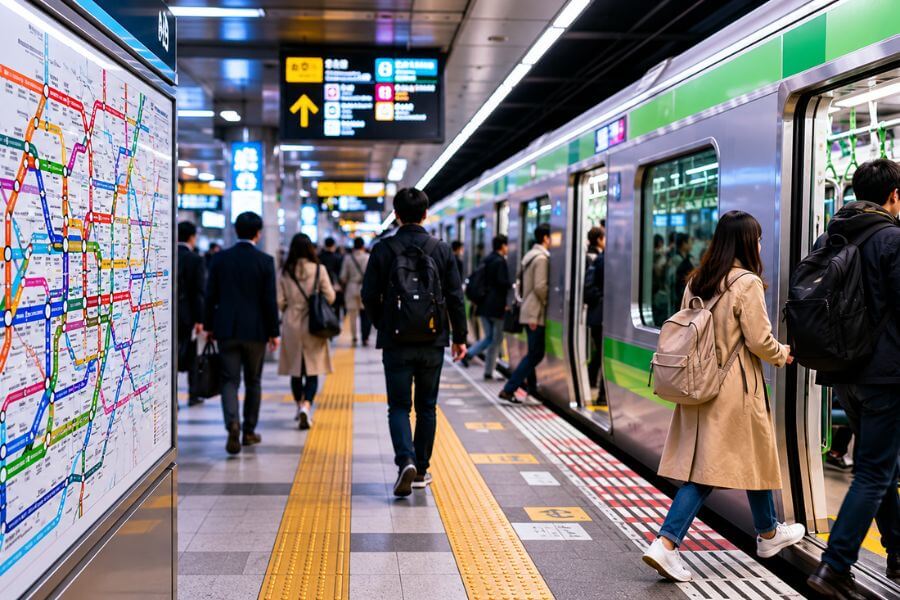
Key Takeaways for Mastering the Rails
- Get a digital IC card like Suica or Pasmo on your phone immediately upon arrival.
- Use Google Maps for real-time route planning, as it provides the exact platform, exit, and carriage details.
- Follow the color-coded signs and alphanumeric station codes to find your platform without needing to read Japanese.
- Always stand in line behind the markings on the floor and let passengers exit before you board.
- Keep your voice low, silence your phone, and be mindful of your backpack or luggage to respect your fellow riders.
- Look for the station identifier signs or the digital boards above the doors to confirm your next stop.
- If you get turned around, station staff are incredibly helpful; show them your destination on your phone, and they will point the way.
Welcome to the Tokyo Subway Adventure
Stepping into a Tokyo subway station for the first time feels like entering a different world. The sheer scale of the network is impressive, stretching far and wide beneath the bustling streets of one of the most vibrant cities on Earth. You might feel a bit nervous at first, seeing the maze of lines and crowds of people moving with precise speed. Do not worry. While it looks complex, the system is built on logic and efficiency. Once you learn a few core principles, you will be moving through the city with the confidence of a long-time resident. This guide is your companion to understanding how the trains operate, how to pay for your journey, and how to behave like a respectful passenger.
The Secret to Simple Payments
The days of struggling with individual paper tickets for every single ride are mostly behind us. The most efficient way to travel in Tokyo involves using a rechargeable smart card, known as an IC card. These cards, such as Suica or Pasmo, serve as your golden ticket to almost every train, subway, and bus in the capital.
Getting Your Card
If you have a modern smartphone, you can add a digital version of these cards directly to your digital wallet. This is often the preferred method because you can top up your balance using your phone at any time. If you prefer a physical card, you can find them at major stations or airport kiosks. Once you have the card on your phone or in your pocket, you no longer have to worry about calculating fares or buying specific tickets before you head out. You simply tap your device or card at the gate when you enter, and tap it again when you leave. The system calculates the exact cost of your trip and deducts it from your balance automatically.
Understanding the IC Card Value
When you get your card, you will need to load it with some initial credit. A good rule of thumb is to start with a few thousand yen. It is wise to keep a small cushion of funds on the card so you never find yourself stuck at an exit gate because your balance dropped below the required amount. If you do run out of funds, look for the yellow or metallic fare adjustment machines located near the exit gates. These machines allow you to add more money to your card in seconds, ensuring you can pass through the gate and continue your journey without frustration.
Reading the Map Like a Professional
Tokyo has multiple train companies operating within the city. You have the Tokyo Metro, the Toei Subway, and the massive JR lines, including the famous Yamanote Loop. While it looks like a spiderweb of lines on paper, you can simplify it by focusing on your specific start and end points.
Using Technology to Your Advantage
Navigation apps are your best friends in Tokyo. Google Maps, for instance, is incredibly detailed. It will tell you which train line to take, which station to transfer at, and exactly which car is closest to the stairs or escalators for your next transfer. It even provides the specific exit number you should use to reach your destination on the street level. Many stations in Tokyo are massive, and taking the wrong exit can sometimes lead you several blocks away from where you actually intended to go. Trusting the app for that final bit of guidance is a pro move that will save you a lot of walking.
Following the Signs
Inside the stations, you will find signs everywhere. They are color-coded to match the lines on the map. If you are looking for a specific train, look for the color of that line and follow the arrows. Each station also has an alphanumeric code, such as “G09” for a station on the Ginza line. These codes are consistent across the network and make it simple to verify you are standing on the correct platform even if you cannot read the local characters. Before you go through the gates, take a moment to look at the large station map to confirm you are heading toward the correct end-of-the-line destination. Platforms will clearly state which direction the train is traveling by listing the “bound for” station.
Mastering the Art of Boarding
The platform is a place of order. When you arrive, you will notice people forming neat lines behind markers on the floor. These markers indicate exactly where the train doors will open. It is important to wait in these lines rather than crowding the area directly in front of the doors.
The Flow of Passengers
When the train pulls in, the doors will slide open and passengers will begin to exit. Always wait for everyone to get off before you attempt to step inside. The flow of movement is constant and efficient, and if you simply wait your turn, you will find that there is almost always space for you to board. Once you are on the train, move toward the middle of the carriage to allow others behind you to enter.
Choosing the Right Carriage
If you are traveling during the morning rush, be aware that some carriages are marked as “Women Only” during specific hours. These are designated to ensure safety and comfort for women, children, and those with disabilities. Look for the signs on the platform and near the train doors. If you are a man traveling during these hours, simply choose a different carriage.
Etiquette and Behavior
Tokyo trains are known for being quiet and clean, and this is a reflection of the shared respect among passengers. Keeping a few simple rules of conduct in mind will help you blend in and ensure a pleasant experience for everyone.
Keep It Quiet
One of the first things you will notice is the relative silence. While people do talk, they keep their voices very low. It is common to see everyone looking at their phones or reading, with very few audible conversations. If you need to speak with your companion, do so in a soft whisper. Refrain from taking phone calls entirely. If you must answer a call, wait until you reach the station and step onto the platform away from the main flow of traffic.
Mind Your Belongings
Space is limited, so be mindful of your bags. If you have a large backpack, wear it in front of your chest rather than on your back. This prevents you from accidentally bumping into other passengers when you turn around. If you are carrying a large bag, try to place it on the overhead racks or keep it between your feet on the floor. Avoid placing bags on the empty seat next to you, as this takes up space that someone else might need.
When Things Do Not Go as Planned
Even with the best preparation, you might occasionally get on the wrong train or get off at the wrong stop. Do not let this ruin your mood. The system is incredibly frequent, and you are never far from a place to correct your course.
Stay Calm and Re-route
If you realize you are on the wrong train, simply get off at the next stop. Look at the maps again to determine the right platform to head back or transfer to the correct line. Because trains run so often, you will rarely wait more than a few minutes for a correction. If you find yourself truly confused, seek out the station staff. They are very accustomed to assisting visitors. Even if there is a language barrier, pointing to your destination on a map or on your phone is usually all it takes for them to provide you with a clear, helpful gesture or direction.
Summary of Key Differences
| Feature | Using Paper Tickets | Using an IC Card |
| Efficiency | Slow, requires constant buying | Fast, tap-and-go |
| Convenience | Need to calculate fare each time | Automatic calculation |
| Flexibility | Limited to single routes | Works across most lines |
| Reusability | None | Reloadable for future trips |
Frequently Asked Questions
What should I do if my IC card stops working at the gate?
If you tap your card and the gate stays closed or beeps, do not panic. It often means your balance is too low to cover the trip, or there was a minor error in your previous tap-in. Look for the fare adjustment machines near the gates. You can insert your card, see the error, and add the necessary funds to clear the balance. If you are still having trouble, the station staff near the glass booth at the gate can help you fix it in seconds.
Is it necessary to print out paper maps?
While having a physical map can be helpful for high-level planning, it is not strictly necessary. Digital apps like Google Maps provide more up-to-date information, including delays or platform changes. If you are worried about your battery, you can download offline versions of maps or take screenshots of your planned route before you leave your hotel.
Are there trash cans on the train or platform?
Generally, no. Tokyo stations have very few public trash cans. It is standard practice to carry your trash with you until you return to your hotel or find a bin at a convenience store. This is part of the culture of keeping the public space clean and tidy.
How do I know if I am on an express or a local train?
Check the electronic displays on the platform. They will indicate whether the next train is a local, rapid, or express service. Local trains stop at every station, while express trains skip smaller ones. If you are traveling to a smaller station, ensure you are on a train that is marked as a “local” service. The signs and your navigation app will clarify this clearly.
Can I eat or drink while riding the subway?
It is considered poor form to eat or drink on local subway trains. It is better to finish your drink or snack before you enter the station or wait until you reach your destination. Long-distance trains like the Shinkansen are a different story, where eating is perfectly acceptable, but for the daily city subway commute, it is best to keep the environment clean and scent-free.