Moving to a new country brings a whirlwind of excitement, from hunting down the best convenience-store snacks to figuring out local train routes. Amid all the fun updates, setting up your life admin tasks is just as vital. In Japan, setting up your health coverage is a non-negotiable step that keeps your physical and financial well-being safe. Knowing how to get on the local health system gives you peace of mind so you can focus on enjoying your daily life. This walkthrough breaks down how to sign up for National Health Insurance so you can navigate the process without stress.
Key Takeaways
For a quick snapshot of the process, keep these essential details in mind before you head out:
- Sign-up Window: You must register within 14 days of moving into your permanent Japanese address.
- Where to Go: Head straight to the local ward office or city hall that handles your residential area.
- The Big Benefit: The plan covers 70% of your medical bills, meaning you only pay a 30% co-payment out-of-pocket.
- New Rules: Traditional paper health cards are phased out, and the system now links directly to your My Number Card, though paper eligibility certificates are available if you lack the card.
- Back-payments Risk: Procrastinating your registration leads to back-billed monthly premiums starting from your official arrival date, not your sign-up date.
What is National Health Insurance in Japan
Known locally as Kokumin Kenko Hoken, National Health Insurance is one half of the public healthcare framework in Japan. It is a community-based system managed by individual cities, towns, and wards. The primary goal of this setup is to ensure that anyone living in the country can access high-quality medical services without facing sudden financial ruin. When you possess this coverage, the system acts as a shield, handling the majority of your healthcare expenses whenever you visit a doctor, dentist, or specialist.
The country uses a universal healthcare model, meaning everybody who lives on the islands must be enrolled in some form of official medical coverage. For working professionals at larger enterprises, companies handle enrollment into Employee Health Insurance. But for a massive chunk of the population, the national community plan is the primary path to staying protected.
Once you finish your registration, you gain access to a network of clinics and hospitals nationwide. You are not locked into a tiny list of specific doctors. You can walk into almost any medical clinic across the country, present your official identification, and receive care under the standardized public payment rates.
Who is Required to Enroll
The local regulations are clear about who needs to sign up for the community plan. If you are a foreign resident planning to stay in Japan for three months or longer, you are legally required to join this system. This rule applies across the board, covering language school students, university attendees, self-employed individuals, freelancers, digital nomads, and people on working-holiday pathways.
Even if you hold private travel protection from your home country, the Japanese government still requires you to enroll in the public plan. Local clinics expect immediate payment at the front desk when you complete an appointment, and they process discounts through the public network.
The only common scenario where you skip this specific registration is if your workplace signs you up for Employee Health Insurance. If you work part-time for multiple employers or your main job does not offer company-sponsored care, the responsibility falls squarely on your shoulders to visit the neighborhood office and set up your personal account.
The Costs and Financial Benefits
The biggest perk of this public system is the direct cost reduction. When you visit a clinic or buy prescribed medicine, you only pay a 30% co-payment at the cashier counter. The public fund automatically handles the remaining 70% of the bill. This makes regular checkups, dental cleanings, and prescription eye drops incredibly reasonable.
Your monthly premium price is not a flat fee. Instead, the local government calculates your monthly bill based on three main factors: your previous year of taxable income earned inside Japan, the exact municipality where you reside, and the total number of people living in your household.
If you are a newly arrived student or a freelancer who just landed in the country, you will not have a documented history of Japanese income for the prior year. In this situation, the office sets your premium at the absolute baseline rate, which is very budget-friendly. As you start working and filing local taxes, your monthly fee adjusts up or down to match your financial situation.
Documents to Gather Before Going
Preparation is the absolute secret to a fast, smooth experience at the local government office. Walking into the building with a incomplete folder means you will likely get sent back home to fetch missing papers. Pack a small folder with these exact items before you hop on the train:
- Your Passport: The staff needs to verify your legal identity, arrival date stamps, and current visa status.
- Your Residence Card: Known as the Zairyu Card, this is your primary identity document while living in the country. It must show your current address printed on the back.
- Your My Number Details: Bring your physical plastic My Number Card if you have it, or the paper notification letter that contains your unique twelve-digit tax identification number.
- Proof of Income Changes: If you recently left a company that provided workplace insurance, bring your official document showing your date of job separation so the staff can transition your account correctly.
- A Reliable Payment Method: Bring your local bankbook or cash-card if you want to sign up for automatic monthly bank transfers right at the window.
Navigating the Ward Office Step-by-Step
Stepping into a bustling city hall or ward office can feel slightly overwhelming, especially if you are still working on your language skills. Thankfully, these buildings are highly organized and designed to move people through lines systematically. Here is the natural progression of how your visit will unfold:
Finding the Right Section
When you first walk through the main doors, look for the central directory board or visit the information desk near the entrance. You need to look for the department labeled for National Health Insurance, often called the Kokumin Kenko Hoken-ka. In many modern buildings, this section sits on the exact same floor as the residential affairs counter where people register their housing addresses.
Grabbing a Number Ticket
Do not just stand in the open lobby waiting for someone to call you over. Look for a small electronic ticket-dispensing machine sitting near the entrance of the health insurance department. Press the button corresponding to new enrollments or general inquiries, take your printed paper slip, and find a seat in the waiting area. Watch the digital overhead monitors until your specific ticket number lights up alongside a designated counter window.
Filling Out the Application Form
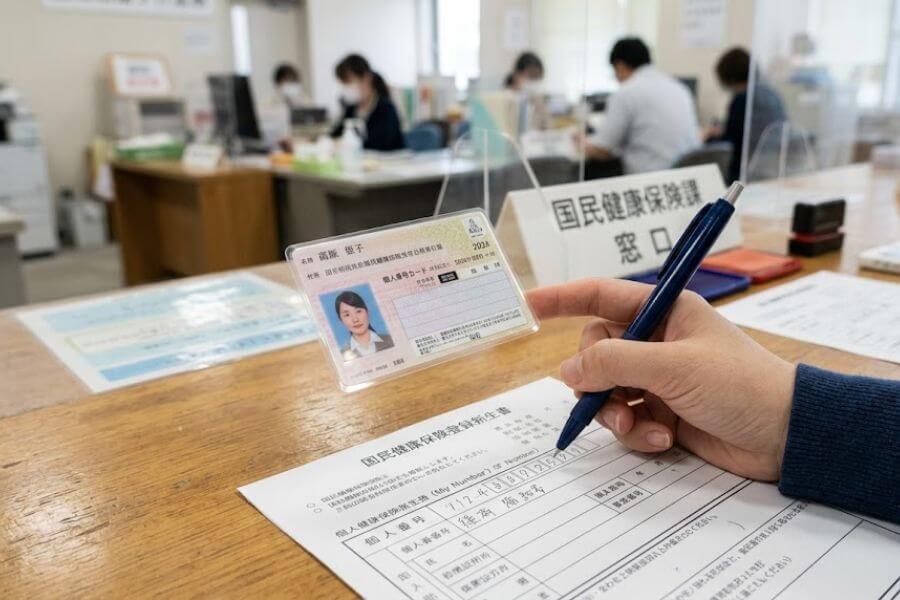
Once you sit down at the counter, explain to the staff member that you want to sign up for the plan. They will hand you a single-page paper application form. The sheet asks for your full legal name, your exact birth date, your current registered address, and your My Number details. Many offices provide English reference guides that show you exactly where to write each piece of information.
Verification and Processing
The employee will take your completed form along with your residence card and passport. They will type your details into the government network to establish your insurance profile. This processing phase usually takes anywhere from fifteen to thirty minutes. While you wait in the seating area, the staff verifies your address status and sets up your digital record.
Receiving Your Coverage Details
Once the data entry wraps up, the clerk will call your name back to the window. Because Japan transitioned away from traditional small paper health booklets, the staff will explain how your coverage links directly to your digital My Number profile. If you do not possess the official plastic card yet, the clerk will print out a physical document known as an Eligibility Confirmation Certificate so you have immediate proof of coverage for hospital visits.
Payment Methods and Premium Slips
A few weeks after your successful registration, a thick envelope will arrive in your residential mailbox. This package contains your official billing breakdown and your monthly premium sheets. Managing these payments is straightforward, and you have a couple of different paths to keep your account current:
Using Cash Payment Slips
The default package includes a stack of individual paper payment slips, with each slip dedicated to a specific calendar month. You can take the current month’s slip into any convenience store across Japan, hand it to the clerk at the register, and pay the balance using physical cash. You can also process these identical slips at local bank branches or post office service windows.
Setting Up Automatic Bank Transfers
If you prefer a hands-off approach, you can register for automatic monthly bank debits. You can set this up by filling out a direct-debit authorization form at your ward office counter or by taking your insurance details and bank card to your local bank branch. Once active, the system automatically pulls the exact premium amount from your checking account near the end of each month, saving you trips to the convenience store.
Important Timing and Deadlines
The local health department operates on strict scheduling rules, and keeping track of your timeline is crucial. You are expected to complete your health registration within 14 days of finalizing your residential address record at your new home.
If you delay your visit to the office for several months, the system does not let you skip out on the costs for the period you missed. Instead, the computer system calculates your premiums all the way back to the exact day you originally arrived in the country or moved into the municipality.
This means a late registration results in a large lump-sum bill covering your missed months, which can create an unexpected burden on your wallet. Registering immediately avoids back-payment surprises and ensures you are covered if you trip on the sidewalk or catch a sudden fever during your first month in town.
Handling Changes in Your Life
Your relationship with the health insurance department changes as your life circumstances shift. Whenever a major change happens, you generally have a two-week window to notify your local ward office so they can adjust your account settings:
Moving to a Brand-New City
If you pack up your things and move to a completely different city or Tokyo ward, you must visit your current office to file a moving-out notice and officially close your local health file. Once you arrive at your new neighborhood, you visit the new local city hall within 14 days to register your new address and restart your health coverage under their local municipal system.
Transitioning to a Corporate Job
If you land a full-time position at a company that provides Employee Health Insurance, your new company HR department will give you a fresh corporate health profile. Once that corporate coverage goes live, you must personally visit your local ward office to cancel your community National Health Insurance plan. Bring your new company information and your old residence details so the clerk can stop your community billings and prevent double-charging.
Leaving the Country Permanently
When your time in Japan comes to an end and you plan to head back to your home country, you cannot just board your flight and forget about your account. You must visit your ward office a few days before your departure date to officially cancel your insurance. The clerk will calculate your final prorated premium balance up to your departure day, allow you to settle the remaining amount in cash, and close your file so you do not accumulate unpaid debts.
System Comparisons
To help visualize how your healthcare options compare depending on your daily activities, this simple table outlines the primary differences between the two main public paths:
| Feature | National Health Insurance (Kokumin Kenko Hoken) | Employee Health Insurance (Shakai Hoken) |
| Primary Users | Students, freelancers, self-employed, unemployed | Full-time corporate workers, regular school teachers |
| Where to Sign Up | Local ward office or city hall | Handled directly by company HR departments |
| How Fees are Split | You pay 100% of the calculated premium | Company pays 50%, you pay 50% via payroll |
| Payment Method | Convenience store slips or bank debit | Automatic deduction from monthly salary |
| Coverage Level | 70% covered by the system, 30% co-payment | 70% covered by the system, 30% co-payment |
Frequently Asked Questions
What happens if I lose my eligibility certificate or need a replacement?
If you misplace your paper certificate before your digital My Number profile is fully up and running, simply return to the insurance counter at your local ward office. Bring your physical residence card and passport to prove your identity. The staff can access your digital file immediately and print out a fresh replacement document on the spot for free.
Can I use my insurance coverage if I travel out of town to another prefecture?
Yes, your public coverage works seamlessly throughout the entire country. If you live in Tokyo but require emergency medical attention while visiting Osaka or Kyoto, you can present your linked identification at any participating clinic. You will receive the exact same 30% co-payment rate as you do at your neighborhood clinic back home.
Does the national health plan cover things like standard dental work?
Yes, the public plan provides excellent support for essential dental care. Standard cleaning appointments, cavity fillings, root canals, and necessary extractions are all covered under the standard 70% discount system. Keep in mind that purely cosmetic treatments, such as professional teeth whitening or high-end orthodontic aligners, must be paid entirely out-of-pocket.
What should I do if my monthly income drops significantly?
If you experience a major loss of income or face severe financial hardship, do not simply ignore your incoming monthly payment slips. Take your identification and proof of your reduced earnings straight to the health insurance department at your city hall. The local government has official financial relief programs that can legally discount or temporarily pause your monthly premium obligations if you qualify.