Planning a trip to Japan is incredibly exciting. You are probably looking forward to the bright neon lights of Tokyo, the peaceful temples of Kyoto, and eating your weight in delicious, authentic sushi. But if you are traveling from America, you are about to step into a culture that operates on a completely different set of social rules.
In the United States, standing out and being expressive is often celebrated. In Japan, the focus is on harmony, respect, and thinking about the group before yourself. Small things that seem totally normal at home can accidentally come across as rude or disrespectful over there.
You do not need to worry, though. The local people are famously polite and gentle with travelers. Still, making an effort to follow their customs goes a long way. This guide breaks down fifteen essential rules to help you navigate your journey smoothly, blend in like a pro, and show maximum respect to your wonderful hosts.
Key Takeaway: The Golden Rule of Japanese Etiquette
If you remember only one thing from this entire guide, let it be this: mind your surroundings and prioritize the comfort of the group.
Japanese etiquette is built around a concept called omotenashi (deep hospitality) and the desire to maintain wa (social harmony). While American culture values individual freedom and speaking up, Japanese culture values quiet consideration, cleanliness, and self-restraint. When in doubt, look around at what the local people are doing and match their volume, energy, and actions. Being observant is your greatest superpower.
1. Keep Your Voice Down in Public Spaces
In America, public transit is often a lively place. People chat loudly on their phones, listen to music, and laugh with friends on the subway. If you do this in Japan, you will notice people giving you uncomfortable looks.
Silence on the Trains
When you step onto a Japanese train or bus, you will immediately notice how incredibly quiet it is. Even during rush hour, when hundreds of people are packed together shoulder-to-shoulder, it can be silent enough to hear a pin drop. Speaking in a loud, boisterous voice is considered highly inconsiderate to the commuters around you who are resting or reading.
Phone Etiquette
You should never make or answer voice calls while riding public transit. Before you board, flip your phone onto silent mode. The local people call this “manner mode.” If your phone rings, scramble to silence it immediately. If you absolutely must speak to the person next to you, keep your voice to a very low whisper.
2. Master the Art of the Trash Chase
If you walk around a major city like Osaka or Tokyo, you will quickly notice something shocking. There are almost no public trash cans on the streets. Yet, the sidewalks are completely spotless.
Hold Onto Your Garbage
This is often a major adjustment for American travelers. In the United States, you can usually find a waste basket on every street corner. In Japan, you are expected to carry your garbage with you until you get back to your hotel room or find a designated disposal spot.
Why Are There No Bins?
The lack of public bins is actually a public safety measure that started in the nineties, but it also reinforces the cultural idea that your trash is your own responsibility. You should bring a small plastic bag in your daypack each morning. You can use it to collect your wrappers, tissues, and empty bottles throughout the day.
Finding a Disposal Spot
You cannot just throw your trash into any random bin you see. When you do find public cans, they are usually grouped next to vending machines or convenience stores. These bins are color-coded and strictly divided by category.
| Trash Category | Where to Find Bins | Proper Action |
| Plastic Bottles | Next to vending machines | Empty the liquid, remove the cap, drop in the specific round hole |
| Aluminum Cans | Next to vending machines | Crush slightly if needed, place in the can-only slot |
| Burnable Waste | Inside convenience stores | Use for food wrappers, tissues, and paper receipts |
3. Never Walk and Eat at the Same Time
In the United States, grabbing a slice of pizza or a coffee and consuming it while walking down the sidewalk is a normal part of a busy day. In Japan, eating while walking is considered sloppy, bad-mannered, and disrespectful to the food itself.
Sit or Stand to Snack
When you buy a snack from a street food stall or a convenience store, you should stand right next to the shop to finish it. You will see groups of local people doing exactly this. They buy a treat, eat it quickly while standing near the counter, throw the wrapper in the store bin, and then continue walking.
The Risk of Spills
The rule also has a very practical side. Walking while consuming food or drinks increases the risk of bumping into someone and spilling something on their clothing. Since Japanese people take great pride in looking neat and tidy, causing a stain on a stranger is a massive social mistake. The only major exception to this rule is during outdoor summer festivals, where eating while strolling around the festival grounds is part of the fun.
4. Handle Your Chopsticks with Extreme Care
Chopsticks, known as hashi, are the primary utensils you will use for most meals. There is a deep web of spiritual and cultural traditions tied to how they are handled. Using them incorrectly can ruin a beautiful dining experience.
The Death Association
The absolute biggest mistake you can make is sticking your chopsticks straight up into a bowl of white rice. Never do this. This specific image looks exactly like a bowl of incense sticks used during traditional Japanese Buddhist funerals. Doing this at a dinner table brings back sad memories of death and is considered a terrible omen. When you are not using your chopsticks, rest them flat across the small ceramic holder provided next to your plate.
Passing Food Directly
Another major taboo is passing a piece of food directly from your chopsticks to another person’s chopsticks. This mimics a funeral ritual where family members pass cremation bones to one another. If you want to share a delicious piece of chicken or a dumpling with your travel buddy, pick it up and place it directly onto their personal small plate instead.
General Chopstick Manners
- Do not point: Avoid using your sticks to point at people or specific dishes on the table.
- Do not drum: Do not tap your sticks on the table or use them like drumsticks.
- Do not spear: Avoid stabbing your food with a single stick to pick it up like a fork.
5. Pay Close Attention to Footwear and Slippers
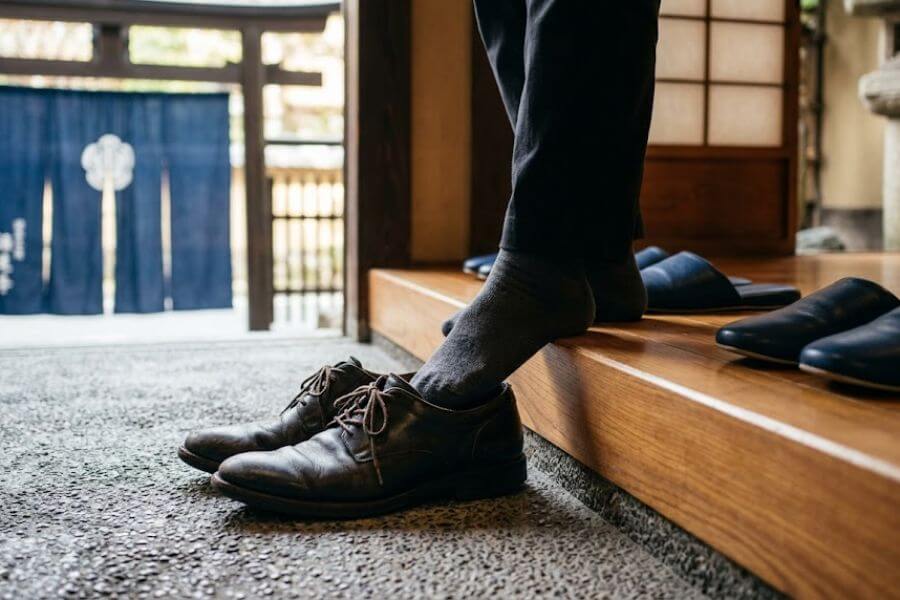
In America, shoes are a basic part of an outfit, and people often wear them throughout the house. In Japan, shoes carry all the dirt and grime of the outside world, and keeping that dirt out of clean indoor spaces is a cultural obsession.
The Boundary Line
When you enter a Japanese home, a traditional inn, or certain historical restaurants, you will step into an entranceway called a genkan. This area is usually a step lower than the main floor. You must take off your outdoor shoes here. You will usually see a shelf to store them, or you can line them up neatly facing toward the outdoor door.
The Slipper Dance
Once your shoes are off, you will often be given a pair of indoor slippers to wear on the wooden hallways. However, if you step into a room with traditional straw mat flooring, known as tatami, you must slide off those slippers too. Tatami mats are delicate and are meant to be stepped on only with clean socks or bare feet.
The Special Bathroom Slippers
This is the part that trips up almost every single American traveler. When you go to use the restroom in a home or restaurant, you will see a specific pair of slippers waiting just inside the bathroom door.
The Toilet Switch
You must slide out of your regular hallway slippers and step into the special bathroom slippers before you enter. The bathroom floor is viewed as unclean, so these slippers never leave that room. The trickiest part is remembering to switch back when you exit. Walking back into a public dining area while wearing the toilet slippers is a funny but highly embarrassing blunder.
6. Understand the No-Tipping Culture
For Americans, tipping is a deeply ingrained habit. We tip our waiters, taxi drivers, bartenders, and hotel staff to show appreciation for good service. In Japan, tipping does not exist, and attempting to do it can cause genuine confusion and awkwardness.
Good Service is the Standard
In the Japanese view, high-quality service is simply the baseline expectation for any job. Workers take immense pride in doing their duties perfectly, and they are paid a fair wage by their employers. They do not need extra financial rewards to do a good job. If you leave extra cash on a table, the waiter will likely assume you accidentally dropped your money.
Running Down the Street
If you leave a tip on a restaurant table and walk out, do not be surprised if your server sprints down the sidewalk after you to return the yen you forgot. It can make the worker feel uncomfortable, as if you think they need charity.
How to Say Thank You
If you receive absolutely incredible service and want to show your appreciation, the best way to do it is with words and actions. Look the worker in the eyes, smile, give a polite nod of your head, and say arigatou gozaimasu, which means thank you very much. Your respect and kind words are worth far more than extra coins.
7. Handle Money with Both Hands and Use the Trays
The way cash and cards are passed from person to person in Japan is highly formalized. Handing a crisp bill directly to a cashier with one hand can look careless and dismissive.
Look for the Small Tray
When you go to pay at a convenience store, a boutique, or a ticket counter, look down at the counter. You will almost always see a small plastic or wooden tray, often with a bumpy rubber mat inside. You should place your cash or credit card directly onto this tray rather than holding it out to the employee.
The Counting Ritual
The cashier will pick up the tray, take your money, and carefully count out your change right in front of you. When they hand you your change, receipt, or credit card back, they will usually hold it with both hands and give a small bow.
Show Equal Respect
If a tray is not present, you should mimic this behavior. Hold your money or card with both hands when passing it over. This simple physical gesture shows that you value the transaction and respect the person who is serving you.
8. Avoid Direct Physical Contact in Public
American culture is physically affectionate. We hug hello, slap friends on the back, and shake hands firmly when meeting new people. In Japan, personal space is highly valued, and public displays of affection are generally avoided.
The Power of the Bow
Instead of shaking hands or hugging, Japanese people greet each other by bowing, known as ojigi. As a tourist, you are not expected to know the exact angles of a perfect formal bow. A simple, polite inclination of your head and upper body is more than enough to show goodwill. Keep your hands at your sides or gently folded in front of you, and avoid looking the person directly in the eyes while you bend.
Avoid the Hug
Even if you become close friends with a local person during your trip, do not move in for a big American bear hug when saying goodbye unless they initiate it. It can catch people off guard and make them freeze up with discomfort. Keep your hands to yourself in public crowded spaces, including when traveling with your romantic partner. Holding hands is fine, but heavy kissing or touching on public streets is frowned upon.
9. Follow the Strict Rules of the Public Bath
Visiting a traditional hot spring, called an onsen, or a public bathhouse, called a sento, is one of the most relaxing experiences you can have in Japan. But these places have incredibly strict hygiene rules that you must follow before your toes ever touch the hot water.
The Wash-First Rule
The most important concept to understand is that the communal bath water is strictly for soaking, not for cleaning your body. When you enter the locker area, you will strip down completely. You cannot wear a swimsuit into a traditional public bath. You will carry only a tiny hand towel into the washing zone.
Sit on the Stool
Before you get into the big hot tub, you must sit down at one of the individual washing stations lined up along the wall. Each station has a mirror, a faucet, a plastic bucket, and a small stool. You sit on the stool, use the soap and shampoo provided, and scrub your entire body clean. Rinse off every single bubble of soap before you stand up.
Keep the Water Pure
Once you are totally clean and rinsed, you can step into the soaking pool. Do not let your small hand towel touch the bath water. Most people fold it up and balance it on top of their heads while they soak. Never splash, swim, or dive around. It is a place for quiet, meditative relaxation.
The Tattoo Complication
It is vital to know that many traditional baths still ban people with tattoos. Historically, tattoos were associated with organized crime groups in Japan. While young travelers use them for fashion today, the old rules stick around. If you have ink, look for tattoo-friendly baths, or buy waterproof bandages to cover small designs before you go.
10. Do Not Point Your Finger at People or Things
In the United States, pointing at a person to identify them or pointing your finger at a map to show a direction is a standard gesture. In Japan, pointing an index finger directly at someone is considered aggressive, accusatory, and rude.
The Open-Hand Gesture
If you need to direct someone’s attention to a specific location, a menu item, or a person, use your whole hand. Extend your arm gently with your palm facing upward, flat and open, as if you are presenting a beautiful gift on a tray.
Pointing at Yourself
If you are trying to point to yourself to say “Who, me?”, do not point to your chest like Americans do. Instead, lightly touch the tip of your index finger to the center of your own nose. It is a small cultural quirk that looks adorable to outsiders but makes perfect sense to the locals.
11. Stand on the Correct Side of the Escalator
When you are rushing through massive, multi-level train stations, escalators are your best friends. But even on a moving staircase, there is a strict social code that keeps pedestrian traffic flowing smoothly.
Leave a Passing Lane
The basic rule is that one side of the escalator is for standing still, and the other side is a clear lane for people who are in a major hurry and want to walk up the steps. If you block the walking lane with your body or your large rolling luggage, you will cause a major pedestrian traffic jam behind you.
The City Divide
The tricky part for tourists is that the correct side actually changes depending on which region of Japan you are visiting. In Tokyo and the surrounding eastern areas, everyone stands on the left side and leaves the right side open for walkers. But if you take the bullet train down to Osaka and the western areas, the rule flips, and people stand on the right side while leaving the left side open.
Look at the Line
Do not panic about memorizing which city does what. Just look at the line of people ahead of you as you approach the escalator steps. See which side the crowd is forming on and fall into line right behind them.
12. Be Careful When Blowing Your Nose in Public
When you catch a cold or experience seasonal allergies in America, it is completely normal to pull out a tissue and loudly blow your nose whenever you need to, whether you are in a meeting, on a bus, or walking down the street. In Japan, the sound of loud nose-blowing is considered unpleasant and unhygienic.
Sniffle Instead
You will notice that Japanese people will sniffle continuously rather than blowing their noses in front of others. If your nose is running, it is actually more polite to sniffle quietly until you can find a private space.
Seek Out a Private Spot
If you absolutely must clear your nose, excuse yourself and head to a public restroom stall, or step into a quiet, secluded side street away from people. If you are stuck on a train and cannot leave, use a soft tissue, do it as quietly as humanly possible, and hide your face away from the crowd. Never reuse a cloth handkerchief for mucus. Handkerchiefs in Japan are strictly used for drying your clean hands after washing them in the restroom.
13. Dress Appropriately for Sacred Temples and Shrines
Japan is home to thousands of gorgeous Buddhist temples and Shinto shrines. While these spots are major tourist attractions, they are also active, sacred places of worship where local citizens come to pray and connect with their ancestors.
Dress with Respect
While there are rarely strict dress code enforcers standing at the gates like you might find in parts of Europe, you should dress modestly out of respect. Avoid wearing super revealing clothing, such as tiny crop tops, short beach shorts, or shirts with offensive language printed on them.
The Hat Rule
When you step under the wooden gates of a shrine or enter a temple building, take off your baseball cap or sun hat. Speak in low, reverent tones, similar to how you would behave inside a cathedral or a library.
Photography Manners
Always look for signs regarding photography. Many temples allow you to photograph the beautiful outer gardens, but strictly ban cameras inside the main altar rooms where sacred statues are housed. If you see a camera symbol with a red line through it, put your phone away into your pocket.
14. Never Mix Up Shrines and Temples
To an outsider, Japan’s historic wooden structures might all look similar at first glance. But shrines and temples belong to two completely different religions, Shinto and Buddhism, and they have different rituals for visitors. Mixing them up or performing the wrong prayer ritual shows a lack of understanding.
Shinto Shrines
Shrines are built for the Shinto religion, which is Japan’s native spiritual belief system focused on nature spirits called kami. You can identify a Shinto shrine by the large, iconic wooden or stone gateway at the entrance, called a torii.
Buddhist Temples
Temples belong to Buddhism, which came to Japan from Asia. Temples usually feature large entrance gates called mon, incense burners out front that puff thick smoke, and buildings housing beautiful statues of the Buddha.
The Prayer Differences
The physical actions you take to pay your respects are entirely different at each location. At a temple, you bow quietly with your hands pressed flat together in a silent posture of reflection. At a shrine, there is a specific, rhythmic sequence of clapping and bowing to wake up the spirits.
| Sacred Site Type | Core Religion | Key Entrance Feature | Proper Greeting Ritual |
| Shinto Shrine | Shinto (Nature Spirits) | Torii Gate (often bright orange or stone) | Bow twice, clap your hands loudly twice, pray, bow one final time |
| Buddhist Temple | Buddhism | Mon Gate & Large Incense Burners | Bow silently with hands pressed together, do not clap |
15. Do Not Cross the Street on a Red Light
In major American cities like New York or Chicago, jaywalking is practically a sport. If there are no cars coming down the road, pedestrians will regularly cross the street without waiting for the walk sign to turn green. In Japan, this is looked down upon.
Follow the Signal Every Time
Japanese culture places a massive emphasis on law, order, and setting a good example for the community. Even if it is two o’clock in the morning, the street is completely empty, and there is not a single car headlight in sight, you will see groups of local citizens standing patiently at the curb, waiting for the little green man symbol to appear.
Setting an Example
Crossing early makes you look impatient, reckless, and disrespectful to the local community rules. It is also seen as a bad influence on any children who might be watching nearby. Take those extra thirty seconds to stand still, enjoy the cool air, and practice the patience that makes Japanese society run so beautifully.
Frequently Asked Questions
What happens if I accidentally make a cultural mistake in Japan?
You do not need to worry. Japanese people are fully aware that international tourists grow up with different traditions, and they do not expect you to be perfect. If you make a mistake, like wearing your hallway slippers onto a tatami mat, someone will gently point it out to you. The best response is to smile, give a small bow of apology, say sumimasen, which means excuse me, and correct your action immediately. It is your attitude and willingness to learn that matters most to your hosts.
Is it rude to drink water or soda while walking down the street?
Yes, sipping a drink while walking is generally viewed the same way as eating while walking. It increases the risk of accidental bumps and liquid stains on others. If you buy a cold green tea from one of the millions of convenient vending machines, stand right next to the machine to drink it. Once you finish the drink, you can drop the empty bottle directly into the recycling container attached to the side of the machine and continue your stroll.
Why do Japanese people wear face masks out on the streets?
Long before global health events, wearing face masks was a normal, everyday sight in Japanese cities. People wear them out of a sense of social responsibility. If someone has a minor winter cold or a summer allergy sneeze, they wear a mask to prevent their germs from airborne spreading to coworkers and strangers on the train. People also wear them during the spring months to protect themselves from heavy cedar pollen. It is an act of consideration for the health of the public.
How should I accept a business card or a gift from a local guide?
If someone hands you a business card or a small souvenir gift, you should always accept it using both hands. Reach out, take the object by its corners, and look at it with interest for a few moments. Do not immediately stuff a business card into your back pants pocket or write notes on it, as this looks like you are treating the person’s identity carelessly. Treat the card or gift with gentle care, give a small bow of thanks, and place it neatly into your wallet or daypack.
Can I talk on my phone if I am riding inside a taxi cab?
While you must stay silent on trains and buses, taxis are private vehicles, so the rules are slightly more relaxed. However, you should still keep your voice to a low, conversational volume so you do not distract the driver. Japanese taxi drivers are professionals who wear clean white gloves and take their driving duties seriously. It is polite to ask the driver for permission before making a long call, or simply wait until you arrive safely at your destination.