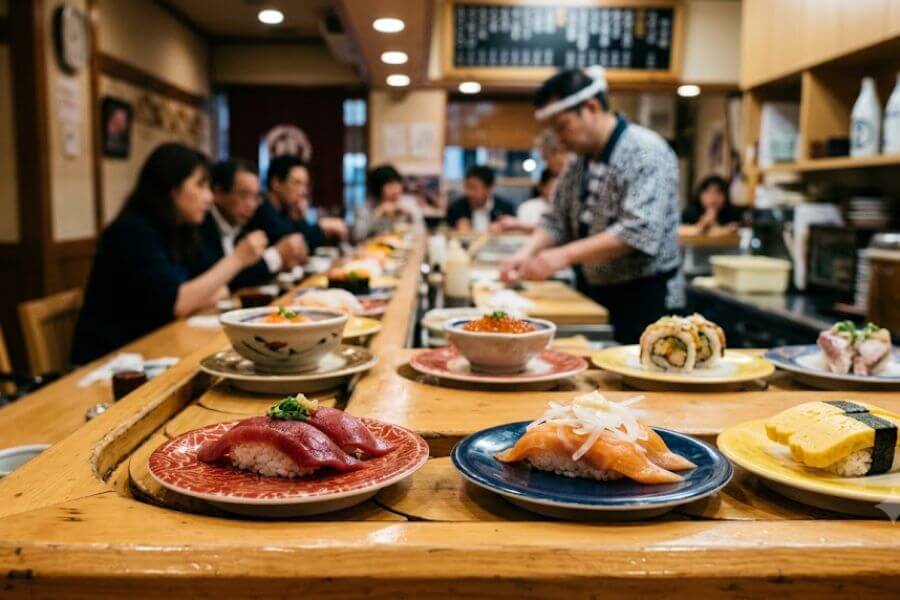
Imagine stepping into a bright, bustling room where tiny plates of delicious sushi glide past you on a miniature highway. Your eyes dart from a plate of bright pink tuna to a piece of crispy shrimp tempura, and all you have to do is reach out and grab whatever catches your eye. This is the magical world of conveyor belt sushi in Tokyo, known locally as kaitenzushi. It is one of the most exciting, fun, and wallet-friendly ways to eat your way through Japan’s capital city.
Finding the absolute best spots in a massive city like Tokyo can feel overwhelming because there are thousands of choices. Some are massive chains with touch screens and bullet trains that deliver your food, while others are hidden gems where master chefs place fresh fish directly onto a moving track right in front of you. This ultimate guide will show you exactly how to hunt down the best conveyor belt sushi experiences in Tokyo, read the hidden signs of quality, master the rules of the belt, and eat like a true Tokyo local.
Understanding the Two Main Types of Belt Restaurants
Before you take your first step onto the neon-lit streets of Tokyo, you need to know that not all conveyor belt sushi restaurants are the same. They generally fall into two different categories, and choosing the right one depends on what kind of adventure you want to have.
The High-Tech Family Mega-Chains
The first type is the large, high-tech chain restaurant. These places feel like a mix between a futuristic cafeteria and an amusement park arcade. When you sit down at your booth, you will see a large tablet screen with pictures of every single menu item. Many of these screens let you choose English, which makes ordering incredibly stress-free.
In these modern shops, the traditional open conveyor belt is often replaced or paired with a high-speed express lane. When you order a specific plate on the tablet, a miniature bullet train or a slick mechanical tray shoots out from the kitchen and stops exactly at your table. A little buzzer sounds to remind you to take your food, and then the train zooms back to the kitchen. These spots are fantastic for families, groups of friends, and anyone who wants a massive variety of foods like french fries, fried chicken, melon soda, and chocolate cake alongside their raw fish.
The Gourmet Chef-Driven Counter Shops
The second type is the gourmet or artisanal belt restaurant. These shops are usually smaller, often featuring just one long wooden counter wrapped around an open kitchen where real sushi chefs stand and slice fish right before your eyes. While they might still have a touch screen for convenience, the focus here is entirely on the quality of the seafood.
In these spots, the chefs constantly place freshly made plates onto a constantly rotating belt. You can look at the texture of the fish, see how the light reflects off the glaze, and grab what looks best. If you do not see what you want on the track, you can shout your order directly to the chef or write it down on a little piece of paper. The ingredients at these shops often come straight from Tokyo’s famous fish markets every single morning, meaning the flavors are deeper, the fish is melt-in-your-mouth soft, and the overall experience feels much more authentic.
Where to Look for the Absolute Best Sushi Spots
Knowing where to look in a city as giant as Tokyo is half the battle. You cannot just walk into any random neighborhood and expect to find a legendary belt restaurant. You need to target specific areas and look in places you might not normally think to look back home.
Underground Train Station Food Paradises
One of the biggest secrets to finding amazing food in Tokyo is to look down. Tokyo’s massive train stations are not just transportation hubs; they are subterranean cities packed with some of the best eateries in the country. Stations like Tokyo Station, Shibuya Station, and Shinjuku Station have massive basements filled with food streets.
Look for areas called depachika, which are basement food halls under major department stores attached to the stations. Gourmet conveyor belt chains love setting up shop in these areas because millions of hungry commuters pass through every day. The competition in these underground halls is fierce, which forces the restaurants to keep their quality incredibly high and their prices reasonable to survive.
The Top Floors of Major Department Stores
If you are not searching underground, your next best bet is to look up. In Tokyo, the upper floors of major department stores like Parco, Shibuya Hikarie, or Marunouchi Building are almost always dedicated to high-end restaurant floors.
Unlike the casual food courts you might find in Western shopping malls, Japanese department store restaurant floors are premium dining destinations. They feature beautiful architecture, immaculate cleanliness, and outposts of very famous restaurants. A conveyor belt sushi shop located on the tenth floor of a luxury shopping building will offer premium cuts of seasonal fish, comfortable seating, and often a stunning view of the Tokyo skyline while you eat.
Entertainment and Nightlife Districts
If you want the high-tech, high-energy style of sushi, you should head straight to the bright lights of Tokyo’s entertainment zones. Districts like Akihabara, which is famous for electronics and anime gaming culture, or Shinjuku and Shibuya, known for their massive neon signs and fashion, are packed with mega-chains.
These locations cater to huge crowds of young people, tourists, and late-night revelers. Because of this, the restaurants here stay open very late, have the newest touch-screen technologies, and offer wild, creative sushi toppings that you will not find anywhere else, like cheeseburger sushi, sweet corn with mayonnaise, or seared salmon drenched in basil pesto.
How to Spot a High-Quality Restaurant from the Street
When you are walking down a street in Tokyo, every restaurant front can start to look identical if you do not know what to look for. You can easily separate the average places from the spectacular ones by keeping an eye out for a few specific visual clues.
The Tell-Tale Signs of a Long Line
It might sound simple, but the absolute best indicator of a fantastic sushi spot in Tokyo is a queue of local Japanese people waiting outside the door. Japanese food lovers are notoriously picky about their raw fish, and they are completely willing to stand in line for an hour or more if the food is worth it.
When you see a line, pay close attention to who is standing in it. If the line is filled mostly with local office workers in business suits, elderly couples, or local college students, you have hit the jackpot. This tells you that the restaurant has a stellar reputation among the people who live in the city and know exactly what good seafood should taste like.
Look for Daily Special Boards
High-quality shops change their menus every single day based on what the buyers bought at the morning fish auction. Before you walk into a restaurant, look closely at the entrance for a small chalkboard or a white dry-erase board covered in hand-written Japanese characters.
These boards list the osume, which means today’s recommendations. A restaurant that takes the time to write out a custom board every morning is telling you that they do not just serve frozen, mass-produced fish. They are serving seasonal seafood that was swimming in the ocean just a few hours prior. Even if you cannot read the kanji characters, you can take a picture of the board with your phone and use a translation app to figure out the special treats of the day.
Watch the Chefs Through the Window
Many traditional belt restaurants have large glass windows facing the street so passers-by can peer inside. Take a moment to watch the people working behind the counter. Are they young kids simply scooping pre-formed rice balls out of a machine and slapping a slice of fish on top? Or are they older, experienced chefs who handle the rice with delicate care and slice the fish using long, razor-sharp knives?
The presence of skilled, middle-aged or older artisans behind the belt is a massive sign of quality. It means the restaurant respects the ancient art of sushi-making and is blending the speed of a conveyor belt with the craftsmanship of a high-end, expensive sushi counter.
Master the Language of the Conveyor Belt
You do not need to speak fluent Japanese to have a wonderful time at a belt restaurant, but knowing a few key words and phrases will help you navigate the menu like a professional and ensure you get exactly what you want.
Essential Sushi Fish Vocabulary
While touch screens usually have pictures, smaller gourmet shops might only have labels on the moving plates or a handwritten menu. Memorizing these simple words will keep you from guessing blindly.
- Maguro: This is standard bluefin tuna, the absolute king of sushi. It is lean, deep red, and has a clean, meaty flavor.
- Chutoro: This is medium-fatty tuna. It is lighter pink than maguro and contains a perfect balance of rich fat and meaty muscle.
- Otoro: This is the ultra-fatty underbelly of the tuna. It looks pale pink with white marble streaks, and it literally melts like butter the moment it touches your tongue.
- Sake: Pronounced sah-keh (not like the rice wine), this means salmon. It is incredibly popular with younger crowds and is often served raw, seared with a blowtorch, or topped with sliced onions.
- Tamago: This is a sweet, fluffy, layered egg omelet. It is a fantastic palate cleanser and a massive favorite for children.
- Ebi: This means shrimp. You can get it boiled, fried as tempura, or completely raw, which tastes surprisingly sweet.
Words for Ordering and Customizing
Sometimes you want to talk to the staff to ask for something specific. These short words will make your interaction incredibly smooth.
- Sumimasen: This means excuse me. Use this to get a waiter’s or chef’s attention if you need help or want to order.
- Sabi-nuki: This translates to without wasabi. Many sushi chefs automatically put a smear of spicy green wasabi paste between the fish and the rice. If you or your kids cannot stand the heat, say this word clearly when ordering.
- O-kaikei: This means the bill, please. Say this to your server when you are done eating and are ready to count your plates and pay.
Understanding the Colorful Plate Pricing System
One of the most confusing things for beginners is figuring out how much money they are spending. Unlike regular restaurants where you pay per dish listed on a paper menu, conveyor belt sushi places track your bill using the actual plates you take off the belt.
Deciphering the Color Codes
Every restaurant uses a distinct system of colors and patterns on their plates to represent different price tiers. For example, a plain white plate might cost one-hundred-and-fifty yen, a green patterned plate might be three-hundred yen, while a shiny gold or black plate could be eight-hundred yen.
Before you start grabbing plates off the line, look around your table or booth. There will always be a laminated guide or a sign on the wall showing pictures of each plate design next to its exact price. Keep this guide handy so you do not accidentally eat ten gold plates when you are on a tight budget.
How the Final Bill is Calculated
When you are completely full and ready to leave, you do not just get up and walk to the register. You must call a server over to your table by raising your hand and saying o-kaikei.
The server will walk over carrying a small plastic ruler or an electronic scanning wand. They will stack your empty plates by color into neat towers. If they are using a modern system, the plates contain tiny microchips inside the ceramic, and the server simply waves an electronic scanner down the side of the stack to calculate your total bill in a single second. If it is a traditional shop, they will count them by hand, write the totals on a small slip of paper, and hand it to you. You then take that paper to the front register near the exit to pay.
The Unwritten Rules of Belt Etiquette
Eating at a kaitenzushi restaurant is an interactive experience, which means there are several social rules you must follow to be a polite guest and avoid ruining the experience for others around you.
The Point of No Return
The absolute number-one rule of conveyor belt sushi is very simple: once you touch a plate on the moving belt, that plate belongs to you. You can never, under any circumstances, pick up a plate, look at it closely, change your mind, and put it back onto the moving track.
Putting a plate back is considered highly unhygienic and incredibly rude to the people sitting down-stream from you. If you accidentally grab a plate of something you do not like, you must keep it at your table, accept the cost, and try your best to eat it or share it with a friend.
Respecting the Passing Tracks
When you are sitting at a long counter, the plates of sushi travel past multiple people before they get to you. Never reach across another person’s personal space or lean over their table to snatch a plate that is coming down the line.
Wait patiently for the plate to enter the clear space directly in front of your own seat before you reach out to grab it. If a plate you really want passes you by because you missed it, do not panic. The track is a loop, and that plate will eventually come all the way around again, or you can simply order a fresh version using the touch screen.
Managing Your Used Tableware
As you finish eating each delicious bite, keep your empty plates stacked neatly at the edge of your table. Do not scatter them all over the place or try to hand them back to the chefs inside the kitchen.
The chefs are focused entirely on food preparation and keeping their hands clean; they do not want to handle your dirty dishes. Stacking your plates in columns organized by color not only keeps your table clean and organized, but it also makes it much easier for the server to count your total at the end of your meal.
How to Set Up Your Table Like a Professional Local
When you first sit down at your sushi station, you will notice an array of containers, jars, and small taps built into the table. It looks a bit like a laboratory, and you need to set up your tools before you start eating.
Brewing Your Own Infinite Green Tea
Every single seat at a conveyor belt sushi restaurant comes equipped with a built-in hot water faucet and a small jar of green tea powder, known as konacha. This tea is completely free and unlimited, and it is designed to clean your palate between different types of fish.
To make your tea, take a small ceramic cup from the shelf above the belt, open the jar of green tea powder, and place one or two small spoonfuls of the green powder into your cup. Then, push the rim of your cup firmly against the black rubber lever of the hot water tap. Be very careful, as the water comes out steaming hot. Give it a gentle swirl, and you have a perfect cup of traditional green tea.
Organizing Your Soy Sauce and Ginger
Next, look for the small ceramic dishes on your table. Pour a moderate amount of soy sauce from the bottle into the dish. Do not fill it all the way to the brim; you only need a shallow pool for dipping.
You will also see a large plastic box filled with pale, thinly sliced pickled ginger called gari. Use the clean chopsticks provided at your table to take a small clump of ginger out of the box and place it on the corner of your plate. This ginger is not meant to be eaten as a topping on your sushi. Instead, you eat a single slice of ginger after finishing a piece of fish to refresh your mouth so you can fully appreciate the distinct flavor of the next piece.
A Head-to-Head Comparison of Tokyo’s Biggest Sushi Chains
If you want an easy, highly reliable, and fun meal, heading to one of Japan’s major national chains is a wonderful option. Here is a handy comparison of the four major kings of conveyor belt sushi that you will find all over Tokyo.
| Chain Name | Tech Level | Best Known For | Vibe |
| Sushiro | Extremely High | Top-quality tuna cuts and creative seasonal menus | Vibrant, energetic, and very popular with local teenagers |
| Kura Sushi | High-Tech Arcade | Interactive plate-dropping games and automated capsule toys | Family-centric, playful, and incredibly clean |
| Hama Sushi | High | Massive variety of soy sauces and budget-friendly prices | Casual, fast-paced, and highly convenient |
| Genki Sushi | Pure Express Lane | Dual-track bullet trains with zero waiting time | Futuristic, fast, and highly popular with international tourists |
Sushiro: The Reigning Quality Champion
Sushiro is consistently voted the number-one conveyor belt sushi chain in Japan for a good reason. While they keep their prices very low, they spend an incredible amount of money on sourcing excellent ingredients.
Their tuna is thick, dark red, and consistently delicious. They also use advanced computer tracking chips on the bottom of every single plate on the belt. If a plate of sushi has been riding around the track for more than a specific number of minutes, an automated mechanical arm swings out and pushes that plate into the trash stream automatically. This guarantees that every single item you pull off a Sushiro belt is guaranteed to be fresh and cold.
Kura Sushi: The Ultimate Food Playground
Kura Sushi is the absolute favorite chain for kids and tech lovers. They have completely eliminated the problem of dirty plates cluttering up your table by building a magical slot into the side of every booth called the bikkura-pon system.
When you finish eating a plate, you slide the empty dish down into this mysterious slot. The slot counts your plates automatically. Every time you drop five plates into the system, a colorful cartoon animation plays on your touch-screen monitor. If you win the game, a giant gashapon capsule toy machine mounted above your table drops a plastic egg containing an exclusive toy, a keychain, or a mini magnet. It turns lunch into an addictive, rewarding game.
The Gourmet Alternatives for an Elevated Meal
If you want to step away from the massive kid-friendly chains and experience sushi that rivals expensive, high-end restaurants for a fraction of the price, you need to seek out Tokyo’s regional gourmet chains.
Midori Sushi and Katsumidori
Katsumidori is the high-speed conveyor belt spin-off of the incredibly famous Midori Sushi restaurant chain. Located in major shopping hubs like Shibuya, these shops are famous for serving gigantic, oversized portions of premium seafood.
When you order a piece of salmon or conger eel at Katsumidori, the slice of fish is often twice as long as the rice ball underneath it, draping over the sides like a long blanket. The quality of their fatty tuna and sea urchin is mind-blowing, and while the lines outside the door can easily take an hour of waiting, the incredible value and taste make it worth every single minute.
Ganso Zushi: The Old-School Classic
If you want to step back in time and experience what conveyor belt sushi felt like in the late twentieth century, look for the bright yellow signs of Ganso Zushi. This is one of the oldest surviving kaitenzushi chains in Tokyo, and they reject the high-tech bullet trains in favor of a classic, cozy atmosphere.
At Ganso Zushi, you sit shoulder-to-shoulder with local workers on small wooden stools around a single moving track. There are no fancy tablets here; you simply watch the plates go round and round, or you talk directly to the sushi chef standing in the center. The prices are incredibly low, the atmosphere is loud and authentic, and it gives you a wonderful glimpse into everyday Tokyo life.
A Step-by-Step Guide to Your First Kaitenzushi Visit
Walking into a foreign restaurant can make anyone feel nervous. Follow this simple chronological sequence to walk through the doors of a Tokyo belt restaurant with total confidence.
Step One: Getting Your Ticket
When you first walk through the door, you will usually see a small electronic touchscreen kiosk near the waiting chairs. Do not just sit down; you need to generate a waiting ticket. Select English on the screen, input how many people are in your group, and choose whether you want a counter seat, a booth table, or whichever becomes available first. The machine will spit out a paper ticket with a number on it. Hold onto this paper and wait for a staff member to shout your number or display it on a wall monitor.
Step Two: Finding Your Station
Once your number is called, a polite staff member will lead you into the dining room. They will hand you a small plastic block or a clipboard with your seat number written on it. Find your matching station, sit down, and place your coats and bags in the wire baskets under your seat or on the racks above your head.
Step Three: The Custom Setup
Before you touch any food, spend two minutes setting up your space. Brew your hot green tea using the powder and the hot tap, pour a small pool of soy sauce into your side dish, open your chopsticks, and lay down a few pieces of pickled ginger. If you have kids, look for the small plastic forks and child-friendly spoons that are usually located on a central shelf in the middle of the restaurant.
Step Four: The Ordering Strategy
Look at the moving belt first to see if anything looks completely irresistible. If it does, grab it immediately. Next, wake up the touch-screen tablet in front of you. Change the language to English, browse through the tabs, and start ordering your dream dishes. It is smart to order just two or three plates at a time so your table does not get overwhelmed and your fish stays ice-cold.
Step Five: The Grand Collection
Keep your eyes glued to the track or your screen. If you are at a tech chain, your tablet will flash bright red, play a little chime, or shout a message when your custom order is approaching your table on the express lane. Quickly lift the plates off the train or tray, and do not forget to press the flashing button on the wall to send the train back to the kitchen so it can help other hungry guests.
Step Six: The Payment Process
When your stomach cannot hold another single bite, hit the large o-kaikei or bill button on your touch screen. A server will come to your table, scan or count your beautiful towers of colorful plates, and hand you a final printed receipt. Take that receipt along with your personal bags to the front counter, pay with cash or a credit card, and walk out into the Tokyo streets completely satisfied.
Frequently Asked Questions
Can vegetarians find enough food to eat at conveyor belt sushi restaurants?
Yes, vegetarians can absolutely enjoy a wonderful meal at most conveyor belt sushi joints, though your options will be focused on vegetables, eggs, and sides rather than seafood. You can order delicious items like kappamaki (cucumber rolls), shinkomaki (pickled radish rolls), tamago sushi (sweet egg omelet), and inari sushi (sweet fried tofu pockets filled with rice). Additionally, the mega-chains offer fantastic side dishes like hot french fries, edamame beans, vegetable tempura, and an array of desserts like ice cream, melons, and cakes. Just be aware that some savory sauces or soups may contain hidden fish broth, so stick to simple, plain vegetable options if you want to be completely safe.
Is the raw fish at cheap conveyor belt restaurants safe to eat for children?
The safety standards for seafood in Japan are among the absolute highest anywhere in the entire world. Even the cheapest one-hundred-yen conveyor belt chains use incredibly advanced refrigeration technologies, strict hygiene rules, and super-fast supply chains to ensure that every piece of fish is completely safe to consume. Millions of Japanese children eat at these restaurants every single week. However, if your children are hesitant about eating completely raw fish, these restaurants offer an endless variety of cooked options, including grilled salmon, seared beef sushi, boiled shrimp, egg omelets, crispy chicken tenders, and warm noodle bowls.
What is the best time of day to visit to avoid the massive lines?
If you want to skip the frustrating crowds and walk straight to a table without waiting, you should aim for the shoulder hours of the day. The peak lunch rush runs from twelve in the afternoon until one-and-a-half past noon, and the dinner rush is packed from half past six in the evening until half past eight at night. If you can schedule your meal for an early lunch around eleven in the morning, or a late afternoon snack between two in the afternoon and five in the evening, you will usually find plenty of empty seats and a very relaxed, quiet dining room.
How much money should I expect to spend per person for a full meal?
One of the greatest things about conveyor belt sushi is that you have complete control over your budget. At a standard family chain like Sushiro or Kura Sushi, most basic plates cost between one-hundred-and-fifty and three-hundred yen. An average adult is usually completely full after eating eight to twelve plates, meaning a satisfying lunch can easily cost under two-thousand yen per person, which is roughly fifteen American dollars. Even if you visit a premium, high-end gourmet belt shop and gorge yourself on luxury cuts of fatty tuna and sea urchin, your total bill will rarely exceed four-thousand or five-thousand yen per person, making it an incredible bargain compared to traditional sit-down sushi bars.
Can I ask the chefs to make a custom plate without certain ingredients?
If you are dining at a chef-driven counter shop, you can easily customize your food by talking directly to the staff or using the options on the digital touch screen. The most common customization is ordering your sushi sabi-nuki, which means without the spicy green wasabi paste. Many touch screens have a dedicated button that lets you order the entire meal wasabi-free. If you have severe allergies to specific items like shellfish, it is highly recommended to show a printed allergy card written in Japanese characters to the manager before sitting down, as cross-contamination can easily happen on a shared moving belt.
Is it considered rude to skip the fish entirely and just eat desserts and sides?
Not at all. The modern conveyor belt sushi experience in Tokyo has evolved into a fun, casual dining style that welcomes everyone, regardless of what they like to eat. The big mega-chains intentionally design their menus to include hundreds of non-sushi items precisely because groups of friends or families often have different tastes. It is completely normal to see a teenager eating a bowl of ramen, a plate of fried chicken, and a slice of strawberry shortcake while their parents focus on the raw fish. Do not feel self-conscious about ordering what makes you happy.