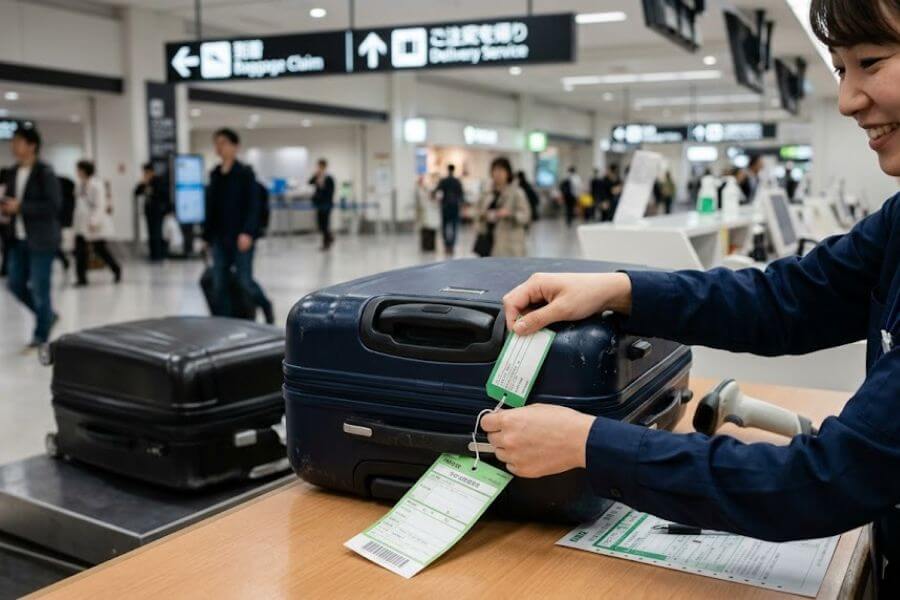
Traveling around Japan is incredible, but navigating its ultra-modern transportation network with bulky bags can quickly drain your energy. Fortunately, Japan has a brilliant solution that feels like a real-life magic trick. It is called hands-free travel. By using luggage delivery services right at the airport, you can wave goodbye to your heavy bags the moment you clear customs and find them waiting safely in your hotel room later that evening. This comprehensive guide will show you exactly how to use this service so you can start exploring Japan completely unburdened from minute one.
Understanding the Magic of Japanese Luggage Delivery
Before you can use this system, it helps to understand what it actually is and why it works so beautifully. In Japan, luggage delivery is a deeply trusted, nationwide network known locally as Takkyubin or Takuhaibin. For decades, local residents have used these services to send everything from golf clubs and skis to daily groceries and business documents across the country.
For international travelers, major delivery companies have set up specialized counters inside every single major Japanese airport. These counters are specifically designed to take your heavy bags straight from the arrival terminal and transport them directly to your hotel, hostel, traditional inn, or even a private apartment rental.
The system operates with near-perfect punctuality and care. Unlike standard cargo shipping in some parts of the world, Japanese luggage delivery treats your belongings with immense respect. Bags are rarely lost, they are handled gently, and they move across the country on strict schedules. It allows you to immediately hop on a high-speed bullet train, grab a bowl of hot ramen, or visit a historic shrine without worrying about where to store your bulky gear.
The Major Service Providers to Look For
When you walk into the arrivals hall of a Japanese airport, you will see a few different company logos. While they all offer a similar high-quality service, knowing their names helps you spot them quickly in a crowded terminal.
- Yamato Transport: This is the most famous delivery company in Japan. You can easily recognize them by their distinct logo, which features a yellow oval with a black cat carrying a little black kitten in its mouth. Because of this logo, people frequently refer to the service simply as the Black Cat company.
- Sagawa Express: Another massive nationwide carrier. Their logo usually features a blue color scheme with a fast-paced delivery worker or a stylized silver galaxy design on their newer trucks. They are incredibly reliable and have a heavy presence at major international hubs.
- JAL ABC: This service is specifically tailored for airport travelers. They work closely with major airlines and operate massive, easy-to-find counters in both the arrival and departure zones of primary airports.
- ANA Cargo / Airport Delivery: Similar to JAL ABC, this service is tied to All Nippon Airways networks and provides seamless airport-to-hotel shipping pipelines for arriving passengers.
How the Timeline Works
A common question for first-time users is how fast the bags actually move. The delivery speed depends mostly on what time your flight lands and where your hotel is located.
If your plane touches down in the morning or early afternoon, most companies can deliver your bags to a hotel in the same general region by the evening of that exact same day. For example, if you land at Tokyo Narita Airport at nine o’clock in the morning, your bags will often arrive at your Tokyo hotel by six or seven o’clock that night.
If you land late in the evening, or if you are sending your bags to a completely different island or a remote mountain village, the delivery will usually take until the following day. Understanding this timeline helps you pack a small, smart daypack with your essentials so you have everything you need for your first night in Japan.
Preparing Before You Leave Home
The secret to a flawless hands-free travel experience begins before you even board your flight. Taking a few simple steps during your packing process will save you a massive amount of time and stress when you arrive at the airport counter in Japan.
Gather Your Hotel Information
The delivery workers need to know exactly where your bags are going. Because Japanese addresses can be formatted differently than Western addresses, you must have the precise details ready.
Before your trip, print out your hotel confirmation voucher or save a clear screenshot on your phone that you can access without an internet connection. Make sure this document includes the full name of the hotel, the complete postal code, the prefecture, the city, and the telephone number. If you are staying at a smaller boutique hotel or a private vacation rental, having the host’s phone number is absolutely vital in case the delivery driver needs help finding the entrance.
Write Your Name Exactly as It Appears on Your Booking
When the delivery company drops your bags off at your accommodation, the hotel front desk staff will check the name on the luggage tag against their guest check-in list. If the names do not match, the hotel might refuse to accept the delivery because they will think it belongs to a stranger.
If your hotel reservation is booked under your legal name, ensure that you write that exact same legal name on the shipping form at the airport. Do not use nicknames, middle initials, or short versions of your name if they do not match your official accommodation booking.
Pack a Dedicated First-Day Backpack
Since there is a high probability that you will be separated from your main suitcases for several hours or even a full day, you need to be strategic about what stays with you. Everyone in your travel group should carry a comfortable backpack or a small carry-on shoulder bag.
Inside this daypack, you should place your passport, your cash and credit cards, your pocket Wi-Fi device or phone charger, any necessary daily medications, a fresh change of clothes, and your basic toiletries. By keeping these essentials on your person, you can comfortably head straight out to see the sights or check into your room even if your large suitcases are still riding in a delivery van across town.
Step-by-Step Guide to Sending Bags from the Airport
Once your flight lands in Japan, you will pass through quarantine, go through passport control, pick up your bags from the luggage carousel, and walk through the customs checkpoint. Once you walk through those final sliding glass doors into the public arrivals hall, the hands-free process officially begins.
Finding the Correct Counter
Every major international airport in Japan has clear, multilingual signs hanging from the ceiling. Look up and scan the signs for icons that look like a suitcase with a little arrow, or text that explicitly says Luggage Delivery, Baggage Delivery, or Cargo Service.
If you land at Tokyo Narita or Tokyo Haneda, these counters are usually located on the far left or far right sides of the main arrivals floor. At Osaka Kansai International Airport, they are similarly positioned near the main exits. If you ever feel confused, simply walk up to any airport information desk and say the words luggage delivery or show them a picture of the Yamato black cat logo. The airport staff will gladly point you in the correct direction.
Approaching the Counter and Measuring Your Bags
When you step up to the counter, the friendly staff member will greet you. They will take your large bags and place them on a scale. They will also take a tape measure to measure the total dimensions of your suitcase.
Japanese delivery companies calculate their prices based on a combination of weight and size. They add together the length, width, and height of your bag in centimeters to determine its size category. Most standard large vacation suitcases fit easily into the maximum size limits, but the staff must check every item individually to calculate the exact cost.
Filling Out the Waybill Way Properly
The staff member will hand you a paper form called a waybill or a denpyo. This form has specific boxes that must be filled out in English or Japanese block letters. Do not panic if you do not speak Japanese; the forms have clear English labels above or below each box, and the counter staff are highly experienced at helping international tourists.
In the destination section, write the hotel name, the complete address, and the hotel phone number. In the sender section, write your own name, your mobile phone number, and your flight number. There is also a small box where you must describe the contents of the bag. You can simply write clothing and personal items.
Finally, you can select a preferred delivery time slot if your hotel has specific check-in hours, though leaving it open usually results in the fastest possible delivery.
+-----------------------------------------------------------------------+
|                       SHIPPING WAYBILL EXAMPLE                        |
+-----------------------------------------------------------------------+
| TO (Destination Accommodation):                                       |
| Postal Code: 100-0005                                                 |
| Address: 1-1 Chiyoda, Chiyoda-ku, Tokyo                               |
| Hotel Name: The Tokyo Grand Hotel                                     |
| Phone Number: 03-XXXX-XXXX                                            |
+-----------------------------------------------------------------------+
| FROM (Your Information):                                              |
| Name: Johnathan Doe                  Flight Number: AA123             |
| Phone Number: +1-555-XXX-XXXX                                         |
+-----------------------------------------------------------------------+
| Contents: Clothing and shoes                                          |
+-----------------------------------------------------------------------+
Making the Payment and Saving Your Receipt
Once the form is complete, the clerk will type the details into their system and give you the final price. You can pay using Japanese yen cash, major international credit cards, or local electronic transit cards like Suica and Pasmo.
After you pay, the clerk will peel off a copy of the waybill and hand it to you. This piece of paper is your official tracking receipt. It contains a unique tracking number that allows you to check the status of your bag online. Keep this receipt in a super safe spot, like your wallet or inside your passport case. You will need to show it to your hotel front desk when you arrive.
Cost and Size Guidelines
To avoid any surprises at the airport counter, it helps to know what to expect regarding sizes, weights, and overall pricing structures. While prices can fluctuate slightly depending on fuel costs and specific company updates, the basic categories remain fairly consistent across Japan.
Understanding Size Categories
Most Japanese delivery providers sort luggage into numeric categories based on the total combined dimensions of the bag. To find your bag’s size, measure the length, add the width, and add the height together.
- Size 120: Combined dimensions are less than 120 centimeters, and the weight is under 15 kilograms. This usually covers small carry-on suitcases or medium duffle bags.
- Size 140: Combined dimensions are less than 140 centimeters, and the weight is under 20 kilograms. This is the sweet spot for standard checked suitcases that most people use for a two-week vacation.
- Size 160: Combined dimensions are less than 160 centimeters, and the weight is under 25 kilograms. This represents the absolute maximum size for standard luggage services. It covers very large, heavy suitcases.
Estimated Pricing Expectations
The cost to send a piece of luggage from an airport to a nearby city hotel is remarkably reasonable, especially when you compare it to the price of taking a taxi or the physical toll of dragging bags yourself.
| Luggage Size | Weight Limit | Estimated Cost Range (Yen) |
| Size 120 (Small/Medium) | Up to 15 kg | 2,000 to 2,500 Yen |
| Size 140 (Standard Large) | Up to 20 kg | 2,500 to 3,000 Yen |
| Size 160 (Extra Large) | Up to 25 kg | 3,000 to 3,800 Yen |
If you are shipping bags across vast distances, such as sending a suitcase from Tokyo Narita Airport all the way down to a hotel in Kyoto, Osaka, or Hiroshima, you can expect to add roughly 500 to 1,000 Yen extra per bag to the base price. Even with that distance premium, it remains an incredible value for the sheer freedom it gives you.
Items That Have Special Rules
If you are traveling with specialized gear, you need to be aware of a few extra rules. Oversized items like golf bag cases, snowboards, skis, and large baby strollers are accepted by almost all airport delivery counters, but they are often categorized under a flat rate oversized fee rather than the standard size grid.
The companies also have strict rules regarding weight limits. If a single suitcase weighs more than 25 kilograms or 30 kilograms depending on the specific carrier, they may ask you to split your items into two separate bags for the safety of their delivery workers.
Arriving at Your Hotel and Picking Up Your Luggage
Once you walk away from the airport counter bag-free, you can enjoy your day to the absolute fullest. You can ride the sleek trains, stop at cool cafes, and take photos without any baggage dragging behind you. When you finally arrive at your hotel in the evening, retrieving your bags is a quick and simple process.
Checking in at the Front Desk
Walk up to the hotel reception desk to begin your normal check-in process. Give the staff member your passport and your reservation details. Once they confirm your room booking, mention that you shipped your luggage directly from the airport earlier that day.
This is the exact moment to pull out that paper waybill receipt you saved at the airport counter. Show the receipt to the hotel staff. The unique tracking number and your name will allow them to instantly identify your bags in their storage room.
Where Your Bags Will Be Waiting
Depending on the specific policy of your hotel, your luggage will usually be in one of two places. At many mid-range and luxury hotels, the staff will have already carried your bags up to your assigned room before you even arrived. You will walk into your room, turn on the lights, and see your suitcases sitting neatly by the closet.
At smaller business hotels, hostels, or traditional ryokans, the staff might keep the delivered bags in a secure holding area behind the front desk. Once you show them your receipt, they will step into the back room, wheel your bags out to you, and hand them over right there in the lobby.
Handling Private Rental Apartments
If you are staying in a private vacation rental apartment where there is no physical front desk or concierge staff on site, using luggage delivery requires a bit more coordination. Delivery drivers cannot simply leave a suitcase sitting outside an apartment door on a busy public street because it is not secure, and they need a physical signature to confirm the delivery.
If you are using an apartment rental, you must coordinate with your host beforehand to see if they can meet the driver, or you must arrange to be physically present inside the apartment during a specific delivery time window to sign for the bags yourself. If that sounds too complicated, you can often arrange to have your bags shipped to a nearby convenience store instead, which acts as a secure pickup point.
Sending Bags Back to the Airport When Your Trip Ends
The hands-free magic works both ways. When your amazing vacation in Japan comes to a close, you do not have to drag those heavy souvenir-filled bags back to the airport on the crowded trains. You can easily ship them from your hotel straight to your departure terminal.
The Critical Advance Booking Window
When you are sending bags to the airport, the delivery companies require a larger safety cushion of time. This is because they must guarantee that your bags arrive well before your flight’s scheduled departure time.
As a strict rule, you must ship your luggage from your hotel at least two full days before your flight leaves. For example, if your flight home departs from Tokyo Haneda on a Thursday afternoon, you must hand your suitcases over to your hotel front desk or a delivery counter no later than Tuesday morning. If you try to ship them on Wednesday, the company will likely decline the shipment because the time window is too tight to guarantee delivery before your plane takes off.
How to Arrange the Return Shipping
Arranging the return trip is just as easy as the first time. Simply walk down to your hotel front desk a couple of days before your departure and tell the staff that you want to send your bags to the airport. The hotel staff will pull out the correct waybill form from their desk drawers.
When filling out the return form, you must explicitly write down the name of your departure airport, the specific terminal number, your airline name, your exact flight number, and the date and time of your departure. This ensures your bag goes to the correct terminal building and is ready for you at the right pickup counter.
Finding the Pickup Counter at the Airport
On the day of your flight, travel to the airport using your daypack. Once you arrive at the correct departure terminal, look at the terminal maps or overhead signs for the Baggage Pickup or Airport Delivery counters. These are usually located on the main departures floor, often very close to the airline check-in desks.
Walk up to the counter, present your paper waybill receipt and your passport, and the clerk will hand over your suitcases. From there, you can immediately walk over to your airline desk, check your bags in for your flight, and head through security completely stress-free.
Frequently Asked Questions
What items are forbidden from being shipped in airport luggage delivery services?
For safety reasons, you cannot ship items that are hazardous, flammable, or extremely fragile. This includes things like loose lithium batteries, power banks, aerosol spray cans, lighter fluid, and fireworks. You should also never place priceless valuables like your laptop, expensive jewelry, cameras, or your physical passports inside your shipped luggage. Keep those high-value electronics and essential documents inside your personal backpack at all times.
Can I use this delivery service if I am staying at a small traditional Japanese inn or ryokan?
Yes, the vast majority of traditional Japanese inns gladly accept luggage deliveries for their incoming guests. Because ryokans pride themselves on incredible hospitality, they are highly familiar with this system. It is always a polite habit to send a quick email to your inn a few days before you arrive just to let them know that a delivery company will be dropping off your suitcases, but they will almost always accept them without any issues.
What happens if my flight gets delayed and my bags arrive at the hotel before I do?
There is absolutely no need to worry if your flight gets delayed or if you change your travel schedule at the last minute. Hotels in Japan understand that travel plans can change. They will securely hold your delivered suitcases in their locked storage rooms for several days if necessary. As long as the name on the shipping waybill matches the name on your room reservation, your bags will sit safely under their care until you finally walk through the front doors to check in.
Is it possible to ship irregularly shaped items like a bicycle, a surfboard, or musical instruments?
Yes, but these unique items fall under special oversized transport rules. Standard airport counters can handle golf bags and snowboards routinely, but exceptionally large items like surfboards or bicycles packed in travel crates might require a specialized cargo service or an advanced booking with a carrier like Yamato. The cost will be higher than a standard suitcase, and the delivery time might take an extra day, so you should research the specific dimensions on the carrier website before your flight.
Can I ship my bags directly from the airport to a local convenience store instead of a hotel?
Yes, this is an incredibly popular option for travelers who are staying in private apartment rentals that do not have a front desk staff. Major delivery companies have partnerships with massive convenience store chains across Japan, such as 7-Eleven, FamilyMart, and Lawson. When filling out your waybill at the airport, you can specify a local convenience store as your pickup location. The store will hold your bag securely behind their counter, and you can pick it up by showing your receipt to the store clerk at any hour of the day or night.