Key Takeaways
Sending packages and luggage out of Japan with the local postal system is a highly reliable way to clear up your hands while traveling or moving. You must prepare all of your shipping information online before you walk up to the counter, as paper handwritten labels are no longer allowed for items containing goods. Your shipping price and speed will depend heavily on whether you choose premium express options, regular airplanes, or deep ocean cargo vessels. To protect your possessions and avoid stressful shipping delays, you must strictly avoid packed hazards like spray cans, lithium batteries, and everyday perfumes.
Getting Started With Japan Post International Shipping
Walking into a local post office in Tokyo, Kyoto, or any cozy Japanese village might feel a little intimidating if you do not speak the local language. However, the distinctive red logo of Japan Post represents your gateway to sending gifts, souvenirs, or heavy suitcases back to your home country. People of all ages use this system every single day to clear out extra weight from their travel bags or send love across the ocean to family members.
Understanding how the system works ensures your belongings cross borders without getting stuck at a sorting facility or a customs checkpoint. When you ship items over oceans and across continents, your box passes through multiple security screenings, airplane or ship cargo holds, and customs warehouses. Japan Post provides a clear framework for this journey, but success depends on how well you prepare your box and fill out your electronic information.
Choosing Your Ideal Shipping Method
Japan Post offers a few distinct ways to send your belongings across the globe, each tailored to different timelines, financial budgets, and weight needs. Choosing the right path involves balancing how quickly you need your items to arrive against how much money you want to spend on the transition.
Express Mail Service
This premium option represents the fastest method available at the post office counter. Airplanes carry these packages with top priority, meaning your box will often reach major global cities in just a few days. This service includes detailed tracking updates and basic insurance coverage automatically, making it perfect for precious souvenirs, important documents, or items you need immediately when you step off your return flight.
Regular Airmail
Standard airmail balances speed and expense by placing your package onto regular commercial flights. It moves slightly slower than the express service because it does not receive absolute priority handling, but it still crosses the world within one to two weeks in most situations. It is a fantastic choice for everyday clothing, books, and typical holiday gifts that do not require emergency speed.
Economy Air
Often referred to as SAL, this hybrid system utilizes empty space on airplanes when it is available. Your package travels through the domestic postal system by ground, boards a flight when cargo space opens up, and resumes ground travel once it lands in your home country. This method strikes a middle ground for your budget, taking around two to three weeks to arrive, though you should verify its current availability for your specific destination before planning your trip.
Surface Mail
If you have massive stacks of heavy books, thick winter blankets, or giant suitcases full of non-perishable goods, ocean surface mail is your best companion. Cargo ships carry these boxes across the seas, which means your items will take anywhere from one to three months to reach their destination. While the wait is long, the financial cost is incredibly low for large, heavy bundles, allowing you to move huge amounts of weight without breaking your piggy bank.
Shipping Methods at a Glance
| Shipping Method | Average Speed | Best Used For | Tracking and Insurance |
| Express Mail Service | 2 to 5 days | High-priority items, valuable gifts, urgent luggage | Full tracking and automatic basic insurance |
| Regular Airmail | 7 to 14 days | Standard holiday gifts, everyday clothing, typical packages | Tracking available as an add-on option |
| Economy Air | 2 to 3 weeks | Moderate budget shipping, non-urgent personal items | Limited tracking depending on destination |
| Surface Mail | 1 to 3 months | Heavy boxes, large suitcases, books, winter gear | Basic tracking included for large parcels |
Preparing and Packing Your Items Safely
The journey across continents can be bumpy, so your packing job must be strong enough to survive drops, stacked boxes, and conveyor belts. If you are shipping a box, try to find a brand-new, double-walled cardboard container. You can purchase sturdy, heavy-duty boxes directly at the Japan Post counter in various sizes, which saves you from hunting through local grocery stores for flimsy trash boxes.
If you are shipping a piece of luggage, like a rolling suitcase or a massive duffel bag, you face unique rules. Japan Post requires you to send suitcases unlocked, or you must leave the physical key securely attached to the handle so customs agents can inspect the contents without destroying your zippers. Because baggage straps and wheels can easily catch on automated sorting machines, wrapping your entire suitcase in a protective layer of thick cardboard or heavy plastic wrap is highly recommended by postal workers.
Inside your package, you must eliminate all empty space to prevent your belongings from rattling around and breaking. Wrap fragile ceramics, delicate toys, or plastic items in multiple layers of bubble wrap or clean packing paper. Fill any remaining gaps with air pillows or crumpled newspapers so that when you press down on the top flaps of your box, it does not cave inward under pressure. Secure all outer seams with high-quality, adhesive cloth packing tape rather than weak paper tape.
Navigating the Strict Rules on Prohibited Goods
International aviation and customs laws are incredibly strict, and failing to follow them can cause your package to be sent back to you or confiscated entirely. Many ordinary household products that seem perfectly safe are classified as dangerous goods when loaded onto international flights. You must inspect every single item before it goes into your box.
Dangerous Electronics and Batteries
Lithium-ion batteries, which power your smartphones, laptops, handheld gaming consoles, and portable power banks, are massive fire hazards in cargo holds. You are absolutely forbidden from shipping loose lithium batteries or external power banks. You can only ship electronic devices containing these batteries if the battery is safely installed inside the device body, the device is completely powered off, and you stay under the maximum limit of two installed batteries per package.
Everyday Cosmetics and Aerosols
Your bathroom vanity holds many items that cannot travel through international mail. Spray cans of any kind, including body deodorants, hairsprays, and shaving creams, are completely banned because pressure changes can cause them to burst. Perfumes and colognes contain high percentages of alcohol, making them flammable liquids that are rejected by aircraft. Similarly, nail polish, alcohol-based sunscreens, and certain hair tonics cannot be shipped overseas.
Food and Flammable Items
Sending snacks is a wonderful way to share your trip, but you must look closely at the ingredient lists. Many countries ban the importation of meat products, and this includes powdered beef or pork broth found inside popular Japanese instant cup noodles and curry blocks. Additionally, matchsticks, lighter fluid, fireworks, and alcoholic beverages with an alcohol content higher than 24 percent are dangerous items that will trigger an immediate rejection at the post office.
Mastering the Online Shipping Tool
You can no longer use old-fashioned pen and paper to write your address labels for international packages containing goods. Global customs agencies now require Electronic Advance Data, which means all your package details must be typed into the Japan Post online system before your package is accepted at the counter.
Setting Up Your Online Account
You need to access the International Mail My Page Service on your smartphone or laptop. Creating a free account takes only a few minutes, requiring your email address, a secure password, and your basic contact information. The mobile version is incredibly convenient because it generates a scannable matrix barcode once you finish entering your data, which you can scan at a special printer kiosk inside the post office branch.
Entering Addresses Accurately
You must type all addresses using Roman letters and standard numbers, even if your local destination uses a different alphabet. Double-check your recipient’s postal code, state or province, street name, and apartment number. It is also vital to include a valid, working telephone number for both yourself and the person receiving the package, as local customs officials will use this number to send text alerts or call if issues arise during transit.
Describing Your Items for Customs
When you fill out the contents section, you must be extremely specific with your descriptions. Writing vague words like “Souvenirs,” “Gifts,” or “Daily Necessities” will cause your package to be flagged and returned. Instead, write clear descriptions such as “100% Cotton T-Shirt,” “Plastic Toy Car,” or “Printed Paper Notebook.” You must also enter the exact quantity of each item, its weight in grams, and its monetary value in Japanese Yen.
Completing the Transaction at the Post Office
Once your box is taped shut and your online shipping label is fully filled out, you are ready to visit your nearest Japan Post branch. Look for the counter with international shipping signs, or look for the friendly workers wearing green or red uniform vests.
Printing the Label and Document Pouch
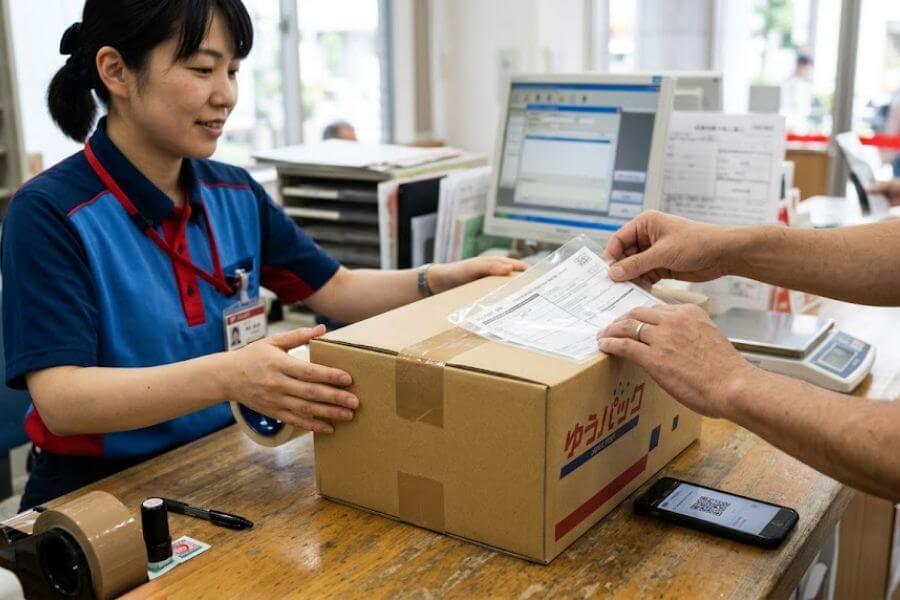
If you used your smartphone to complete the online form, locate the small printer kiosk inside the post office lobby, which is called a Yu-Pris Touch machine. Scan the barcode on your phone screen, and the machine will automatically print your multi-page shipping document. Take these papers to the counter, where the clerk will provide a clear, adhesive plastic pouch. Stick this pouch firmly onto the top of your box and slide the printed sheets inside.
The Weighing and Inspection Process
The postal clerk will place your package onto a digital scale to verify its exact weight and size measurements. They will then carefully read through your printed customs descriptions. Do not be surprised if they ask you direct questions about your contents, such as asking if your electronics contain lithium batteries or if your snacks contain meat. They are doing this to save you from shipping failures, so answer their questions honestly and patiently.
Paying for Shipping and Getting Your Receipt
You can pay for your postage using Japanese Yen cash, major international credit cards, or popular local electronic payment smart cards. Once payment is processed, the clerk will hand you a detailed receipt containing your unique tracking number. Keep this piece of paper in a safe spot, as that code is your only way to monitor your package as it flies or sails across the world toward its destination.
Frequently Asked Questions
What happens if I accidentally include a banned item in my package?
If the Japan Post x-ray machines or security teams discover a prohibited item like a spray can or loose battery inside your box, they will halt the shipment immediately. In most cases, the package will be sent back to your local Japanese address, and you will lose the money you paid for postage. In stricter scenarios involving dangerous goods, security teams might confiscate the item or the entire package without returning it.
Can I ship a standard suitcase without putting it inside a box?
Yes, you can ship an exposed suitcase via Japan Post international services, but you must follow specific rules. The suitcase must remain completely unlocked, or you must secure the physical key to the outside handle so customs officers can look inside if needed. Because conveyor belts can damage straps, wheels, and handles, it is highly smart to wrap the suitcase in protective plastic or heavy cardboard sheets before bringing it to the counter.
How do I track my package once it leaves Japan?
Your official payment receipt features a unique tracking number, which usually consists of a series of letters and numbers. You can enter this code directly into the tracking section of the Japan Post website. Once the package arrives in your home country, you can also copy that identical tracking number into your local domestic post office website for more precise, local delivery updates.
Will the person receiving my package have to pay customs taxes?
It is highly possible, depending on the total monetary value you declared on your digital customs form and the unique import laws of your destination country. Most nations have a specific money threshold for gifts and personal items. If your package value goes over that limit, your recipient will receive a notification from their local customs office requiring them to pay import taxes or duties before the package is dropped off at their doorstep.