Key Takeaways
Before diving into the fine details of Tokyo boardroom dynamics, here is your quick survival checklist for mastering Japanese business etiquette:
- The Business Card Is an Extension of the Person: Treat every business card (meishi) with absolute respect. Never slide it, write on it, fold it, or stuff it into your pocket.
- Hierarchy Dictates the Flow: The highest-ranking person enters first, sits in the seat furthest from the door, and initiates the business card exchange.
- Seating Plans Are Math Problems: The power seat (kamiza) is at the back of the room away from the exit. The lower-status seat (shimoza) is right next to the entrance door.
- The Bow Matters More Than the Handshake: Keep your hands at your sides (men) or clasped in front (women), bend from the waist, and keep your eyes downcast.
- Silence Is Not a Failure: Long pauses in a conversation mean the other party is deeply considering your words, not that they are ignoring you or rejecting your idea.
Imagine walking into a sleek, glass-walled conference room in the heart of Tokyo. Your shoes are polished, your presentation is perfect, and your suit is crisp. You feel ready to conquer the world. Then, the senior executive across the table reaches into a leather case, pulls out a small piece of cardboard with two hands, and bows. Suddenly, you realize you have no idea which hand to use, where to put your own card, or even where you are supposed to sit.
Navigating the world of Japanese corporate culture can feel like walking through an invisible maze. One wrong step might not ruin a deal, but knowing the unwritten rules shows that you respect your hosts. This guide will walk you through the essential rituals of the Japanese business card exchange and corporate meetings, ensuring you blend in like a seasoned local professional.
The Secret Code of Meishi: More Than Just Cardboard
In many Western countries, a business card is a piece of paper you toss onto a desk or shove into your back pocket after a quick glance. In Japan, the business card, or meishi, is treated like an extension of the person’s soul and professional identity. It tells everyone in the room exactly where you fit in the corporate ecosystem. Treating a card poorly is equivalent to disrespecting the person who gave it to you.
When you travel to Japan for work, you must carry a dedicated business card holder. A high-quality leather or metal case shows that you value your own professional identity and the cards you will receive. Dropping your cards loose into a pants pocket or pulling them out of a plastic baggie is a major mistake that signals a lack of professionalism.
To make the best impression, your cards should be dual-sided. One side should feature your information in English, and the alternate side should feature a clean, accurate translation in Japanese. When you hand your card to a local executive, you always present it with the Japanese side facing up, oriented so they can read it immediately without turning it over.
Step-by-Step: The Business Card Dance
The business card exchange is a beautiful, choreographed ritual. It usually happens the exact moment you meet your hosts, before anyone sits down. If you are meeting a large group, the exchange happens in order of rank, starting with the highest-ranking executive and moving down down to the junior employees.
Prepare Your Equipment
Before you even walk into the meeting room, make sure your card case is easily accessible. You do not want to fumble through a messy briefcase or backpack while a row of executives waits patiently. Take out the exact number of cards you will need and place them lightly on top of your open case.
The Approach and the Bow
Hold your card case with both hands at chest level. Hold your own business card between the thumbs and index fingers of both hands, making sure your fingers do not cover the company logo or your name. Step forward, make brief eye contact, and bow slightly at a fifteen-degree angle.
The Verbal Introduction
As you offer your card, state your company name, your department, and your full name clearly. A standard phrase to use is, “Nice to meet you. My name is [Your Name] from [Company Name].” If you want to impress your hosts, you can say the Japanese phrase, Yoroshiku onegaishimasu, which roughly translates to, “Please treat me well” or “I look forward to working with you.”
The Multi-Tasking Handover
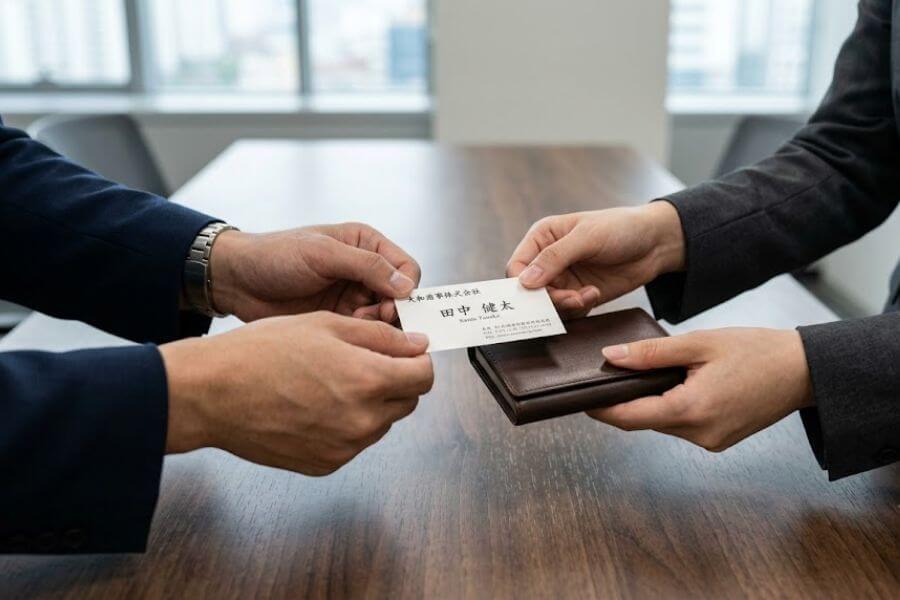
What happens when both you and the Japanese executive are trying to give and receive a card at the exact same time? This is where the dance gets tricky. You should extend your card with your right hand while using your left hand to receive their card on top of your card case. This means your case acts like a tiny, respectful presentation tray.
[Your Card Case]
   └── Left Hand holds the case to receive their card
   └── Right Hand extends your card to their case
The Inspection Period
Once you have received the executive’s card, do not immediately set it down or put it away. Hold it with both hands at chest level and study it carefully for at least five to ten seconds. Read their name, note their title, and confirm their company. If you are unsure how to pronounce their name, this is the perfect time to ask politely. You can point gently to the characters and say, “Could you tell me how to pronounce your name correctly?” Your hosts will appreciate your desire to avoid mistakes.
Where Does the Card Go Next?
Now that the exchange is complete, the ritual continues at the conference table. Never put the cards away into your pocket while you are sitting at the table. Instead, keep them out in front of you for the entire duration of the meeting.
If you are meeting with one person, place their card neatly on top of your leather card holder, which sits on the table to your left. If you are meeting with a whole panel of people, do not stack their cards. Instead, arrange the cards on the table in a horizontal line that mirrors exactly where each person is sitting across from you. This acts like a visual map, helping you remember everyone’s name and title during the conversation.
Meishi Care Rules
| What to Always Do | What to Never Do |
| Use two hands to give and receive | Slide a card across a smooth table surface |
| Keep cards pristine, clean, and unbent | Write notes or phone numbers on a received card |
| Align cards to match the seating arrangement | Use a card to clean under your fingernails or fidget |
| Keep your card case on the table | Stuff a card into your tight back pants pocket |
Room Navigation: Mastering the Seating Chart
In a Japanese office, a meeting room is not just a room with chairs. It is a highly structured space where every square inch is tied to corporate hierarchy. Before you walk inside, you need to understand the concepts of kamiza and shimoza.
Kamiza translates to the upper seat or the power seat. This spot is reserved for the highest-ranking person in the room, or for honored guests. It is always the seat located furthest away from the entrance door, usually positioned near a wall with a nice view, artwork, or the company display. Sitting here protects the high-ranking individual from the noise and distraction of people walking past the doorway.
Shimoza translates to the lower seat. This is the spot reserved for junior employees, service providers, or vendors. It is always located closest to the entrance door. The person sitting here is expected to handle tasks like opening the door, signaling the staff for drinks, and managing incoming materials.
Deciding Where You Sit
As a foreign guest, you will almost always be guided toward the kamiza side of the table as a sign of traditional hospitality. However, you should never simply walk in and plop down in the best chair. Stand next to the chair you think is yours and wait for your hosts to explicitly invite you to sit down. If you are unsure, wait for the senior member of your own team to take their spot first.
The Art of the Japanese Business Bow
While the modern global economy has made handshakes common in Tokyo, the bow remains the ultimate sign of respect, humility, and professionalism. Mastering the basic mechanics of a business bow ensures you start every meeting on the right foot.
The most important rule of bowing is that your movement comes entirely from your hips, not your neck. Keep your spine perfectly straight and your shoulders relaxed. If you bend just your neck or your upper back, the movement looks sloppy and insincere.
Men should keep their arms straight down at their sides with their fingers pressed together against their thighs. Women should clasp their hands gently in front of their bodies, right hand over left hand, resting just below the waist.
Finding the Right Angle
The depth of your bow communicates the level of respect you are showing to the other person. There are three primary types of bows used in the professional world:
Eshaku (The Greeting Bow)
This is a casual fifteen-degree tilt used for morning greetings, walking past colleagues in the hallway, or welcoming someone into an office. It is quick but polite.
Keirei (The Respectful Bow)
This is the standard thirty-degree bow used for business meetings, client interactions, and welcoming guests. This is the angle you will use most often during your trip.
Saikeirei (The Deep Respectful Bow)
This is a dramatic forty-five-degree bow reserved for profound apologies, major favors, or meeting top-tier government officials or legendary corporate leaders. You likely will not need this unless a major mistake occurs.
While bowing, keep your eyes cast downward toward the floor. Looking up at the other person while your body is bent is considered aggressive and confrontational. Hold the lowest position for a full second before rising smoothly at the same speed you went down. If your host offers a handshake alongside a bow, avoid trying to do both at the same exact time to prevent an accidental, awkward bump of heads.
Inside the Meeting: Communication and Silence
Once everyone is seated and the business cards are arranged, the formal meeting begins. Western business culture often prizes aggressive debating, fast talking, and filling every silence with sound. In Japan, communication values harmony, consensus, and careful reflection.
One of the first things you will notice in a Japanese boardroom is the presence of long, heavy silences. In the West, a five-second pause can feel like an eternity, causing people to nervous-talk or change their offer. In Japan, silence is a sign of deep respect. It means the executives are taking your words seriously, evaluating your proposal, and choosing their response with care. If you ask a question and the room goes quiet, do not interrupt. Wait patiently for them to break the silence.
Deciphering the Polite No
Maintaining harmony, or wa, is the foundational pillar of Japanese social interaction. Because of this, Japanese businesspeople will rarely say the word “no” directly to your face. They believe a blunt refusal causes a loss of face and damages the relationship. Instead, they use softer, indirect phrases to signal a negative response. You need to learn to listen to what is unsaid.
If you propose a feature or a price point, and the executive responds with phrases like, “That might be difficult,” “We will consider it,” or “We need to study this further,” they are usually telling you “no.” A sharp intake of breath through the teeth while tilting the head is another clear physical sign of disagreement or hesitation. If you see these signs, do not press harder. Instead, offer to provide more information or suggest looking at alternative options.
Body Language and Eye Contact
In many Western countries, looking someone dead in the eye is a sign of honesty and confidence. In Japan, prolonged, intense eye contact can feel uncomfortable, intense, and confrontational. Instead of staring directly into your counterpart’s eyes, focus your gaze gently on their neck, tie knot, or the space between their eyebrows.
Avoid grand, expressive gestures with your hands. Keep your arms relaxed on the table or in your lap. Pointing at people with an open finger is considered rude. If you need to direct attention to someone or a specific document, use an open hand with your palm facing upward.
Dress for Success: The Corporate Uniform
First impressions in Japan are visual, and the corporate world values conformity over personal flashiness. The goal of business clothing is to show that you respect the organization and blend in seamlessly with the team.
For men, the standard uniform is a dark, well-fitted suit in black, navy blue, or dark gray. White long-sleeve shirts are the standard, paired with a conservative, understated tie. Avoid bright neon colors, wild patterns, or massive, loud jewelry.
For women, a dark trouser suit or a conservative skirt suit is appropriate. Blouses should have modest necklines, and skirts should fall below the knee when sitting down. It is customary to wear flat shoes or low, comfortable heels, especially since you may be doing a significant amount of walking through train stations and corporate campuses.
The Shoe Factor
You must pay special attention to your footwear. In Japan, you will frequently enter areas where you must remove your outdoor shoes. This includes traditional restaurants with tatami mats, certain historic office buildings, and private homes.
Always wear high-quality, clean socks or stockings with absolutely no holes, tears, or stains. Your shoes should be easy to slip on and off quickly. Fumbling with complicated straps or tight laces while a group of executives waits for you at an entryway creates an unnecessary bottleneck.
Dining and Entertainment: After Hours Etiquette
In Japan, the real business often happens after the sun goes down. Evening dinners and drinking sessions, known as nomikai, are essential tools for building personal trust and cementing professional partnerships. These casual settings allow everyone to let their guard down, speak more freely, and build a bond known as nominitation (a blend of the Japanese word for drinking and the English word communication).
While the atmosphere at an evening dinner is relaxed, your manners are still being observed. The rules of hierarchy carry over directly to the restaurant table. The most senior guest will be seated furthest from the entrance, often with their back to a decorative alcove.
Navigating the Chopstick Rules
When eating a traditional meal, your handling of chopsticks is heavily observed. There are several major taboos you must avoid to keep from causing discomfort at the table:
- Tsukitate-bashi (The Incense Stick): Never stick your chopsticks vertically into a bowl of white rice. This resembles the incense sticks used at traditional Japanese funerals and is considered bad luck.
- Hashi-watashi (The Bridge): Do not rest your chopsticks across the top of your bowl like a bridge when you are not using them. Use the ceramic chopstick rest (hashioki) provided at your place setting.
- Neburi-bashi (The Licking): Avoid licking sauces off the ends of your chopsticks or chewing on the wood.
- Hashi-to-hashi (The Bone Passing): Never pass food directly from your chopsticks to another person’s chopsticks. This mimics a funeral ritual involving ancestral bones. If you want to share food, pick it up and place it gently onto their small side plate (torizara).
The Art of Pouring Drinks
During a professional dinner, you should never pour your own alcoholic drink. This is a fundamental rule of Japanese hospitality. Keep an eye on the glasses of your colleagues and hosts. When a glass drops below one third full, pick up the bottle with both hands and refill their drink.
When someone offers to pour a drink for you, pick up your glass with your right hand, support the bottom lightly with your left hand, and hold it out toward them with a slight bow. Take a small sip before setting the glass down on the table.
[Your Glass] ── Held with both hands (Right on side, Left supporting bottom)
   ▲
   └── [Host's Bottle] ── Poured with both hands as a sign of respect
If you do not drink alcohol, you do not need to worry. You can simply state politely that you do not drink, or say osake ga yowai desu (I am weak with alcohol). You can participate fully in the toasts using green tea, water, or non-alcoholic beer. The act of sharing the moment is what matters, not the alcohol content of your glass.
Follow-Up: Locking in the Relationship
The meeting does not end when you walk out the office door. To solidify the connection you just made, you should send a formal follow-up email within twenty-four hours of your interaction. This email serves two distinct purposes: it expresses your gratitude for their time, and it creates a permanent written record of the discussion points and next steps.
Address your email to the primary contact person, but make sure to include the proper titles for everyone who attended. In Japanese business correspondence, names are followed by the honorific suffix -sama, which is the professional version of -san. For example, you would address an email to a Mr. Tanaka as Tanaka-sama.
Keep the tone of your email polite, structured, and clear. Express your appreciation for their hospitality, summarize any agreements or action items, and clearly outline who is responsible for the next deliverables. This shows that your team is organized, reliable, and deeply committed to building a long-term professional relationship.
Frequently Asked Questions
What should I do if I accidentally drop a Japanese business card during an exchange?
Do not panic. Accidents happen, and your hosts understand that you are navigating a foreign culture. Pick up the card immediately with both hands, look at the owner, bow slightly, and apologize sincerely by saying sumimasen (excuse me) or moushiwake gozaimasen (I am deeply sorry). Inspect the card carefully to ensure it did not get dirty or bent, and place it gently on top of your card case. The key is to show immediate care and avoid acting like the incident was minor or funny.
Is it acceptable to use hand sanitizer immediately after a handshake or business card exchange?
You should avoid using hand sanitizer right in front of your hosts immediately after touching their hands or receiving their business card. Doing so can be interpreted as a sign that you find them or their card unclean, which can cause offense. If you want to clean your hands, wait until you have a private moment, such as a quick trip to the restroom, or wait until the formal meeting has concluded and you have left the room.
What do I do if I run out of business cards during a multi-company networking event?
Running out of cards is a difficult situation, but you can handle it smoothly with the right language. Never simply say “I don’t have any left” and walk away. Instead, bow politely and explain that you have unfortunately distributed all your cards for the day. Apologize and offer to write down your contact information on a neat piece of notepad paper, or ask for their card and promise to send your digital contact details via email as soon as you return to your hotel.
How should I handle a situation where a Japanese executive falls asleep during my presentation?
It is surprisingly common for senior executives to close their eyes during long presentations in Japan. In Western cultures, this is seen as a sign of boredom or disrespect. In Japan, however, it is often interpreted differently. It can mean the executive is listening intently to your voice, concentrating deeply on your words without visual distractions, or that they are exhausted from extreme overtime work but trust their junior staff to manage the details. Do not raise your voice, stop speaking, or call them out. Continue your presentation smoothly with the same energy and focus.
Can I accept a business card from a Japanese professional if I do not have a card case yet?
If you are caught without a card case, you can still accept their card, but you must modify your behavior to show respect. Receive the card with both hands, study it carefully, and hold it respectfully during your conversation. When it is time to put it away, place it carefully into an inside jacket pocket near your heart, or inside a clean notebook or planner. Never put it into your pants pocket, as sitting on someone’s business card is considered highly disrespectful. Make it a top priority to purchase a proper card case before your next meeting.