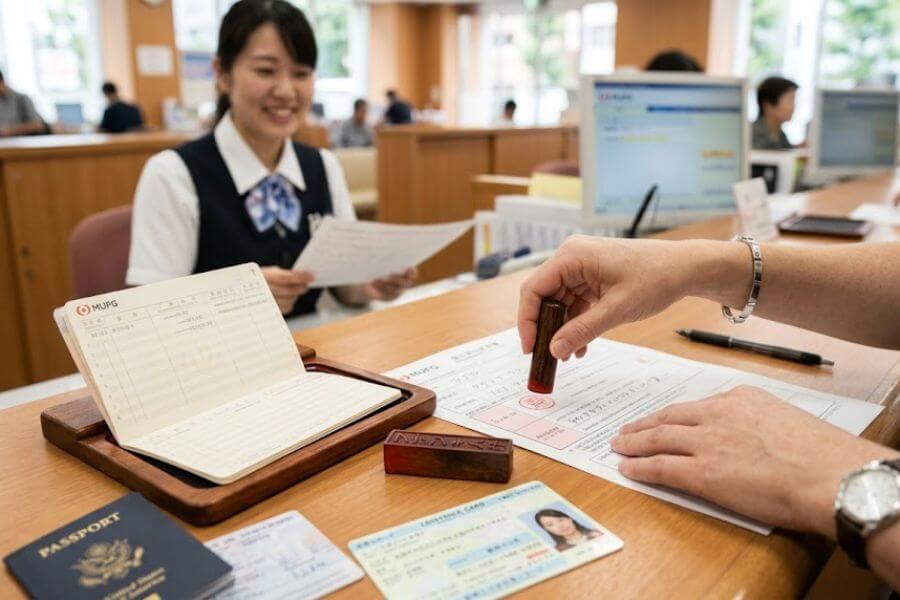
Moving to Japan is a massive adventure. You get to eat authentic ramen every day, explore neon-lit streets, and dive headfirst into a beautiful culture. But before you can comfortably settle into your new life in Tokyo or Osaka, you have to tackle a major real-world task: setting up your finances. Navigating a foreign financial system can feel like trying to read a map upside down, especially when you are balancing the rules of two different countries.
As an American citizen, your path to getting a local debit card and an account number involves a few unique twists due to tax agreements between Washington and Tokyo. This guide breaks down every single detail of the process so you can walk into a local branch with total confidence, avoid common traps, and walk out with your new bank book in hand.
Key Takeaways For Quick Planning
If you are short on time and want to understand the core facts right away, here is the essential roadmap for your financial setup in Japan.
- The Six-Month Rule: Most traditional institutions require you to live in the country for at least half a year before opening a standard account. However, specific expat-friendly options allow you to open one immediately upon arrival.
- The FATCA Factor: Because of American tax laws, you must provide your US Social Security Number (SSN) or Individual Taxpayer Identification Number (ITIN). Japanese institutions are required by law to report this data back to the United States.
- Essential Paperwork: You cannot open an account with just a tourist visa. You absolutely need your physical Residence Card (Zairyu Card) with your current address officially stamped on the back by your local ward office.
- Name Matching is Critical: Your name on your application must match your passport and residence card exactly. Middle names often cause computer system errors, so you must fill out the paperwork precisely as it appears on your legal IDs.
- The Traditional Hanko Stamp: While many modern digital platforms accept a standard signature, traditional local institutions might still request a personalized name stamp (hanko) to verify your paperwork.
The Landscape of Japanese Banking
When you first arrive, the sheer variety of financial institutions can feel overwhelming. Japan relies heavily on cash compared to the United States, although digital payments are growing fast. Understanding the different types of financial institutions will help you choose the right home for your money.
Mega-Banks
These are the massive national institutions with branches and ATMs on almost every corner of the country. The big three are MUFG (Mitsubishi UFJ Financial Group), SMBC (Sumitomo Mitsui Banking Corporation), and Mizuho. They offer robust services, global wire transfers, and high security. The downside for newcomers is that they strictly enforce the six-month residency rule for foreigners and rarely provide English customer service at physical branches.
Trust and Regional Banks
Regional banks serve specific prefectures or areas. Examples include the Bank of Kyoto or Yokohama Bank. They are fantastic if you live in a specific region and want to support local businesses, but their systems are rarely designed for international expats, and English support is almost nonexistent.
Postal Banking (Japan Post Bank)
Known locally as Yucho Ginko, this is the absolute lifesaver for newly arrived expats. Because it doubles as the national postal system, there is a branch in practically every neighborhood, village, and town. Most importantly, they do not enforce the six-month residency rule for basic cash accounts. You can walk in during your first week in Japan and open an account, provided you have a proper visa and a registered address.
Next-Generation Digital Options
In recent years, internet-only options have revolutionized life for foreigners. Institutions like Sony Bank, Rakuten Bank, and SBI Shinsei Bank offer excellent English interfaces, user-friendly smartphone applications, and much lower fees for foreign transfers. Sony Bank, in particular, has an English app designed specifically for foreigners to open accounts right after landing.
| Bank Type | Best For | English Support | Six-Month Rule Enforced? |
| Japan Post Bank | Brand new arrivals, rural residents | Limited but accessible | No (for basic accounts) |
| Digital Platforms (Sony Bank) | Tech-savvy expats, early arrivals | Excellent | No |
| Mega-Banks (MUFG / SMBC) | Long-term residents, corporate paychecks | Very low at standard branches | Yes |
| Regional Banks | Local businesses outside main cities | Virtually none | Yes |
Why US Expats Face Unique Hurdles
Opening an account as an American is slightly different than it is for an expat from Canada, Europe, or Australia. This boils down to a specific piece of American legislation known as FATCA, which stands for the Foreign Account Tax Compliance Act.
The Long Arm of Uncle Sam
The United States is one of the very few nations that taxes its citizens based on citizenship rather than where they live. To catch tax evaders, the US government requires foreign financial institutions around the world to report the financial balances and account activities of American citizens.
Why Some Local Branches Hesitate
Because complying with FATCA requires extra paperwork, specialized computer tracking systems, and strict legal reporting, some smaller regional Japanese financial institutions simply prefer not to deal with the administrative headache. If you walk into a tiny local bank branch, the clerks might look nervous or even turn you away. It is nothing personal; they simply might not be trained on how to process American citizen applications under FATCA rules. Stick to the major national players or digital-first choices to avoid this friction.
The Golden Window: Timing Your Application
Timing is everything when you are trying to establish your financial footprint in a new country. You cannot just walk off the plane and head straight to a branch. You need to follow a specific chronological order to ensure your application gets approved.
Step 1: Landing and Immigration
When you enter Japan on a mid-term or long-term visa (such as a work visa, student visa, or spouse visa), the immigration officer at the airport will print and hand you your physical Residence Card, known as the Zairyu Card. If you enter on a temporary tourist visa, you are legally locked out of opening a local account.
Step 2: The Ward Office Visit
Your residence card will initially say “Address Unregistered” on the back. Within fourteen days of finding a permanent place to live, you must visit your local city hall or ward office (Kuyakusho). They will officially write your new address on the back of your card and seal it with an official stamp. Financial institutions will reject your application instantly if this address is missing or does not match your paperwork.
Step 3: Getting a Local Phone Number
Almost every institution in Japan uses two-factor text verification for security. They also need a valid domestic phone number to call you if there is an issue with your account. You usually need to sign up for a local mobile phone plan before applying for a financial account. Because phone companies also want a bank account to bill you, this can feel like a chicken-and-egg paradox. The easiest way around this is to use an American credit card to pay for your initial Japanese mobile phone plan, then use that new Japanese phone number to open your bank account.
Essential Documents Checklist
Before you head out the door, you must gather your paperwork. Japanese bureaucracy is famous for its precision. Missing a single document or having a tiny smudge on a form can cause your application to be rejected. Put these items into a secure folder before you leave your apartment.
Your Valid US Passport
This serves as your primary photo identification and proves your nationality. Make sure your passport has plenty of time left before it expires, as some institutions get nervous if your passport expires in less than a year.
Your Residence Card (Zairyu Card)
This is your most valuable piece of plastic in Japan. It proves you are a legal resident and shows your approved period of stay. The address on the back must be perfectly legible.
Your US Social Security Number
Do not forget to memorize or bring a copy of your Social Security Number. Because of the FATCA regulations explained earlier, the clerk will type this number into a separate tax compliance screen. If you do not have this number ready, they will stop the application process on the spot.
Proof of Employment or School Enrollment
If you are working in Japan, bring your official employment contract or a document called a Zaishoku Shomeisho (Certificate of Employment) from your company. If you are a student, bring your official Certificate of Enrollment from your university. Institutions want to see exactly why you need an account and where your money is coming from.
Your Japanese Name Stamp (Hanko or Inkan)
Historically, Japan did not use handwritten signatures for legal documents. Instead, everyone used a small wood or stone stamp dipped in red ink. Today, internet-based options and many post offices let foreigners sign with a pen. However, traditional institutions still prefer a stamp. You can buy a cheap custom stamp with your last name written in Japanese characters (Katakana) at a local stamp shop or online for about ten to twenty dollars. It is a wonderful cultural keepsake and makes the process much smoother at traditional branches.
Cash for Your Initial Deposit
Most institutions require you to make a small initial deposit to activate the account. This can be as little as one thousand yen, which is roughly seven to ten US dollars depending on current exchange rates. Bring crisp, clean bills to show respect and ensure the automated deposit machines accept them without a hitch.
The Grand Challenge: The Six-Month Residency Rule
This is the biggest roadblock that trips up unsuspecting expats. Under Japan’s Foreign Exchange and Foreign Trade Act, foreigners who have been in the country for less than six months are generally classified as “non-residents” for financial purposes.
What Happens If You Apply Early at a Mega-Bank?
If you walk into a traditional massive institution during your first month in Japan, they will likely tell you that you are ineligible for a standard account. If your employer absolutely insists that you use a specific mega-bank for your payroll, your company’s human resources department will need to issue a special corporate letter confirming your employment to bypass this rule.
The Restricted Non-Resident Account
Some places might allow you to open a highly restricted account before the six-month mark. With this type of account, you can deposit and withdraw cash at physical ATMs, but you cannot send or receive international wire transfers, you cannot set up automatic utility bill payments, and you cannot use online banking. Once you cross your six-month anniversary, you must return to the branch with your residence card to upgrade your status to a full resident account.
Step-By-Step Guide to Opening an Account Online
If you want to skip the stress of speaking Japanese face-to-face with a bank teller, using a modern digital provider is your absolute best bet. Sony Bank offers a fantastic smartphone app completely in English that allows you to complete the entire application from your couch.
Step 1: Download the Dedicated App
Search for the official English account opening app on your smartphone’s application store. Make sure you are downloading the genuine version provided directly by the institution.
Step 2: Scan Your IDs
The application will ask you to use your smartphone camera to take high-quality pictures of your physical Residence Card and your US Passport. Follow the on-screen prompts to tilt your card at different angles so the app can verify the holographic anti-counterfeiting features on the plastic.
Step 3: Enter Your Personal Details
Type in your full legal name, date of birth, and current Japanese address. Ensure that you enter your name exactly as it is printed on your passport. If your passport says “Michael John Smith,” do not type “Mike Smith.”
Step 4: Complete the Tax Information Screen
Because you are an American citizen, the app will display a specific FATCA declaration screen. You will check a box confirming you are a US tax resident and enter your nine-digit Social Security Number.
Step 5: Submit and Wait for Review
Once you submit the digital form, a human compliance officer will review your documents. This review process usually takes anywhere from three to seven business days. You will receive an email update once your application is formally approved.
Step 6: Receive Your Cash Card by Secure Mail
Your new cash card and debit card combo will arrive at your apartment via a special high-security postal service called Kakutoku Yubin. The postal delivery worker cannot simply leave this package in your mailbox or with a roommate. You must show your physical residence card to the mail carrier at your door to prove your identity before they will hand over the envelope.
Step-By-Step Guide to Opening an Account at a Branch
If you prefer a traditional experience, or if you live in a rural area where Japan Post Bank is your only practical choice, you will need to handle things in person. Walking into a physical branch can be nerve-wracking, but following a clear structure keeps things moving forward nicely.
Step 1: Choose the Right Time to Visit
Japanese branches have unique operating hours. They are typically open Monday through Friday from 9:00 AM until 3:00 PM. They close strictly at 3:00 PM, and they are closed on weekends and national holidays. Aim to arrive around 10:00 AM or 1:30 PM to avoid the heavy morning and lunchtime rushes.
Step 2: Take a Number Ticket
When you walk through the automatic doors, you will see a small ticket-dispensing machine near the entrance. Press the button for “Opening a New Account” (Shinki Koza). Take your numbered paper ticket and sit in the waiting lounge until your number flashes on the digital display board above the teller counter.
Step 3: Present Your Document Folder
When your number is called, walk up to the counter, greet the clerk politely, and hand over your folder of documents. You can say: “Koza wo akeitai desu,” which translates to “I would like to open an account, please.”
Step 4: Fill Out the Application Form
The teller will hand you a detailed paper application form. It will require your name, address, date of birth, and employer details.
- The Katakana Name Section: You will need to write the phonetic pronunciation of your western name using Japanese Katakana characters. If you do not know how to write your name in Katakana, ask your company’s human resources manager or a Japanese friend to write it down for you on a scrap of paper before you head to the bank.
- The PIN Number Setup: You will choose a four-digit personal identification number (PIN) for your ATM card. Avoid obvious combinations like your birth year or repeating numbers, as Japanese financial systems use advanced security algorithms that reject weak passwords.
Step 5: Complete the US Tax Certification Form
The clerk will hand you an additional single-sheet form printed in both English and Japanese. This is the FATCA declaration form. Write your full name, your US home address (or your last permanent US residence), and your Social Security Number clearly in the designated boxes.
Step 6: Ink Your Stamp or Sign the Form
If the bank requires a traditional stamp, the clerk will hand you a small red ink pad. Press your custom hanko firmly into the red paste, then press it straight down onto the form inside the designated circular box. Be very careful not to smudge or twist the stamp, or you will have to fill out a brand new form. If they accept signatures, sign your standard legal signature using a black ink pen.
Step 7: Wait for Processing and Receive Your Materials
The teller will ask you to sit back down in the waiting area while they input your data into the central computer system. This process takes about thirty to forty-five minutes. Once everything is cleared, they will call you back up to the counter and hand you your brand new bank book, known as a Tsucho. Your physical ATM card will be printed and mailed to your residential address a week later.
Decoding Your Japanese Bank Book and ATM Card
When you receive your financial materials, they will look slightly different than the plastic cards you are used to back in the United States. Understanding how to read your new tools is key to avoiding transaction mistakes.
The Bank Book (Tsucho)
Unlike the US financial system, which abandoned paper passbooks decades ago, Japan still loves the traditional bank book. It is a small paper booklet with a magnetic strip on the back. When you slide this booklet into a local ATM, the machine physically prints your latest transactions, deposits, and balances directly onto the paper pages. It is an incredibly satisfying way to track your money, and many landlords or utility companies will ask to see a photocopy of the first page of your bank book to verify your official routing details.
Reading Your Account Coordinates
Your account does not use the standard western International Bank Account Number (IBAN) format. Instead, your financial identity is split into three specific numbers:
- Bank Code (Ginko Kodo): A unique four-digit number assigned to the institution.
- Branch Code (Tenpo Kodo): A three-digit number representing the exact neighborhood branch where you opened your account.
- Account Number (Koza Bango): A seven-digit personal identification number unique to your funds.
- Account Type: Almost all personal expat accounts are classified as Futsu Yokin, which means an ordinary savings or checking account that accrues minimal interest.
Navigating the Japanese ATM System
ATMs in Japan are incredibly advanced, but they operate under a set of cultural guidelines that might surprise a new American expat.
Convenience Store ATMs Are Kings
You do not need to look for a specific bank branch to get cash. Convenience store chains like 7-Eleven, Lawson, and FamilyMart have ATMs that operate twenty-four hours a day, seven days a week. They accept almost all domestic cards and have full English language settings.
The Phenomenon of ATM Service Fees
In the United States, you are usually only charged a fee if you use a competitor’s ATM. In Japan, you can be charged a tiny fee even when using your own bank’s ATM if you make a withdrawal outside of standard business hours. Withdrawing cash late at night, on a Sunday afternoon, or during a major national holiday like Golden Week often incurs a service fee of one hundred to two hundred yen. To save money, plan your cash withdrawals for Friday afternoons before the weekend fees kick in.
Moving Money Across Borders: International Transfers
At some point during your expat journey, you will likely need to send money back home to pay off US student loans, invest in your American retirement accounts, or send cash to family. International wire transfers require careful navigation to avoid massive fees.
The Traditional Swift Transfer Method
You can walk into a major Japanese bank branch and request an international wire transfer to your American financial institution. This requires your US bank’s SWIFT code, routing number, and account details. While this method is highly secure, it is incredibly expensive. You will often face flat sender fees of three thousand to five thousand yen, poor foreign currency exchange rates, and additional receiving fees from your American provider.
Expat-Friendly Digital Transfer Services
To get around these high costs, most smart expats use specialized third-party peer-to-peer transfer apps. These services allow you to link your local Japanese account via a standard domestic transfer, convert your yen to US dollars at the mid-market exchange rate with no hidden markups, and deposit the dollars directly into your American account within a day or two. This path can save you hundreds of dollars a year in unnecessary corporate fees.
Crucial Financial Reporting Rules For US Expats
Earning money and storing wealth abroad triggers serious legal responsibilities back home. Failing to file the correct paperwork with the US government can lead to catastrophic financial penalties, so you must keep immaculate records.
The FBAR Requirement (FinCEN Form 114)
This is the most critical reporting rule for any American living in Japan. If the total combined balance of all your foreign financial accounts (including bank accounts, investment portfolios, and corporate pension schemes) hits or exceeds ten thousand US dollars at any single moment during the calendar year, you must file an FBAR.
This form is submitted electronically directly to the Financial Crimes Enforcement Network, an arm of the US Treasury Department. It is purely an information disclosure form, meaning you do not pay any tax on this money; you are simply letting the government know that the funds exist. The penalty for failing to file this form by mistake can start at ten thousand dollars, so mark your calendar every spring to file it alongside your standard tax returns.
FATCA Form 8938
If your financial footprint grows significantly while living abroad, you might also need to attach Form 8938 to your annual IRS tax return. For single expats living outside the United States, this requirement usually triggers if your total foreign assets are worth more than two hundred thousand dollars on the final day of the tax year, or if they crossed three hundred thousand dollars at any point during that year.
The Foreign Earned Income Exclusion (FEIE)
When it comes to filing your annual US income taxes, you can use special tax tools to avoid paying double taxes on your Japanese salary. The Foreign Earned Income Exclusion allows you to exclude a substantial amount of your foreign earnings from US taxation. Alternatively, you can use the Foreign Tax Credit (FTC) to subtract the income taxes you already paid to the Japanese government from your final US tax liability. Always consult with a certified public accountant who specializes in expat taxation to ensure you maximize your deductions and stay fully compliant.
Frequently Asked Questions About Japanese Bank Accounts
Can I open an account using my middle name if it is on my passport?
You actually must include your middle name if it is printed on your passport and your residence card. Japanese financial systems are extremely rigid about exact identity matches. If your middle name is omitted on the application but appears on your legal plastic ID, the compliance department will flag the file and pause the process. Write your full name exactly as it appears in the machine-readable zone at the bottom of your passport photo page.
What should I do with my local account if I decide to move back to the United States?
If you pack up your things and leave Japan permanently, you are legally required to close your bank accounts before you depart the country. Walk into a physical branch during your final week, present your residence card, and request to close the account (Koza Kaiyaku). They will hand you your remaining balance in cash. If you leave your account open with money inside, the institution may eventually freeze the assets due to mail bouncing back from your old address or your visa expiring, making it incredibly difficult to reclaim your funds from overseas.
Why does my Japanese debit card keep getting rejected when I try to buy things on American websites?
Many domestic Japanese cash cards use a unique local security protocol called 3D Secure that is configured specifically for Japanese online retailers. When you try to use that card on an American shopping platform, the foreign security system often flags the transaction as highly suspicious or incompatible. To shop seamlessly on global websites, look into opening a modern account that provides a card co-branded with major worldwide networks like Visa or Mastercard, which handle international transactions much more smoothly.
Can a family member back home open a Japanese account on my behalf before I arrive?
No, it is completely impossible for anyone else to open a personal account for you. Japanese anti-money laundering laws are incredibly strict and require the individual account holder to physically verify their identity using a current domestic residence card. You must wait until you land in the country, register your address at your local ward office, and complete the digital or in-person application process entirely by yourself.
Is it possible to hold US dollars directly inside my Japanese savings account?
Traditional accounts at places like Japan Post Bank only hold Japanese yen. However, if you choose a modern digital-first option like Sony Bank or SBI Shinsei Bank, you can easily open a multi-currency wallet. This allows you to hold, buy, and sell US dollars alongside your domestic yen balances inside a single smartphone application, which is incredibly useful for timing currency exchange rates or protecting your wealth from market fluctuations.