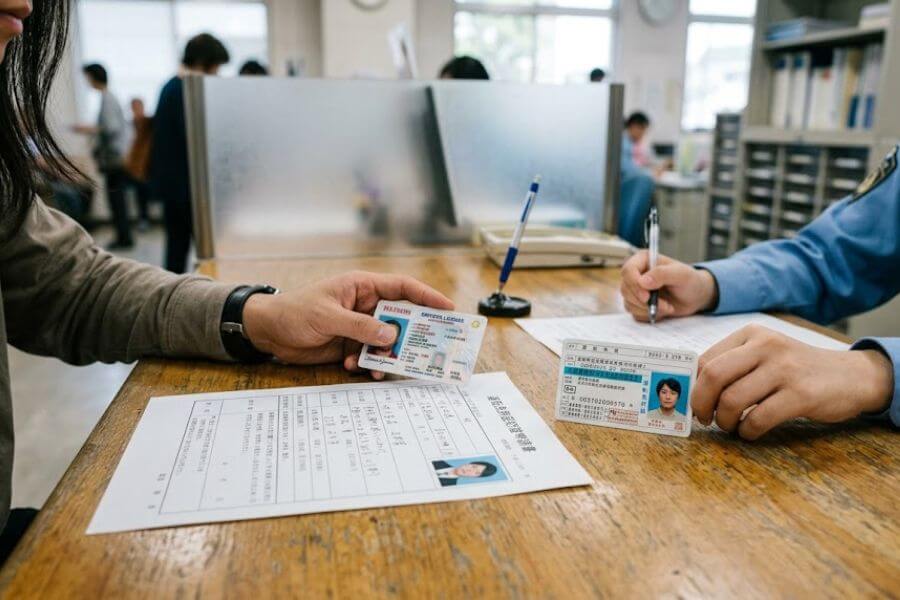
Driving in Japan gives you the ultimate freedom to explore hidden mountain villages, ancient temples, and remote surf spots that trains simply cannot reach. If you already hold a valid US driver license, you have a massive head start. You do not need to start from scratch like a brand new driver. Instead, you can go through a special conversion process known in Japan as Gaimen Kirikae.
This comprehensive guide walks you through every single turn, detour, and checkpoint of the conversion process. We will cover everything from the initial paperwork to the final driving test so you can get behind the wheel and start your Japanese road trip adventure.
Key Takeaways
Before diving into the fine details, let us look at the most critical points you need to remember throughout this process.
- The Three-Month Rule: You must prove that you lived in the United States for at least ninety days after your US license was issued.
- Official Translation Needed: You cannot just translate your license yourself. You must get an official translation from the Japan Automobile Federation or an authorized embassy.
- Two-Part Testing: The process requires a simple eye exam, a short ten-question written rules test, and a practical driving test on a closed course.
- Patience is Mandatory: The entire conversion process usually requires multiple visits to the driver license center. It can take anywhere from a few weeks to a couple of months to complete.
Why You Need a Japanese License
You might wonder why you cannot just use an International Driving Permit forever. An International Driving Permit is a fantastic tool for tourists, but it is only a temporary band-aid.
The One-Year Limit
Japan has very strict laws regarding residency and driving. An International Driving Permit is only valid for up to one year from the date you land in Japan. If you live in Japan for more than a year and continue to drive on an international permit, the police consider it driving without a license. This carries severe penalties, heavy fines, and can even ruin your visa status.
Daily Life Benefits
Having a real Japanese driver license changes everything. It serves as an official, government-issued photo identification card. This means you can leave your passport safely at home when you go about your daily life. It makes opening bank accounts, signing apartment leases, and picking up packages at the post office incredibly smooth. Plus, buying or renting a car in Japan becomes a breeze when you flash a local license.
Step One: Checking Your Eligibility
Before you gather documents or spend any money, you need to make sure you meet the basic requirements set by the Japanese government. Japan is very strict about these rules, and they will check your timeline with a fine-tooth comb.
The Ninety-Day Physical Presence Requirement
This is the rule that catches most people off guard. You must prove that you stayed in the United States for at least ninety days after your current US driver license was issued. The Japanese licensing center needs to see that you actually drove and gained experience in the country that gave you the license.
If you renewed your US license right before moving to Japan, your issue date might look brand new. This makes it look like you have zero days of experience back home. To fix this, you will need to get an official driving history record from your home state DMV to show when you originally got your license.
License Validity
Your US driver license must be completely valid and unexpired when you walk into the Japanese license center. If your license expires while you are living in Japan before you start this process, you cannot convert it. You would have to go through the entire Japanese driving school system, which takes months and costs thousands of dollars. Keep a very close eye on your expiration date.
Minimum Age Requirements
In Japan, the minimum age to drive a standard passenger vehicle is eighteen years old. Even if your home state in the US allowed you to drive alone at sixteen or seventeen, you must wait until your eighteenth birthday to apply for a Japanese license.
Step Two: Gathering Your Required Documents
The Japanese bureaucratic system loves paperwork. If you are missing even one stamp, one photocopy, or one signature, the officers will politely send you home. Dedicate plenty of time to gathering these items.
+-----------------------------------+-----------------------------------+
| Required Document                 | Purpose / Specific Requirement     |
+-----------------------------------+-----------------------------------+
| Valid US Driver License           | Proves your current driving state |
+-----------------------------------+-----------------------------------+
| Official Japanese Translation      | Must be from JAF or US Embassy    |
+-----------------------------------+-----------------------------------+
| Valid Passport(s)                 | Proves identity and 90-day stay   |
+-----------------------------------+-----------------------------------+
| Juminhyo (Residency Certificate)  | Proves your address in Japan      |
+-----------------------------------+-----------------------------------+
| Two Passport-Sized Photos         | Used for your application files   |
+-----------------------------------+-----------------------------------+
Your US Driver License
Bring your actual physical plastic license. Make sure it is clean and readable. If your home state uses digital licenses or mobile apps, note that Japanese license centers do not accept them. They want the physical card.
Passports New and Old
You must bring your current passport. If your current passport was issued recently, you must also bring your old, expired passports. The licensing officers use the entry and exit stamps in your passports to count the exact number of days you spent in the United States after getting your driver license. They will literally count the days on a calendar in front of you.
Juminhyo (Official Certificate of Residence)
You can get this document at your local ward office or city hall in Japan for a small fee. When you request it, make sure to ask for a version that shows your nationality and visa status. It must not include your Individual Number (also known as My Number) unless specifically requested by your local license center. This document must be issued within three months of your application date.
Application Photos
You need two recent photographs that are thirty millimeters wide by thirty-six millimeters high. They must show your face clearly against a plain, solid background with no hats or sunglasses. You can find small photo booths outside almost every train station and supermarket in Japan that print this exact size.
Proof of Your Stay in the United States
If your passport stamps are unclear, messy, or if you used automated airport gates that do not stamp your passport, you need alternative proof. You can use college transcripts, tax returns, utility bills, or old bank statements showing continuous monthly activity in the US for those mandatory ninety days.
Step Three: Getting Your License Translated
You cannot just bring your English license to the counter and expect the officers to read it. You need an official, legally recognized translation into Japanese.
The Japan Automobile Federation (JAF)
The most common and trusted way to get your translation is through JAF. They have offices all over the country, and they also offer an online application service. You submit a high-quality scan or photo of the front and back of your US license and pay a fee of around three thousand yen.
JAF usually processes these translations within a few days, but during busy seasons, it can take a week or more. The final document tells the Japanese government exactly what vehicles you are allowed to drive, what restrictions you have (like wearing glasses), and when your license expires.
Foreign Embassies and Consulates
Some US consulates or embassies in Japan can provide an official letter translating your license details. However, most drivers find the JAF service faster and much more widely accepted at local licensing centers. Stick with JAF if you want to avoid any misunderstandings at the counter.
Step Four: Booking an Appointment at the License Center
Every single prefecture in Japan has at least one Unten Menkyo Center (Driver License Center). This is a massive government building where people take tests, renew licenses, and register vehicles.
Finding Your Local Center
You must go to the specific license center that rules over the prefecture where you live. For example, if you live in Kanagawa Prefecture, you cannot go to a center in Tokyo. Check your prefecture police website to find the designated location that handles foreign license conversions.
The Reservation System
In recent years, many busy prefectures have switched to an advance booking system for foreign license conversions to reduce wait times. You might need to call a dedicated English line or use an online booking portal to secure a morning or afternoon slot. In less populated areas, you might just show up during specific morning hours. Call ahead or check online to avoid a wasted trip.
Step Five: The Application Review Day
When your big day arrives, eat a good breakfast and show up early. The application review process is famously thorough and requires a lot of sitting around in waiting rooms.
Submitting the Paperwork
When you arrive, you will head to the window labeled Gaimen Kirikae. You will hand over your mountain of documents, passports, photos, and translations. The officer will look through everything to verify your identity, check your visa status, and calculate your ninety days of residence in the US.
The Interview
Do not let the word interview scare you. It is usually just a casual conversation at the counter. The officer will ask questions about how you got your original license in America. They might ask things like:
- How old were you when you learned to drive?
- Did you go to a professional driving school or did your parents teach you?
- What kind of car did you practice in?
- What was the weather like on the day of your road test in America?
- Did your US test take place on public roads or a closed parking lot?
They ask these questions to make sure you actually took a real test and understand how cars operate. Answer honestly and calmly. If you do not speak Japanese, it is highly recommended to bring a bilingual friend to help keep things moving smoothly.
Step Six: The Aptitude and Written Tests
Once your paperwork passes the inspection, you will move forward to the testing phase. The first part tests your eyes and your basic knowledge of Japanese road rules.
The Vision Exam
The eye test in Japan uses a unique tool called the Landolt C ring. Instead of reading letters of the alphabet, you look at a circle that has a small gap in it. The circle looks like the letter C. You just tell the examiner where the gap is: top, bottom, left, or right. If you do not speak Japanese, you can simply point your finger in the direction of the opening.
They will also test your color vision to make sure you can easily distinguish between red, yellow, and green traffic lights. If you normally wear glasses or contact lenses to drive, make sure you wear them to the center. Your Japanese license will get a special stamp noting that lenses are required.
The Written Test
The written knowledge test for a foreign conversion is incredibly short. It only consists of ten true or false questions. In most prefectures, you can take this test in English, and some centers even offer languages like Spanish, Chinese, or Portuguese.
To pass, you need to answer at least seven out of ten questions correctly. The questions focus on basic, everyday road safety and common signs. For example, a question might ask if you must stop completely at a solid red flashing light, or if it is okay to drive after drinking a small amount of alcohol (hint: Japan has a strict zero-tolerance policy for drinking and driving).
Step Seven: Mastering the Japanese Driving Course
Now we arrive at the most challenging part of the whole process: the practical driving test, known as the Jitsugi Shiken. Unlike in the US, where you often drive around local neighborhood streets with an examiner, the Japanese conversion test takes place on a highly detailed, miniature simulated road course right at the license center.
Understanding the Course Map
When you pass your written test, the center will hand you a map of the driving course. There are usually two or three different route variations (Route A, Route B, etc.). You will not know which route you are driving until the day of the test.
The course features miniature intersections, traffic lights, pedestrian crossings, blind corners, and obstacles. You are expected to memorize the turns, lane changes, and specific stopping points before you get into the car. Take time to walk the course on foot during lunch breaks if the center allows it.
The Crank and the S-Curve
These are the two famous obstacles that strike fear into the hearts of applicants.
- The Crank: A narrow, zig-zag path with sharp ninety-degree turns lined with tall poles. If your wheels touch the curb or if your bumper hits a pole, you lose major points.
- The S-Curve: A winding, snake-like path that requires precise steering and careful speed control.
The trick to conquering both is to look far ahead through the turns rather than staring down at your front bumper, and to utilize your side mirrors to track your rear tires.
Step Eight: Step-by-Step Driving Etiquette
In Japan, the driving test is less about your actual ability to steer a car and more about your ability to follow a highly choreographed safety routine. The examiners look for perfect etiquette from the moment you approach the vehicle.
1. Check Under the Vehicle: Before entering.
Walk completely around the car. Stop and look under the front and rear bumpers to ensure no children, animals, or objects are hidden underneath. Look at all four tires to check their condition.
2. Enter Safely: Opening the door.
Look both ways down the track to check for oncoming traffic. Open the driver door just wide enough to slip inside quickly, then close it firmly. Lock the door immediately once you are seated.
3. Adjust Your Environment: Cabin setup.
Adjust your seat so you can push the pedals fully down. Adjust your rearview mirror and both side mirrors explicitly, even if they look perfect already. Make a big, visible show of checking them so the examiner notices.
4. Fasten and Confirm: Final checks.
Click your seatbelt into place. Check that the passenger (the examiner) has their belt on too. Make sure the parking brake is engaged and the car gear is securely in Park.
5. Start the Engine: Ignition.
Foot firmly on the brake pedal, turn the key or push the start button. Check the dashboard to ensure no warning lights stay on.
Step Nine: Driving on the Track
Once the car starts, you are officially being graded. You start with a perfect score of one hundred points, and deductions are made for every tiny mistake. You need to finish the course with at least seventy points to pass.
The Art of the Left Turn
Driving in Japan happens on the left side of the road. When you want to turn left, you must perform a very specific routine to prevent scooters or cyclists from squeezing past you on the inside.
Three seconds before your turn, check your rearview mirror, check your left mirror, and look over your left shoulder to check your blind spot. Turn on your left signal. Then, physically move your car closer to the left curb, hugging it tightly as you approach the corner. This blocks the lane so no two-wheeled vehicles can slide up beside you.
Conquering Intersections
When you approach a flashing yellow light or an open intersection, you must slow down and actively scan for danger. Do not just glance with your eyes. Physically turn your head left and right, pointing your chin toward the side windows. Many drivers say the phrase Migi, Hidari, Migi (Right, Left, Right) out loud to show the examiner they are checking every single direction before moving forward.
Handling Obstacles
The course will often have a fake broken-down vehicle or a large construction cone blocking your lane. To pass it, treat it like a lane change. Signal right, check your mirrors and blind spot, move into the opposite lane to pass the obstacle with plenty of clearance, then signal left and return to your original lane once you are clear.
Step Ten: Receiving Your Japanese License
If you hear the magical words “You passed,” congratulations! You have conquered one of the most stressful bureaucratic tasks in Japan. But do not head home just yet; there are a few final steps to complete on your big day.
Paying the Final Fees
You will be directed to a machine or a cashier counter to buy processing stamps. The fees for the application, testing, and license issuance usually add up to around five thousand yen total, depending on your prefecture. Keep your receipts safe.
Setting Your PIN Codes
The modern Japanese driver license contains an embedded computer chip that stores your personal data securely. You will go to a small terminal machine and enter two separate four-digit PIN codes of your choice. These PIN codes protect your private information and are used if you ever need to update your address at a police station in the future.
The Photo and the Wait
You will line up for one final photo session. This photograph is the one that actually goes onto your official license card, so make sure your hair looks exactly how you want it. After the photo is taken, you will wait in a large hall for about an hour while the automated printers generate the cards. When they call your name, you will step up, verify that your name and address are spelled correctly, and walk out into the world as a fully licensed driver in Japan.
Traffic Signs Comparison
Japanese road signs use shapes and colors that might look quite different from what you grew up seeing in the United States. Knowing these at a glance is vital for passing both your written test and your practical driving test.
+-------------------+-------------------+-------------------+
| Sign Meaning      | US Appearance     | Japanese Design   |
+-------------------+-------------------+-------------------+
| Stop Sign         | Red Octagon       | Red Inverted      |
|                   |                   | Triangle          |
+-------------------+-------------------+-------------------+
| No Entry          | White Square with | Red Circle with   |
|                   | Red Circle        | White Horizontal  |
|                   |                   | Bar               |
+-------------------+-------------------+-------------------+
| One Way           | Black Arrow inside| White Arrow on a  |
|                   | White Rectangle   | Blue Rectangle    |
+-------------------+-------------------+-------------------+
| Slow Down         | Yellow Diamond    | Blue Inverted     |
|                   |                   | Triangle          |
+-------------------+-------------------+-------------------+
Crucial Tips for Success
Many foreign drivers fail their first practical driving test simply because they treat it like a casual drive on a Sunday afternoon. To pass on your first or second try, you need to adopt a highly focused, professional mindset.
Dress for Success
Do not show up to the license center wearing flip-flops, sandals, high heels, baggy sweatpants, or hats. The examiners take their jobs very seriously, and your outfit tells them how much you respect the process. Wear comfortable, clean clothes and solid closed-toe shoes like sneakers that allow you to feel the pedals perfectly.
Over-Exaggerate Every Movement
The examiner sits next to you with a clipboard, looking down frequently to take notes. If you just glance at your mirrors using your eyes, the examiner might assume you are not looking at all. You need to make your movements obvious. Move your whole head when checking mirrors, lean forward slightly when scanning intersections, and make sure your safety checks are impossible to miss.
Maintain a Steady Speed
Do not drive too fast, but do not crawl along at a snail pace either. The track usually has a designated straightaway where you are expected to accelerate smoothly up to about forty kilometers per hour to prove you can handle speed. Once you approach the tight corners or the S-curve, slow down using smooth, controlled braking. Consistency shows the examiner that you are in absolute control of the car.
Frequently Asked Questions
Can I drive a manual transmission car with my new Japanese license?
When you convert your US license, the Japanese government looks at how you take your practical test. If you take the test in an automatic car, your new Japanese license will receive an Automatic Only restriction stamp. This means you are legally banned from driving standard manual shift cars. If you want a manual license, you must explicitly request a manual car for your driving test and demonstrate proper clutch control and gear shifting on the course.
What happens if I fail the practical driving test on my first attempt?
Failing the driving test on the first try is completely normal, and you should not feel discouraged at all. Many drivers need two, three, or even more attempts to pass the strict grading system. If you fail, the examiner will give you specific feedback on what mistakes you made. Listen carefully, write down their notes, and then go to the scheduling window to book your next test date. You will have to pay a small re-testing fee each time you return.
Do I have to display a beginner sticker on my car after getting my license?
In Japan, brand new drivers must display a yellow and green leaf-shaped sticker known as a Shoshinsha Mark on their front and rear bumpers for their first year of driving. Because you are converting an existing foreign license rather than starting as a beginner, you generally do not have to use this sticker if you can prove you have more than a year of total driving experience back home. However, if you want extra space and patience from local drivers on the road, buying one at a hundred-yen shop and putting it on your car is a great safety strategy.
Will the Japanese license center confiscate or punch holes in my US license?
No, the Japanese driver license center will not take away your American license, nor will they damage it or punch holes through it. They understand that you still need your US license when you return home to visit family or travel on vacation. They will simply look at it, verify its authenticity, make a photocopy for their internal files, and hand the physical plastic card right back to you safe and sound.
Is there a time limit after moving to Japan to start this conversion process?
There is no official countdown clock that starts the moment you move to Japan to convert your license. You can live in the country for several years on a working visa or student visa and still apply for a conversion down the road, provided your US driver license stays completely valid and unexpired. However, remember that your International Driving Permit expires exactly one year after your arrival date, so you should start the conversion process well before that year ends if you plan to drive continuously.