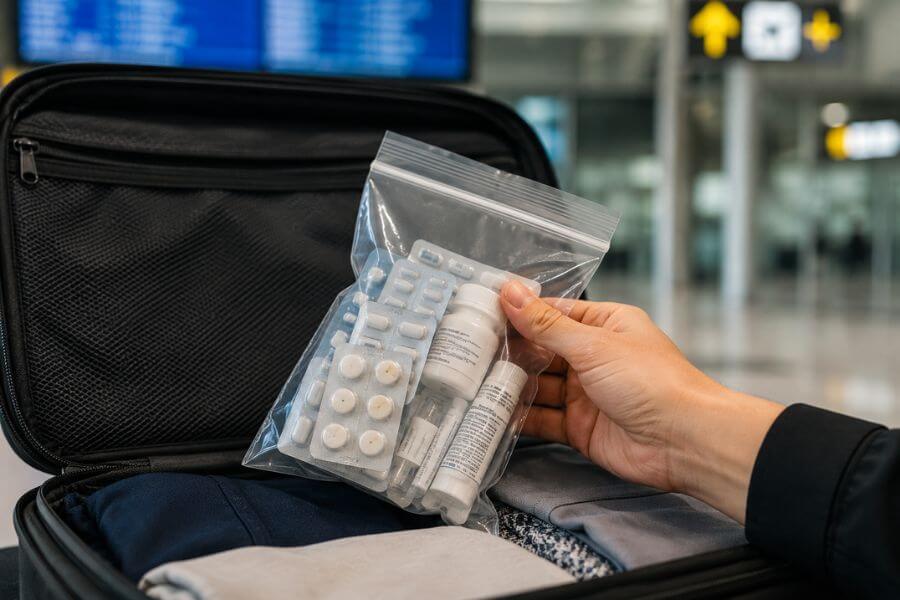
Key Takeaways
- Strict Substance Restrictions: Japan bans certain over-the-counter and prescription medications common in Western nations, including items containing stimulants like pseudoephedrine or specific strong pain relief compounds.
- The One-Month Supply Rule: You can generally bring up to a 30-day supply of standard, legal prescription medication without prior paperwork.
- The Yunyu Kakunin-sho Certificate: If your required personal supply exceeds 30 days, or if you carry specific medical devices like syringes or CPAP machines, you must secure an official import certificate before boarding your flight.
- Digital Application Portal: The process for securing your import certificate is handled through an online system managed by the Ministry of Health, Labour, and Welfare.
- Original Pharmacy Packaging: All tablets, capsules, and liquids must remain in their original pharmacy containers clearly showing your name, the physician’s name, and the exact dosage instructions matching your documentation.
- Declare Upon Entry: You must declare your medications on your customs arrival form and present your physical or digital certificate to border control officers when requested.
Understanding the Landscape of Japanese Medication Laws
Traveling to a new country brings a sense of wonder, but packing your bags requires close attention to local laws. When your destination is Japan, the rules surrounding what you put inside your body are highly specific. The Japanese government maintains a strict stance on pharmaceuticals, medical devices, and over-the-counter products. This framework stems from a cultural and historical commitment to public health safety and the control of potentially habit-forming substances.
As a traveler, assuming that a drug is legal in Japan simply because your local doctor prescribed it can lead to serious complications at the border. The regulatory system does not differentiate between a casual tourist carrying a weekend supply and a commercial importer when it comes to banned substances. If an ingredient violates local statutes, customs officers will enforce the law. Therefore, understanding the system becomes a critical part of your vacation or business trip planning.
The primary body supervising these laws is the Ministry of Health, Labour, and Welfare. They categorize healthcare items into distinct buckets: general prescription pharmaceuticals, narcotics, psychotropics, stimulants, medical equipment, and cosmetics. Each category carries a unique threshold for personal importation. Knowing where your healthcare items fit into these categories allows you to prepare the exact documentation required, ensuring your entry through airport customs remains smooth and without incident.
The Basic Threshold for Bringing Health Items into Japan
For the vast majority of international visitors making short journeys, the rules are straightforward. The Japanese government recognizes that people need their daily treatments while away from home. Because of this, they established a generous baseline allowance for standard, non-controlled prescription items.
If your daily routine involves a standard pill for high blood pressure, cholesterol, or cholesterol management, you can bring up to a 30-day supply without filling out advance paperwork. This rule is designed to accommodate standard vacation lengths without burdening the visitor or the local administration with excess bureaucracy. The crucial factor here is that the substance must not fall under any restricted categories like narcotics or stimulants.
| Item Type | Maximum Quantity Allowed Without Certification | Action Needed If Over Limit |
| Standard Prescription Tablets | 30-day supply | Apply for Yunyu Kakunin-sho |
| Over-the-Counter Products | 2-month supply | Apply for Yunyu Kakunin-sho |
| Vitamins and Supplements | 2-month supply | Apply for Yunyu Kakunin-sho |
| Disposable Contact Lenses | 2-month supply (up to 60 pairs) | Apply for Yunyu Kakunin-sho |
| Self-Injection Kits (Insulin) | 1-month supply | Apply for Yunyu Kakunin-sho |
| Inhalers and Asthmatic Sprays | 30-day supply | Apply for Yunyu Kakunin-sho |
If you plan to stay in Japan for longer than one month, or if your health condition requires you to carry multiple months of supplies at once, the basic allowance is no longer sufficient. At that point, you cross the line from a standard traveler into an importer of health products for personal use. Crossing this line triggers the requirement for an official authorization document, which you must secure well before your departure date.
What is the Yunyu Kakunin-sho Certificate
The phrase Yunyu Kakunin-sho translates directly to “Import Confirmation Certificate.” In the past, seasoned travelers to Japan might have known this document by its old name, the Yakkan Shoumei. While the name updated to reflect modernized administrative systems, the core purpose remains identical. It is an official piece of paper issued by a pharmaceutical inspector representing the regional bureaus of health and welfare in Japan.
This certificate acts as your legal shield at the airport border crossing. It proves to the customs agents that a qualified specialist evaluated your medications, checked your prescriptions, and formally granted you permission to bring those specific substances into the country for your personal treatment. Without this document, if you carry more than a 30-day supply, the excess items will be confiscated at the border, and you could face formal questioning or delays.
The certificate lists your exact name, passport details, arrival date, flight number, and the precise quantities of each drug you are permitted to carry. Because it is highly individualized, you cannot reuse a certificate from a previous trip, nor can you use a certificate issued to a spouse or family member. Every individual traveler requires their own paperwork, detailing their unique medical situation.
The Digital Shift: Applying via the Online Portal
The days of printing out forms, filling them out with a pen, and mailing physical packages across the ocean to Tokyo or Osaka are gone. The Japanese government streamlined the administrative process by launching a dedicated online portal. This digital platform allows international visitors to submit applications, upload supporting medical papers, and track the status of their requests from anywhere across the globe.
Using the portal cuts down on the waiting period and eliminates the costs associated with international postage. You can access the system via a standard web browser on a personal computer. The interface is available in English, making it accessible for global travelers. The system works by having you create a personal user profile, after which you fill out digital data fields and upload scanned copies of your physical documents.
Once a pharmaceutical inspector reviews your digital folder and finds everything in order, they issue the certificate electronically. You will receive an email notification containing a link to download the completed PDF file. You can then print this file out to keep with your passport or save it securely on your mobile phone to present electronically upon your arrival at the terminal.
Preparing Your Digital Account
Before you can submit any documents, you must register a new user account on the official application website. The platform requires a valid email address that you check regularly, as all updates and inquiries regarding your files will go directly to that inbox. Choosing a secure password and setting up your profile with your full name exactly as it appears on your passport prevents matching issues during the review phase.
Uploading Your Travel Details
The system ties your application directly to your specific travel dates and entry point. You will need to enter your exact arrival date, the name of the airport where you will clear customs, and your flight number. The authorities use this data to route your application to the correct regional bureau of health and welfare. For instance, if you land at Narita or Haneda, your file goes to the Kanto-Shinetsu bureau, while landing in Osaka routes it to the Kinki bureau.
Essential Documents for Your Application
To successfully complete the online process, you must gather several supporting papers from your healthcare provider and your travel agency. The inspectors will not approve an application based on your word alone; they require verifiable proof that the medications belong to you and were legally obtained.
A Detailed Physician’s Statement
The most critical document in your folder is a letter or statement from your prescribing doctor. This note must be written on official clinic letterhead and signed by the medical professional. The letter must explicitly state your full name, date of birth, the specific medical diagnosis requiring the treatment, and a full breakdown of the drug regimen. This breakdown must include the commercial name of the drug, the active generic ingredient, the exact strength per tablet, and the daily consumption instructions.
Valid Written Prescriptions
Along with the doctor’s summary letter, you should provide copies of your actual pharmacy prescriptions or the official pharmacy printouts that come attached to your medication bags. These receipts or labels serve as secondary proof that the items were filled by a licensed pharmacy. Ensure that the text on these labels is completely legible, with no blurred ink or torn sections, so the reviewer can match the quantities perfectly.
A Copy of Your Passport Data Page
The inspectors must verify your identity to ensure the certificate matches the traveler. You need to upload a high-quality scan or photo of your passport information page. The picture must be clear, your signature must be visible, and all text strings must be fully readable. If your passport is nearing its expiration date, ensure it remains valid for the entire duration of your planned stay in Japan.
Your Complete Travel Itinerary
You must show proof of your travel path and the length of your stay. A copy of your flight confirmation or an itinerary document from your airline showing your departure from your home country, entry into Japan, and eventual exit date is required. If you are entering the country via a specialized program, such as an international teaching contract or an exchange program, an official itinerary letter from your sponsoring organization must be uploaded as well.
Step-by-Step Guide to the Online Process
Navigating the online system is logical if you tackle the process in order. Rushing through the data entry or skipping fields can result in your file being kicked back for corrections, which extends the processing time.
Step One: Initial Login and Category Selection
Log into your newly created account on the portal. The main dashboard will present you with options based on your reason for importing items. As a visitor, you will select the option for personal use importation. This choice opens the correct forms designed specifically for travelers.
Step Two: Entering Personal and Travel Data
Fill out the digital fields regarding your personal identity and travel route. Type your name exactly as it shows on your passport, avoiding nicknames or middle initials if they are not printed on your official travel identity card. Enter your flight codes and selection for your arrival airport carefully.
Step Three: Cataloging Your Medications
This section requires you to build a digital list of every single item you intend to bring that requires certification. You will add items one by one, typing out the precise brand name, active chemical ingredient, total number of pills or volume of liquid, and the daily dosage.
Step Four: Document Attachment and Upload
Upload your scanned documents into their designated slots. The portal accepts common file formats like JPEG or PDF. Keep file sizes reasonable so they upload without errors, but make sure the text remains crisp and readable when zoomed in.
Step Five: Final Review and Submission
Take a moment to cross-reference every number you typed against your physical medication bottles. The total pill count on your screen must match the amount you are carrying. Once you are confident in the accuracy of the data, click the final submit button to send your file to the regional health bureau.
Understanding Banned Substances and Zero-Tolerance Rules
This is the area where travelers run into the most severe trouble. Japan enforces a zero-tolerance policy for certain chemical compounds that are commonplace in Western households. In many Western nations, you can buy cold remedies or sinus pills over the counter at any corner grocery store. In Japan, some of these exact same products are treated under laws similar to those governing illicit narcotics.
The absolute ban applies heavily to medications containing stimulants or amphetamine derivatives. These laws are unyielding; a valid prescription from a foreign doctor will not override a structural ban on an illegal substance. Trying to bring an outlawed substance into the country can result in immediate seizure, prolonged detention by border police, and potential deportation or criminal charges.
It is your responsibility to check the chemical composition of your health products. Do not rely on the commercial brand name, as manufacturers often change active ingredients based on regional markets. Look closely at the fine print on the back of the box to identify the exact generic compounds before you pack.
Pseudoephedrine and Cold Remedies
Pseudoephedrine is a highly common decongestant found in popular sinus relief pills, allergy tablets, and daytime cold syrups worldwide. Japan restricts this compound due to its potential use in manufacturing illegal stimulants. Any medication containing more than a ten percent concentration of pseudoephedrine is illegal to bring across the border. Many common over-the-counter allergy formulations exceed this limit, making them completely contraband.
Amphetamines and Attention Deficit Medications
If you manage attention deficit hyperactivity disorder with prescription stimulants, you must exercise extreme caution. Compounds like Adderall, which contain amphetamine salts, are completely illegal in Japan. There are no exceptions made for tourists, and you cannot get a certificate to bring them in. Other options, like those containing methylphenidate, require special narcotic authorization rather than the standard import certificate.
Codeine and Strong Pain Relief
Codeine is a narcotic pain reliever frequently mixed into prescription cough syrups or low-strength pain tablets in various countries. Japan bans medications containing codeine above very low concentrations unless you obtain a specific narcotic import license from the Narcotics Control Department. Carrying these items casually in your luggage without dedicated clearing papers will trigger immediate alarms at customs.
The Special Category: Narcotics and Psychotropics
If your medical care requires the use of heavy pain management drugs, strong sedatives, or specific psychiatric treatments, your paperwork path diverges from the standard import certificate. These substances fall under the jurisdiction of the Narcotics Control Department of Japan.
For these medications, the standard portal application is not enough. You must apply for a specific advance permission certificate directly from the narcotics authorities. This process requires a highly specialized application form where your physician must justify the absolute medical necessity of the drug during your stay.
The processing times for narcotic and psychotropic clearances can be longer than standard applications. The authorities inspect these requests with extreme scrutiny. If approved, you receive a specialized license that you must present to custom officials through a dedicated inspection line at your arrival terminal.
How to Handle Medical Devices and Equipment
Health maintenance does not stop at pills and liquids. Many people travel with specialized medical equipment to manage long-term conditions. The Japanese government categorizes many of these devices as medical apparatuses, which means they are subject to their own set of entry rules.
If you carry disposable syringes for a condition like diabetes, or if you use a continuous positive airway pressure machine to manage sleep apnea, you must declare these items. The good news is that you can bring these pieces of equipment with you, but you must include them in your application process to avoid holdups.
| Equipment Type | General Rule | Documentation Requirement |
| CPAP Machine | Allowed for personal sleep apnea treatment | Include in application if carrying extra backup units |
| Insulin Pump | Allowed when attached to the body | Document with doctor’s statement |
| Syringes and Needles | Restricted due to safety laws | Requires certificate detailing exact counts |
| Glucose Monitors | Allowed for personal testing | Keep with original prescription documentation |
| Nebulizers | Allowed for asthma management | Standard documentation of medical need |
When listing devices on your application, you must provide the manufacturer name, the model number, and the exact quantity of accessories, such as backup needles or replacement tubes. Keeping these devices in their dedicated carrying cases along with their user manuals helps customs officers identify them quickly during a physical baggage check.
Timelines and Planning for Success
When planning a trip to Japan, timing is everything. You cannot leave your medication paperwork until the weekend before your flight. The regional health bureaus handle thousands of applications from global travelers weekly, and their review processes follow a methodical schedule.
The optimal window to submit your online application is between four to six weeks prior to your departure date. This gives the inspectors ample time to review your text fields, check your attached files, and contact you via email if they find any missing items or require clarification regarding a specific pill or device.
If you submit your application less than two weeks before your flight, you are taking a major gamble. There is no expedited service available for late submissions, and the system operates strictly on a first-come, first-served basis. If your departure day arrives and your certificate is still marked as pending in the portal, you will have to leave your excess or restricted items behind.
Packing Your Medications Correctly
Once you receive your electronic certificate and your travel day arrives, how you pack your health items matters just as much as having the paperwork itself. Poor packing habits can raise suspicions and lead to lengthy delays during your baggage inspection.
Always place your medications inside your carry-on luggage rather than your checked bags. Checked suitcases can get lost, delayed, or exposed to extreme temperature variations in cargo holds that could compromise the stability of your liquids or pills. Keeping your items in your hand luggage ensures they stay with you at all times and are instantly accessible when you reach the customs desk.
Keep Everything in Original Bottles
Never use generic plastic pill organizers or weekly divider boxes when crossing international borders. All tablets and capsules must remain inside the original bottles or blister packs provided by your dispensing pharmacy. The label on the container must be intact and display your name, the pharmacy details, the exact name of the drug, and the clear schedule instructions. Customs agents need to visually match the text on your bottles to the text printed on your approved certificate.
Matching Quantities Perfectly
The total number of pills inside your carry-on bags should match the numbers stated on your documentation. If your certificate grants you permission to import ninety tablets for a three-month stay, do not pack one hundred tablets “just in case.” Carrying more pills than your certificate authorizes can invalidate the entire document, leading to the confiscation of the excess items and extra scrutiny for the rest of your luggage.
Arriving in Japan: Navigating Customs Control
When your flight lands at a Japanese airport, you will exit the aircraft and proceed through the standard immigration lanes to scan your passport and register your fingerprints. After collecting your checked suitcases from the baggage carousel, you will walk toward the final barrier: Customs Control.
Every traveler entering Japan must fill out a customs declaration form, either via a physical paper card handed out on the airplane or through a digital QR code generated via the official government travel website. This form asks a direct question regarding whether you are bringing restricted items, narcotics, or quantities of goods that exceed standard limits into the country.
You must answer this question honestly. Check the box indicating that you are carrying medications. Attempting to slip through the green lane without declaring your items is an offense. If officers conduct a random check and discover non-declared prescriptions, the consequences are severe, regardless of whether the pills are legal or not.
Approving Officer Inspection
By marking your form correctly, you will be directed to an inspection desk. Walk up to the customs officer with a calm demeanor and present your passport, your completed declaration form, and your printed or digital import certificate.
The Physical Validation
The officer will review your paperwork and ask you to open your carry-on bag to show the medication containers. They will compare the names on the prescription bottles with the line items on your approved certificate. They may count the blister packs or look closely at the milligram designations. As long as your physical items match your certificate text perfectly, the validation process takes only a few minutes, after which the officer will smile, return your papers, and wave you through into the arrivals hall.
What to Do If You Lose Your Medication in Japan
Even with perfect preparation, unexpected situations can happen. If you lose your baggage while traveling, or if you accidentally leave your medication bottle in a hotel room on the other side of the country, you need to know how to navigate the local medical system to get a replacement.
You cannot simply walk into a Japanese pharmacy with a copy of a foreign prescription and expect them to fill it. Japanese pharmacies operate under strict domestic laws and can only dispense drugs based on a script written by a physician licensed within Japan. A foreign piece of paper holds no legal weight for local pharmacists.
To secure a replacement, you must visit a local clinic or hospital in Japan. You will need to see a resident doctor, explain your medical background, and undergo a local evaluation. It is highly beneficial to have a digital photo of your original pharmacy labels or a copy of your doctor’s statement saved on your phone. This allows the Japanese physician to understand your exact treatment protocol and look for an equivalent brand or generic compound approved for use within the domestic Japanese medical market.
Summary Table of Key Procedures
To keep your thoughts organized as you prepare for your journey, review this quick guide outlining your responsibilities based on your specific health requirements.
| Your Situation | Documentation Needed | Where to Apply | When to Take Action |
| Vacation under 30 days with standard pills | None required | Not applicable | No advance action needed |
| Stay over 30 days with standard pills | Yunyu Kakunin-sho | MHLW Online Portal | 4 to 6 weeks before flight |
| Carrying a CPAP machine and standard items | Yunyu Kakunin-sho | MHLW Online Portal | 4 to 6 weeks before flight |
| Carrying self-injection insulin kits | Yunyu Kakunin-sho | MHLW Online Portal | 4 to 6 weeks before flight |
| Carrying heavy prescription pain narcotics | Narcotic Import License | Narcotics Control Department | 6 weeks or more before flight |
| Carrying over-the-counter cold items | None if under 2-month limit | Check ingredient labels | Inspect boxes before packing |
Frequently Asked Questions
Can I bring my birth control pills to Japan for a two-month summer vacation without any paperwork?
No, you cannot bring a two-month supply of birth control pills without paperwork. The basic threshold for all prescription medications allows a maximum of a 30-day supply without prior clearance. Since your trip lasts two months, your supply will exceed this 30-day allowance. You must use the online portal managed by the Ministry of Health, Labour, and Welfare to apply for and secure a Yunyu Kakunin-sho certificate before you travel. Make sure to upload your prescription copy and your travel itinerary to ensure your application gets approved smoothly.
What happens if I bring a banned allergy medication into the country by mistake?
If you bring a banned medication into Japan, even completely by accident, it is treated as a violation of local drug laws. If customs officers find the item during a baggage inspection and you did not declare it, the substance will be confiscated immediately. You could face intensive questioning by airport border police, lengthy delays, fines, or potentially being denied entry into the country. To avoid this, read the ingredient list on all over-the-counter allergy items before you leave home to ensure they do not contain pseudoephedrine concentrations over ten percent.
My daily medication is a vitamin supplement. Do I need an import certificate for a six-week stay?
No, you do not need an import certificate for your vitamins in this specific situation. The Japanese government sets a different personal allowance threshold for non-prescription health goods, vitamins, and dietary supplements. You are permitted to bring up to a two-month supply of these products for personal use without filling out any advance paperwork. Since your stay is six weeks, your supply falls well within the allowed two-month limit. Keep the supplements in their commercial packaging so customs agents can clearly identify them as standard vitamins if your bags are inspected.
Can my doctor in my home country send a digital prescription directly to a pharmacy in Tokyo?
No, foreign doctors cannot send prescriptions to Japanese pharmacies. Japanese pharmacies are bound by national laws that state they can only dispense medications based on orders written by a physician who holds a valid medical license issued by the government of Japan. If you run out of your pills or lose your supply during your travels, you must schedule an appointment at a local Japanese medical clinic or hospital. The doctor there will perform a personal health check and write a new, local prescription that you can take to a neighborhood pharmacy.
Is a CPAP machine considered a restricted device that requires the Yunyu Kakunin-sho form?
Yes, a CPAP machine falls under the classification of specialized medical equipment. While you are fully permitted to bring one into Japan for personal use to treat sleep apnea, you generally need to include it in your paperwork preparation if you are carrying multiple backup pieces or if your stay involves complex medical gear. If you are simply bringing one single machine for personal use during a short holiday, it often clears customs without a formal certificate, but it is highly recommended to carry a signed statement from your physician confirming your diagnosis and your need for the device to avoid any unexpected holdups at the border.
Can I pack my prescription tablets in a daily pill organizer to save space in my hand luggage?
No, you should never pack your prescription tablets in a daily pill organizer when traveling internationally to Japan. Customs officers must be able to verify exactly what every pill is, who it belongs to, and whether it matches your documentation. You must keep all medications inside the original plastic bottles or foil blister packs provided by your pharmacy. The official label must be fully attached and clearly show your full name, the doctor’s name, the drug name, and the specific dosage instructions. Packing items loosely in an unlabelled organizer raises immediate red flags and will likely lead to confiscation.
What should I do if the online portal rejects my doctor’s note for lacking specific details?
If the regional bureau reviews your online application and determines your doctor’s note is missing critical information, they will send a notification to your registered email address explaining what is wrong. You will need to contact your physician’s office immediately to get an updated letter. Ensure the new note includes the specific active generic ingredient, the milligram strength per pill, your precise daily dosage, and a clear statement of your medical diagnosis on official clinic letterhead. Once you receive the corrected file, log back into the portal, delete the old document, upload the new scan, and resubmit your file for review.