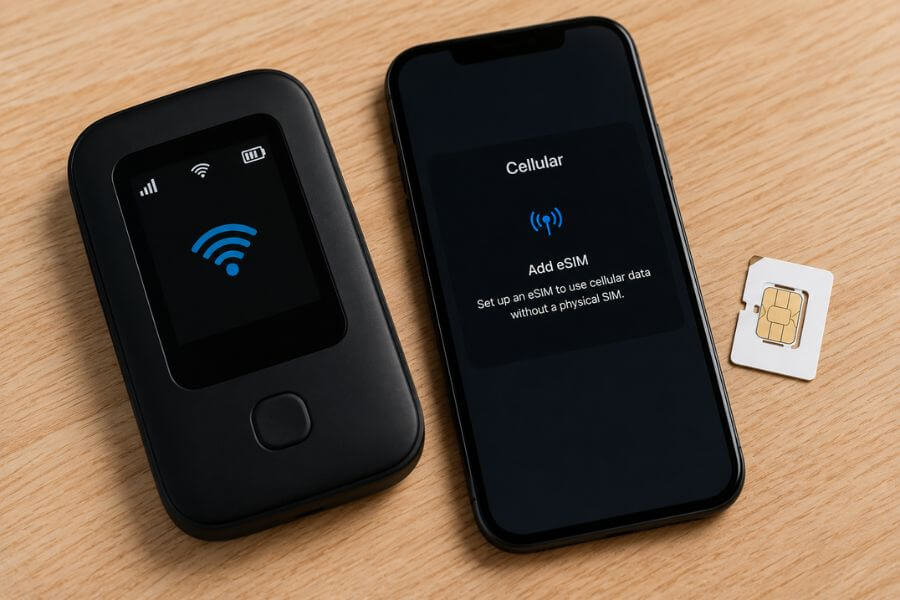
Key Takeaways
- Pocket Wi-Fi is a small router you carry that creates a private network for multiple devices like laptops, tablets, and phones.
- An eSIM is a digital version of a SIM card built directly into your smartphone, requiring no physical hardware.
- Choose a Pocket Wi-Fi if you are traveling in a group or family, as it allows everyone to share one connection.
- Choose an eSIM if you are a solo traveler or a couple, as it is cheaper, lighter, and saves you from carrying extra gear.
- Always ensure your phone is unlocked and supports eSIM technology before purchasing a digital plan.
- Pocket Wi-Fi devices must be picked up and returned, while eSIMs can be set up entirely online from your home.
- Battery life is a major factor; a Pocket Wi-Fi needs charging throughout the day, whereas an eSIM uses your phone’s battery.
Welcome to Your Japan Connectivity Guide
Planning a trip to Japan is thrilling. You are likely dreaming of glowing neon signs in Tokyo, peaceful temples in Kyoto, or the delicious taste of fresh sushi. While you map out your adventures, one question often pops up: how will you stay connected? Navigating Japan requires maps, translation apps, and instant access to information. You have two main paths for your digital needs: a portable router known as Pocket Wi-Fi or a modern digital option called an eSIM. This guide helps you pick the right tool for your specific travel style.
What is Pocket Wi-Fi?
Think of a Pocket Wi-Fi as a tiny, personal internet station that fits in your hand. It is a small device that catches mobile network signals from cell towers in Japan and turns them into a local wireless network. You simply connect your phone, laptop, or tablet to this network using a password, just like you do with your home internet.
When you rent one, you usually pick it up at the airport upon arrival or have it sent to your hotel. It comes with a charger and a bag to carry it in. Because it is a separate piece of gear, it acts as the bridge to the web for every device you bring along. This means you do not need to worry about your phone being compatible with Japanese networks or swapping out any tiny parts inside your phone.
What is an eSIM?
An eSIM is a revolution for travelers. The “e” stands for embedded. Instead of buying a plastic chip to stick into your phone, you download a digital file that tells your phone how to talk to Japanese mobile networks. If you have a modern smartphone, you already have the hardware for this built inside.
You buy your plan online before you leave your home. You receive a QR code or a code to enter into your settings. Once you set it up, your phone treats it like a local SIM card. It is invisible, takes up no space, and stays inside your phone the whole time. You do not have to pick it up or return it, and you can keep your home phone number active if you set your phone up correctly.
Comparing Your Two Main Options
Choosing between these two depends on who you are and what you carry. Here is how they stack up against each other.
| Feature | Pocket Wi-Fi | eSIM |
| Hardware | Requires a rental device | None, it is digital |
| Setup | Needs pickup/return | Done online before you fly |
| Capacity | Connects many devices | Typically one per phone |
| Power | Needs its own battery | Uses your phone battery |
| Portability | An extra item to carry | None, inside your phone |
| Best For | Groups and families | Solo travelers and couples |
Why Choose Pocket Wi-Fi?
The biggest benefit of a Pocket Wi-Fi is sharing. If you are traveling with a group of friends or a family, you do not need to buy a separate data plan for every single person. One device acts as a hub for everyone. If you have a laptop for work or a tablet for kids, they can connect just as quickly as a phone.
It is also great if your phone is a bit older or locked to a specific carrier. Because the Pocket Wi-Fi does the heavy lifting of connecting to the network, your phone only needs standard Wi-Fi capabilities. It is a reliable, predictable way to get online, and most rental companies offer great support if you run into any trouble.
Why Choose an eSIM?
The freedom of an eSIM is hard to beat. You land in Japan, turn off airplane mode, and you are instantly online. There are no lines at an airport counter to pick up a rental, and no stress about returning the device before you fly home. Since it lives inside your phone, you never have to worry about leaving it behind at a cafe or forgetting to charge it.
It is much more cost-effective for solo travelers. You only pay for the data you need for your own device. Plus, it is environmentally friendly because you are not handling plastic cards or extra shipping boxes. If you value a lightweight bag and a quick setup, this is your winner.
Factors to Consider Before You Decide
Before making your choice, look at your travel habits. Are you traveling with children who might need their tablets? If so, the shared connection of a router is very helpful. Do you enjoy long days of hiking or city walking where you want to travel light? The heavy weight of a router might become annoying by the third day.
Check your phone’s status too. Some older phones do not support eSIM technology. You can usually find this in your phone settings under “Cellular” or “Mobile Data.” If you see an option to “Add eSIM,” your device is ready. If not, the Pocket Wi-Fi is your most reliable backup.
Also, think about your battery habits. A router will last about eight to twelve hours, but you must remember to charge it every night. If you forget, you will be without internet the next day. An eSIM relies on your phone battery, which you are already used to managing.
Frequently Asked Questions
Is an eSIM better for battery life?
Yes, generally. Since an eSIM uses your phone’s existing internal antenna, it is often more efficient than maintaining a separate connection through a router. However, using any mobile data will drain your phone battery faster than just using Wi-Fi at a hotel.
Can I share my eSIM data with friends?
Many modern smartphones allow you to create a “Personal Hotspot” using your eSIM data. This lets your friends connect to your phone’s internet. However, this will drain your phone’s battery very quickly and might use up your data allowance faster. It is not as effective as a dedicated Pocket Wi-Fi for groups.
What happens if I lose my Pocket Wi-Fi device?
This is a risk you should keep in mind. Rental companies usually charge a fee for a lost or damaged device. If you are prone to losing things, the eSIM is much safer because it is locked inside your phone.
Can I make phone calls with these options?
Most travel eSIMs are data-only, meaning they do not provide a local Japanese phone number. However, you can use apps like WhatsApp, Line, or FaceTime to make calls over the internet. Pocket Wi-Fi provides the same data-based calling capabilities.
Which is cheaper for a one-week trip?
For one person on a one-week trip, an eSIM is almost always cheaper. Pocket Wi-Fi rentals have a “base” cost for the device rental, which makes them more expensive for single users. The cost-effectiveness of Pocket Wi-Fi only really starts to show when you split that cost across three or more people.