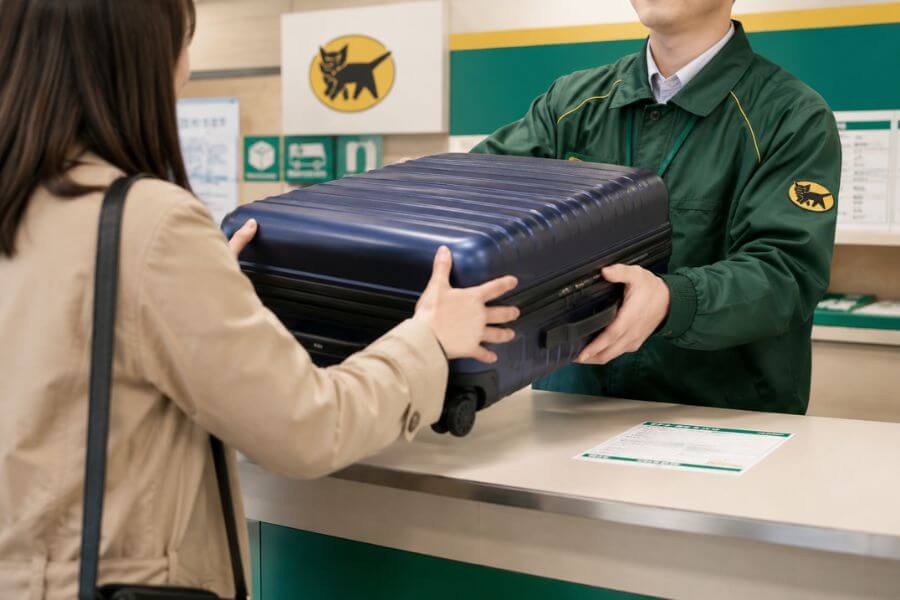
Imagine landing in Tokyo after a long flight. You walk out of the terminal, not with a giant suitcase dragging behind you, but with just a small daypack. You breathe in the city air, grab a coffee, and head straight to a vibrant neighborhood to start exploring immediately. No hotel check-in detour. No wrestling with luggage on crowded commuter trains. This is the reality of traveling across Japan when you utilize the local baggage delivery system, widely known as Takkyubin. This guide will walk you through everything you need to know to move through Japan with freedom and grace.
Key Takeaways
- Takkyubin is a reliable, affordable service that sends your bags from one point to another, usually arriving the next day.
- Most hotels and convenience stores act as shipping agents, making it simple to send your gear anywhere in the country.
- Always pack a smaller bag with your essentials for the night so you are not stuck without clothes if your main bag takes an extra day.
- Fill out your shipping slips clearly, using your destination hotel’s address and your reservation name exactly as it appears on your booking.
- This service is a game-changer for train travel, as many Japanese trains have limited space for large suitcases.
Understanding the Takkyubin System
The word Takkyubin is actually a trademarked name belonging to Yamato Transport, but it has become the generic term locals and travelers use for any door-to-door courier service. Think of it as a personal logistics assistant that handles your heavy lifting. Japan has an incredibly efficient network that allows you to ship everything from fresh seafood and golf clubs to your heavy winter wardrobe.
For a traveler, this means you can send your big suitcase from your hotel in Kyoto to your next stop in Osaka, or even from the airport directly to your hotel. The items are typically transported via small trucks and are handled with immense care. It is a fundamental part of the Japanese travel experience that turns the often stressful task of moving hotels into a seamless process.
Why You Should Use Luggage Forwarding
The primary reason to use this service is the sheer convenience it provides. Japan is a country of walking, stairs, and sometimes very crowded public transportation. Trying to navigate a subway station with a massive suitcase during rush hour is an experience most people prefer to skip. By forwarding your luggage, you free yourself to move around comfortably.
Another significant benefit is time. You no longer have to worry about finding lockers at train stations that are large enough for your bags. Instead of spending your precious vacation time navigating to your hotel to drop off bags, you can go straight from the train station to your first sightseeing activity. It effectively adds hours of exploration time back into your trip.
How to Get Started at Your Hotel
Most hotels in Japan are well-versed in helping guests with this process. If you are staying at a traditional hotel or a large chain, simply approach the front desk. They will have a stack of shipping slips ready for you.
When you fill out the slip, you will need the name of your next hotel, the check-in date, and the phone number of the destination hotel. Ensure you write your name exactly as it appears on the reservation at the destination hotel. This is vital because the hotel needs to match your arriving bag to your existing room booking. Once you fill out the paperwork and pay the fee, the hotel staff will take your bag, tag it, and ensure it is ready for the courier.
Shipping from Convenience Stores
If you are staying in an Airbnb or a smaller guesthouse that does not offer a front desk service, you can easily use a convenience store. Major chains like 7-Eleven, Lawson, and FamilyMart all partner with courier companies to accept parcels.
Simply walk into the store with your suitcase. You can ask for a shipping slip at the counter. Even if you do not speak Japanese, the staff is usually very familiar with the process. You fill out the slip, they measure your bag, you pay the fee, and they give you a copy of the receipt. This receipt contains a tracking number, which allows you to see where your bag is on its journey.
Comparing Your Options
When deciding how to move your belongings, it helps to see how the forwarding service stacks up against other methods of transport.
| Method | Convenience | Cost | Effort Level |
| Takkyubin | High | Affordable | Very Low |
| Station Lockers | Medium | Low | High |
| Taxi | High | Very High | Low |
| Carrying Bags | Low | Free | Extremely High |
As the table shows, Takkyubin offers the best balance of price and ease. While taxis are convenient, they become prohibitively expensive over long distances, and they cannot help you if you are traveling between cities. Station lockers are great for day trips, but they are often full, especially in busy tourist hubs.
The Logistics of Timing
In most cases, your bag will arrive at your next destination by the next day. If you are traveling between major cities like Tokyo, Kyoto, and Osaka, it is almost guaranteed. However, there are exceptions. If you are traveling to a remote island or deep into the mountains, it might take two days.
Always ask the staff at the desk about the expected delivery time. They have access to regional charts and will let you know if your bag will arrive tomorrow or the day after. If you are heading to a remote area, it is wise to plan ahead so you do not arrive before your belongings do.
Packing Your Essentials Bag
Because your main luggage will be traveling on a separate path, you must be strategic about what stays with you. Your “essentials bag” should contain everything you need to survive comfortably for 24 to 48 hours.
Include items like pajamas, a change of clothes, toiletries, your chargers, and any medication. Many travelers prefer to carry a small backpack that holds these items. This ensures that even if there is a minor delay, you are not stranded without your necessities. Think of this as your “emergency carry-on” for your land journey.
Costs and Payment
The cost of shipping is generally very reasonable. Depending on the size of the suitcase and the distance it is traveling, you can expect to pay roughly between 15 and 25 dollars. The weight usually matters less than the total dimensions of the bag, so it is often cheaper to consolidate your items into one large bag rather than several small ones.
Payment is typically handled at the time of drop-off. If you are sending it from a hotel, they might sometimes allow you to pay upon arrival at the destination hotel, but paying upfront is the standard approach at convenience stores. Make sure to have cash or a credit card ready when you go to drop off your bag.
Handling Oversized Items
If you are traveling with large sports equipment like skis, snowboards, or golf clubs, the system can still handle it. These items have specialized shipping categories and covers. You can often purchase a protective cover directly at the convenience store or hotel where you drop off your gear.
For items like these, it is even more important to schedule your shipping a day or two in advance. While regular suitcases are standard, oddly shaped items may take a little extra coordination with the local delivery depot.
Avoiding Common Pitfalls
While the process is very smooth, there are a few things to watch out for. First, never leave anything in your suitcase that you might need before it arrives at your next destination. This sounds simple, but people often accidentally leave their passports or train passes tucked away in their luggage.
Second, ensure that your suitcase is locked properly. While theft is extremely rare in Japan, it is still a good practice to secure your belongings. Third, keep your receipt in a safe place. That piece of paper is your proof of service and contains the tracking information should you need to call the courier company for an update.
Frequently Asked Questions
Will my luggage be safe during transit?
Yes. The Japanese courier system is world-renowned for its reliability and care. Your bags are handled with the same respect as other valuable cargo, and damage or loss is incredibly rare.
Can I ship my bag from one city to another, or only within the same city?
You can ship anywhere within the country. It is perfectly normal to send your bag from a hotel in Tokyo to a hotel in Hiroshima, and the system is designed to handle these long-distance transfers easily.
What happens if my bag does not arrive on time?
Delays are very rare. If it does happen, the courier company usually updates the status of the parcel in their tracking system. Your hotel staff can also call the local depot to get an update on the exact location of your bag.
Can I send bags from the airport to my hotel?
Yes. There are counters in both Narita and Haneda airports specifically for luggage forwarding. This is a popular way to start your trip, as it lets you head straight to a museum or a restaurant without worrying about a bulky suitcase.
Do I need to speak Japanese to use this service?
Not at all. While knowing a few phrases helps, the shipping slips are designed to be filled out with basic information that is easy to understand. Many hotels and convenience stores also have English-speaking staff or visual guides to help you through the process.