Key Takeaways
Before diving into the full breakdown, here are the core facts you need to remember for your Japanese shopping adventure:
- The Magic Number: You must spend at least 5,000 yen (before tax) at a single store or designated shopping mall in a single day to qualify.
- Keep Your Passport Handy: You need your physical passport with the temporary visitor stamp to get the tax exemption. Digital copies or photo IDs will not work.
- Two Different Categories: Goods are split into general items (like clothes and electronics) and consumables (like snacks and cosmetics). They have different rules regarding packaging and when you can use them.
- No Tax at the Register: Most major stores will deduct the 10 percent consumption tax right when you pay, meaning you do not have to wait in long airport lines to get your cash back.
- Do Not Open the Sealed Bags: Consumable items will be placed in a special plastic bag. If you tear it open before leaving Japan, you might have to pay the tax back at the customs desk.
Imagine walking down the neon-lit streets of Tokyo, surrounded by towering walls of tech gadgets, beautiful anime figures, and shelves filled with wild matcha-flavored snacks. Japan is a paradise for shoppers, but things can get pricey quickly. Thankfully, the Japanese government gives international travelers a massive discount through their tax-free shopping program. For visitors from the United States, this means you can save up to 10 percent on almost everything you buy. This comprehensive guide will show you exactly how to navigate the system so you can stretch your dollars and bring home an extra suitcase full of amazing souvenirs.
Understanding the Japanese Consumption Tax
To get the most out of your shopping trip, you first need to understand what you are actually saving. In the United States, sales tax varies by state, city, and even the type of item you buy. In Japan, things are much simpler because the country uses a flat nationwide tax called the consumption tax.
The standard consumption tax rate in Japan is 10 percent. This applies to most items you will buy as a tourist, including clothing, shoes, electronics, watches, and souvenirs. There is a slightly lower rate of 8 percent for food, drinks, and newspapers, but this only applies if you take the food to go. If you sit down at a restaurant or eat inside a convenience store, the rate bumps up to 10 percent.
When you see a price tag in Japan, the law requires stores to show the total price including tax. This means the number you see on the tag is exactly what you pay at the register. However, many stores also display the pre-tax price in smaller numbers underneath or next to the total. When you shop tax-free, that lower pre-tax number is the amount you will actually pay. Saving 10 percent might not sound like a fortune when you buy a single keychain, but if you buy a high-end camera, a designer jacket, or a massive haul of Japanese skincare products, those savings can easily add up to hundreds of dollars.
Who Qualifies for Tax-Free Shopping?
The tax-free shopping system is designed specifically for tourists and short-term visitors. The Japanese government wants to encourage people from other countries to spend money and take unique goods home with them. Because of this, the rules about who can participate are very strict.
The Temporary Visitor Status
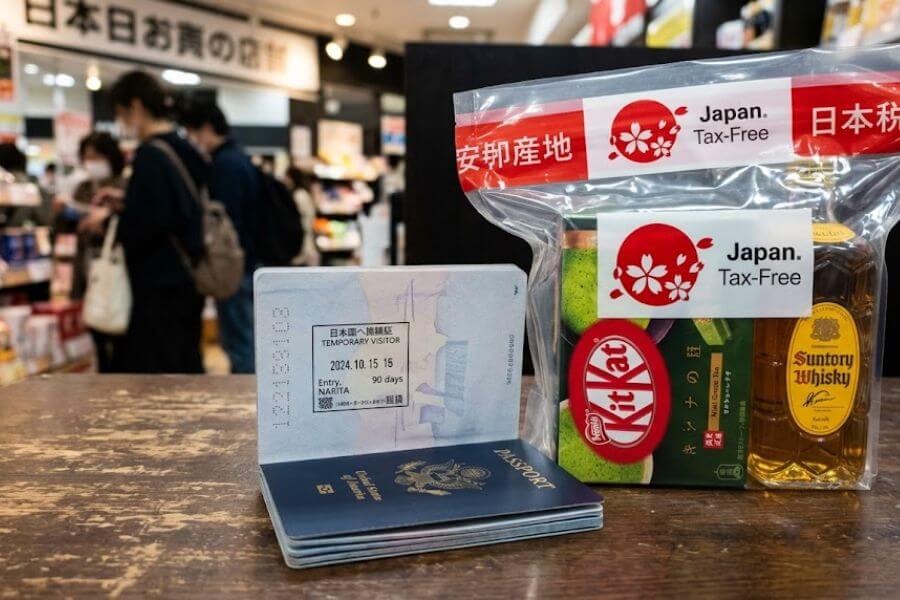
To buy items without paying the consumption tax, you must be a non-resident of Japan. For American tourists, this means you must enter the country under the “Temporary Visitor” visa status. When you pass through immigration at the airport, the officer will place a small square sticker into your passport. This sticker displays the date you entered Japan, the duration of your stay (usually 90 days), and your official status as a temporary visitor.
If you enter Japan on a student visa, a work visa, a military status, or any long-term residency program, you cannot shop tax-free. Even if you are an American citizen, living in Japan for more than six months disqualifies you from the program.
The Crucial Passport Rule
You must carry your physical passport with you while shopping to get the tax exemption. Stores will not accept a photocopy of your passport page, a picture of it on your smartphone, or your US driver’s license. The store clerks must see the original physical passport to scan your data and verify your entry stamp. If you leave your passport in your hotel safety deposit box, you will have to pay the full price including tax, and you cannot come back the next day with your passport to get a refund for a previous purchase.
What Items Can You Buy Tax-Free?
Japan divides consumer goods into two separate categories for tax-free shopping. This is the part of the system that confuses most tourists, so it is important to understand the differences. The two groups are general goods and consumable goods. Each category has its own specific set of rules regarding how you handle them inside the country.
General Goods
General goods are items that are meant to last for a long time and will not disappear or lose value when you use them. Think of these as durable products that you can wear, use, or display.
- Electronics: Smartphones, cameras, laptops, headphones, and hand-held gaming consoles.
- Fashion and Accessories: Clothes, shoes, sneakers, luxury handbags, sunglasses, and jewelry.
- Traditional Crafts: Kimonos, ceramics, chopsticks, kitchen knives, and decorative art.
- Entertainment: Anime figures, manga books, video games, vinyl records, and character plushies.
The major rule for general goods is that you are allowed to use them while you are still inside Japan. If you buy a new jacket or a pair of walking shoes tax-free, you can open the box, put them on, and wear them around Kyoto immediately. The only requirement is that you must take these items out of Japan with you when you leave. They cannot be left behind or given away as gifts to people living in Japan.
Consumable Goods
Consumable goods are products that get used up, eaten, or worn down quickly. These are items that can be depleted while you are on vacation.
- Food and Drinks: Japanese snacks, candies, bags of matcha powder, green tea leaves, and bottles of sake or whiskey.
- Cosmetics and Skincare: Face masks, sunscreens, lotions, lipsticks, and hair products.
- Health Products: Vitamins, over-the-counter medicines, pain-relief patches, and eye drops.
Because these items can be easily consumed, the Japanese government has a strict rule: you cannot use or consume these products while you are still inside Japan. When you buy consumables tax-free, the store clerk will wrap them inside a special heavy-duty plastic bag and seal it with red security tape. This bag must remain completely sealed until you leave the country. If you open the bag to eat a piece of candy or use a facial wipe while in your hotel room, you are technically breaking the law, and you could be forced to pay the tax back when you reach the airport customs counter.
Combining Goods
Can you mix general goods and consumables to reach the spending limit? Yes, but only if the store allows it and handles the entire purchase under the consumable rules. If you buy a t-shirt (general good) and a box of chocolates (consumable) together, the store will package both items together inside the sealed plastic security bag. This means you will not be able to wear the t-shirt until you return home to the United States.
The Minimum and Maximum Spending Limits
You cannot walk into a convenience store, buy a single bottle of soda, and ask for it to be tax-free. The system requires you to spend a minimum amount of money to qualify for the exemption.
The universal rule across Japan is that you must spend a minimum of 5,000 yen (before tax is added) at one specific store on the exact same day. If a price tag shows 5,500 yen including tax, the pre-tax price is 5,000 yen, which means you hit the exact threshold.
Limits for General Goods
For general items, your total purchase must be 5,000 yen or more at a single shop. There is no official upper limit on how much you can spend on general goods. If you want to purchase a high-end designer watch worth 1,000,000 yen, you can buy it completely tax-free, saving yourself a massive 100,000 yen in the process.
Limits for Consumable Goods
For consumables, the rules are slightly tighter. Your total purchase must fall between 5,000 yen and 500,000 yen (before tax) at a single shop on the same day. The government puts a cap on consumables because they want to prevent people from buying commercial quantities of medicine or cosmetics to resell them illegally online.
Summary of Rules and Limits
To keep these details clear, look at this breakdown of how the two item types compare:
| Feature | General Goods | Consumable Goods |
| Examples | Clothes, cameras, shoes, toys | Snacks, makeup, medicine, alcohol |
| Minimum Spend | 5,000 yen (before tax) | 5,000 yen (before tax) |
| Maximum Spend | No upper limit | 500,000 yen per day per store |
| Can Use in Japan? | Yes, you can wear or use them | No, must stay sealed in the bag |
| Packaging | Standard store bags or boxes | Special sealed security bag |
How to Identify Tax-Free Stores
Not every single shop in Japan offers tax-free shopping. Small neighborhood fruit stands, tiny capsule toy shops, and local ramen bars generally do not participate. However, the vast majority of businesses that cater to tourists are fully equipped for the process.
The easiest way to find out if a store participates is to look for the official Japan Tax-Free logo. This logo features a stylized red and white cherry blossom next to the words “Tax-Free.” You will usually see this sticker pasted prominently on the front windows of the store, near the entrance escalators, or directly on the cash registers.
Major Japanese retail chains are almost always tax-free. This includes massive electronic department stores like Yodobashi Camera and Bic Camera, giant discount hauls like Don Quijote, major clothing brands like Uniqlo and GU, and large lifestyle stores like Loft and Hands. Large department stores like Isetan, Takashimaya, and Mitsukoshi also offer tax-free shopping, though they sometimes handle the refunds through a centralized service desk rather than at individual counters.
If you are unsure whether a shop offers the discount, you can ask a staff member. Simply show them your passport and say, “Tax-free?” The employees will instantly understand what you mean and point you toward the correct counter.
The Two Methods of Tax-Free Shopping
Depending on the store you visit, your tax-free transaction will happen in one of two ways. Both methods are straightforward, but knowing what to expect will keep you from feeling overwhelmed at the checkout counter.
Method One: Direct Deduction at the Register
This is the most common and convenient method used by major chains like Don Quijote, Uniqlo, and Bic Camera. In these stores, you do all of your shopping and bring your items to a cash register that is specifically marked with the Tax-Free logo.
The cashier will scan your items, look at your physical passport, scan the barcode on your immigration sticker, and instantly subtract the 10 percent tax from your bill. You only pay the net pre-tax amount. This method is fantastic because you keep your money right away, and you do not have to fill out complex refund forms or carry extra coins around.
Method Two: Centralized Refund Counters
This method is common in large multi-story shopping malls, premium outlet centers, and high-end department stores. When you shop at these locations, you pay the full price including tax at the individual clothing boutique or cosmetics counter. The clerk will hand you your items along with a standard store receipt.
Once you are done shopping for the day, you gather all your receipts and head to the building’s central Tax-Free Service Counter, which is usually located on the basement level or the top floor. The staff at the desk will check your receipts, verify your passport, and hand you your tax refund in cash.
There is an important detail to keep mind with this second method: many department stores charge a small processing fee for this service. This fee is usually around 1.5 to 2 percent of the purchase price. This means instead of getting a full 10 percent back, you might only receive an 8 or 8.5 percent refund. The store automatically deducts this fee from your cash refund, so you do not need to pay anything extra out of pocket.
Step-by-Step Guide to the Checkout Process
To ensure your shopping trip goes smoothly, let us walk through exactly what happens when you step up to a tax-free register in Japan.
Step 1: Find the Right Counter
Look around the store for a cash register displaying the red and white cherry blossom logo. In large stores, there might be a long line dedicated entirely to tax-free customers, while local shoppers use standard registers. Make sure you get in the correct line, as standard registers often cannot process tax exemptions.
Step 2: Present Your Goods and Passport
Place your items on the counter and hand your physical passport to the store clerk. Open your passport to the page containing your temporary visitor sticker so the clerk can find it quickly. If you are traveling with family members, remember that the person whose passport is being scanned must be the one paying for the items. You cannot use your friend’s passport to get a tax break on items you are buying with your own credit card.
Step 3: Digital Processing
The cashier will scan your items and then use a digital scanner to read the QR code on your passport sticker. Since late 2021, Japan has gone completely digital with its tax-free records. In the past, clerks would staple a paper receipt directly into your passport, creating a bulky mess of papers by the end of your trip. Now, everything is sent electronically to the Japanese National Tax Agency database, making the process much cleaner and faster.
Step 4: Sign the Declaration
The clerk may ask you to sign a digital touch screen or a small piece of paper. This signature confirms that you understand the rules of the tax-free system. By signing, you promise that you will take the items out of Japan and that you will not open or consume any sealed consumable goods while inside the country.
Step 5: Final Payment and Packaging
You pay the pre-tax total using cash, a mobile payment app, or a US credit card. If you bought general goods, the clerk will hand them back to you in a regular shopping bag. If you bought consumables, the clerk will carefully arrange them inside the clear security plastic bag, seal the top, and hand it over. Your transaction is now complete.
Packing Your Tax-Free Purchases
Once you return to your hotel room with bags of cool souvenirs, you face a new task: packing everything into your luggage for the long flight back across the Pacific. You must organize your bags carefully to avoid issues at the airport.
Packing General Goods
Since you are allowed to use general goods immediately, you can take them out of their retail boxes and shopping bags. If you bought shoes, you can ditch the bulky cardboard shoeboxes to save space. If you bought clothes, you can fold them up and pack them into your suitcase alongside your regular wardrobe. You can even pack these items into your checked luggage or carry them with you in your carry-on backpack.
Packing Consumables
Consumables require much more caution. You must leave these items inside their sealed security bags. Do not try to compress the bag by poking holes in the plastic to let the air out, as any sign of tampering could invalidate your tax-free status.
If you bought liquid consumables like high-quality sake, Japanese whiskey, soy sauce, or liquid facial toners, you have to navigate the international airline safety rules. The Transportation Security Administration and Japanese airport security do not allow containers with more than 3.4 ounces of liquid in your carry-on luggage. Therefore, these liquid tax-free items must be packed into your checked suitcases. Wrap the sealed plastic bags in thick sweaters or bubble wrap to protect the glass bottles from breaking during transit. Do not worry about airport customs not seeing them; it is perfectly acceptable to check these items in, as long as you declare them digitally if asked.
What Happens at the Airport?
When your vacation comes to an end and you arrive at major Japanese hubs like Tokyo Haneda, Tokyo Narita, or Kansai International Airport, you will pass through a final checkpoint before heading to your departure gate.
Checking in Your Luggage
Go to your airline desk and check your large bags as you normally would. If a ticketing agent asks if you have tax-free items in your suitcase, simply say yes. It is standard practice for tourists to put large, heavy, or liquid tax-free items into their checked baggage. You do not need to show these items to the airline staff.
The Customs Scan Counter
After you pass through the security baggage screening and right before you hit the passport control gates, you will see a dedicated desk marked Customs. This counter features digital passport scanners.
Instead of talking to an officer, you will usually approach an automated terminal. You scan your physical passport face-down on the glass reader. The machine will instantly pull up the digital records of every single tax-free purchase you made during your trip. In most cases, the machine will display a confirmation screen, and you are free to walk away. The entire process takes less than ten seconds.
Random Inspections
While the process is mostly automated, customs officers do perform random spot checks. If you are selected for an inspection, an officer will ask to see your carry-on items or ask you to confirm what is inside your checked bags. They want to make sure you actually have the goods with you and did not leave them behind in Japan.
If you opened a sealed bag of consumables or cannot prove that you have the items with you, the officers have the legal right to charge you the 10 percent consumption tax right there at the airport. You would have to pay it on the spot using cash or a credit card. As long as you followed the rules, kept your bags sealed, and have your purchases accounted for, you have absolutely nothing to worry about.
Smart Tips for Maximizing Your Savings
Now that you know the mechanics of the system, let us look at some clever strategies to make your money go even further while shopping in Japan.
Combine Your Shopping Trips
Because you need to reach the 5,000 yen minimum at each individual shop, it is smart to group your purchases together. Instead of buying one box of snacks at five different convenience stores throughout the week, make one big trip to a massive discount department store like Don Quijote at the end of your trip. By stacking your candy, cosmetics, and souvenirs into a single shopping cart, you can easily blast past the 5,000 yen mark and get the tax deduction on everything all at once.
Look for Credit Card Stack Discounts
Many massive retailers offer extra discounts to foreign tourists who pay with specific credit cards. For example, stores like Bic Camera or Yodobashi Camera frequently run promotions where you get the standard 10 percent tax-free savings plus an additional 3 to 7 percent discount if you pay with a Visa, Mastercard, or American Express card. Look for promotional flyers near the store entrance or check the store’s official English website on your phone before you head to the register. These stackable discounts can bring your total savings close to 15 percent.
Check Exchange Rates and Foreign Transaction Fees
The US dollar has been historically strong against the Japanese yen, making Japan an incredibly affordable destination for American travelers. To maximize this advantage, ensure you use a US credit card that charges zero foreign transaction fees. If your card charges a 3 percent fee on every international purchase, it will eat into a chunk of the 10 percent tax-free savings you worked so hard to get.
Common Mistakes to Avoid
Even experienced travelers can make errors when navigating a foreign tax system. Here are the most frequent blunders American tourists make and how you can avoid them.
Forgetting the Physical Passport
This is the number one mistake tourists make. It is easy to think that carrying a digital photo of your passport on your smartphone is safe enough, but Japanese law strictly forbids stores from using copies. If you go on a shopping spree without your physical passport in your pocket, you will have to pay the full tax amount, with no way to claim it back later.
Damaging the Security Seal Tape
When a store clerk hands you a sealed bag of delicious snacks or high-end face lotions, the temptation to open it up in your hotel room can be intense. Resist the urge. The red or silver security tape used to seal these bags is designed to reveal hidden patterns or text if it is peeled back. If an airport customs official notices that the tape has been ripped or re-sealed, they will assume you used the products in Japan and charge you the full tax rate.
Buying Items for Friends Living in Japan
If you are visiting friends or family members who live and work in Japan, you might think you can use your tourist status to buy them a brand-new laptop or a luxury watch tax-free. Do not do this. The tax-free system relies entirely on the promise that the items are leaving the country with you. If you leave the item behind in Japan and customs asks to see it at the airport, you will be caught in a very uncomfortable situation and hit with a heavy fine.
Frequently Asked Questions
Can I get a tax refund at the airport if I forgot to do it at the store?
No, you cannot. Japan does not have a centralized airport refund system like some European countries do. All tax-free processing must happen at the point of sale inside the store on the exact same day you buy the items. Once you leave the shop and pay the full tax amount, that transaction is finalized, and airport customs cannot give you your money back.
Do children qualify for tax-free shopping in Japan?
Yes, children of any age qualify for tax-free shopping, provided they have their own physical passport containing the valid temporary visitor sticker. However, the payment method used must match the person presenting the passport. If you are using your child’s passport to get a tax break, you should technically be paying with cash or a card that belongs to them, though many stores are flexible if a parent is paying for a minor child’s toys or clothes.
Can I eat the food items I bought tax-free if I get hungry during my trip?
No, you cannot eat any food or drink items that were purchased under the tax-free system while you are still inside Japan. These items are classified as consumables and will be sealed inside a secure plastic bag. If you want to enjoy some Japanese snacks or drinks during your vacation, you must buy them normally at a convenience store or supermarket and pay the standard consumption tax on them.
What happens if I lose my passport after making tax-free purchases?
If you lose your passport, your top priority should be contacting the US Embassy or Consulate in Japan to get an emergency replacement passport. However, because your original temporary visitor sticker and its unique QR code will be gone, your digital link to your previous tax-free purchases will be broken. When you exit Japan with a replacement passport, explain the situation honestly to the customs officials at the airport.
Are hotel stays, train tickets, and restaurant meals tax-free for tourists?
No, services are never tax-free. The tax-free shopping program only applies to physical goods that you pack up and take out of the country. Money spent on hotel rooms, bullet train tickets, theme park admissions, and restaurant meals represents things that are experienced and consumed entirely within Japan. Therefore, you must always pay the standard 10 percent consumption tax on these expenses, and there is no way to get a refund for them.