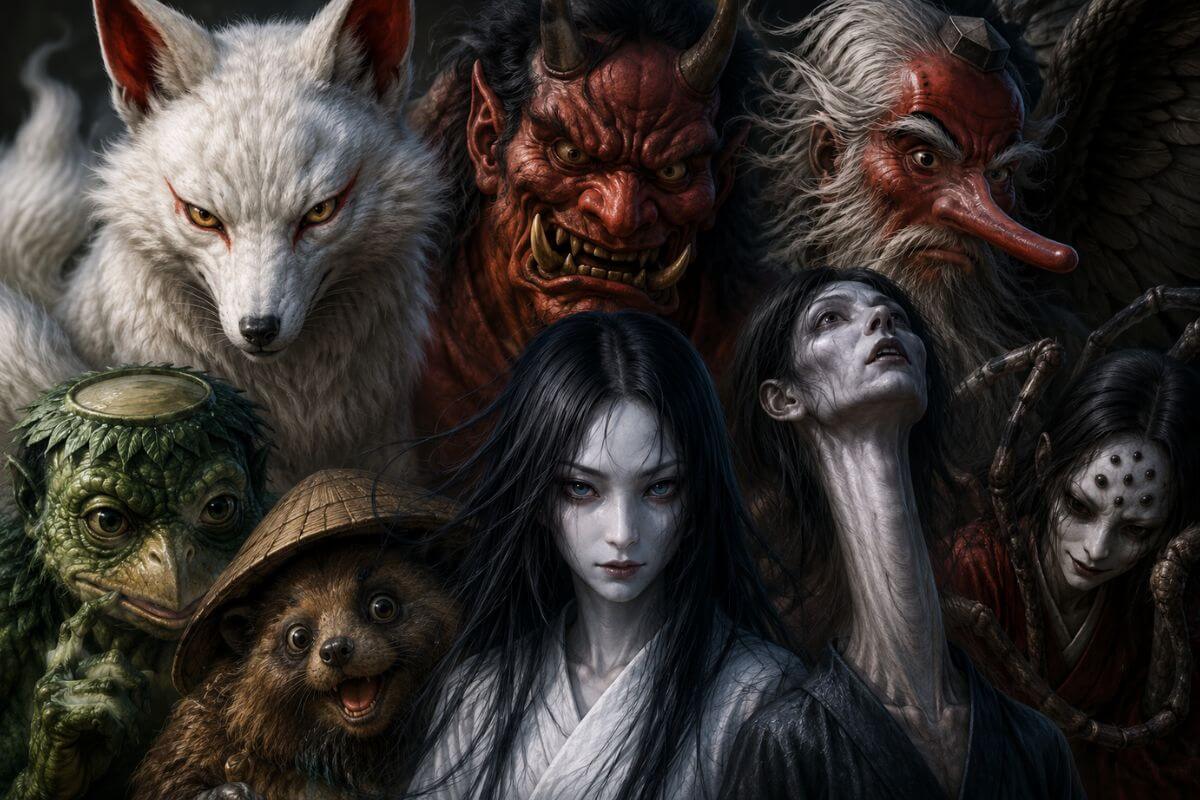
Japan’s world of yokai is filled with strange spirits, shape shifting creatures, cursed beings, and mysterious monsters that have been part of local legends for hundreds of years. These stories were once used to explain things people could not understand, like sudden storms, strange sounds in the forest, missing travelers, or even bad luck inside the home.
As you explore Japanese folklore, you quickly notice that yokai are not always evil. Some are playful tricksters, some protect nature, and others punish people who behave badly. Their stories have survived through books, theater, paintings, anime, movies, and modern games, making them an important part of Japanese culture even today.
In this guide, you will discover the fascinating stories behind Japan’s most famous yokai and learn why these supernatural beings still capture people’s imaginations around the world.
Quick Summary Table 🗾
| Rank | Yokai | Type | Famous For | Main Theme |
|---|---|---|---|---|
| 1 | Kitsune | Fox Spirit | Shape shifting and magic | Intelligence and trickery |
| 2 | Oni | Demon | Giant horned monsters | Punishment and fear |
| 3 | Tengu | Mountain Spirit | Martial arts masters | Pride and discipline |
| 4 | Kappa | River Creature | Dangerous water spirit | Respect for nature |
| 5 | Yuki Onna | Snow Woman | Beautiful winter ghost | Love and death |
| 6 | Tanuki | Raccoon Dog Spirit | Mischief and transformation | Humor and luck |
| 7 | Rokurokubi | Long Neck Woman | Human by day, monster by night | Hidden secrets |
| 8 | Nurarihyon | Mysterious Old Spirit | Sneaking into homes | Deception |
| 9 | Jorogumo | Spider Woman | Seducing travelers | Temptation and danger |
| 10 | Gashadokuro | Giant Skeleton Spirit | Massive night monster | Revenge and suffering |
How We Ranked These Yokai 🏮
We used several important factors to rank these famous Japanese spirits and demons:
- Popularity in Japanese folklore and modern culture
- Historical importance in old legends and stories
- Unique appearance and supernatural powers
- Influence on anime, movies, games, and books
- Cultural meaning and symbolism
- How memorable and terrifying the story is
- Connection to real places and traditions in Japan
1. Kitsune 🦊
Kitsune are magical fox spirits that are among the most famous yokai in all of Japan. In Japanese folklore, foxes are believed to grow stronger and wiser as they age. Some legends say a kitsune gains a new tail every hundred years, eventually reaching nine tails and becoming incredibly powerful.
The most fascinating part of kitsune stories is their ability to shape shift into humans. Many tales describe beautiful women who secretly turn out to be fox spirits. Sometimes the kitsune falls in love with a human, while other times it tricks people for fun or revenge.
You will often notice that kitsune are connected to the Shinto god Inari, the deity of rice, prosperity, and agriculture. Because of this, fox statues stand outside many shrines across Japan.
One famous story tells of a man who unknowingly married a kitsune disguised as a woman. She lived happily with him for years until one night the family dog frightened her, causing her fox form to appear. Even after being discovered, she continued returning to visit her husband and child.
Kitsune stories became so popular because they mix romance, mystery, intelligence, and supernatural fear into one unforgettable creature.
2. Oni 👹
Oni are giant demon-like creatures with horns, sharp teeth, wild hair, and massive clubs. They are often shown with red or blue skin and are considered some of the most terrifying beings in Japanese folklore.
In older stories, oni lived in mountains, caves, or hell itself. They attacked villages, kidnapped people, and punished the wicked. Parents even used oni stories to scare children into behaving properly.
One of the best-known legends involves the hero Momotaro, a boy born from a peach. He traveled to an island filled with oni and defeated them with the help of animal companions.
Another famous tradition connected to oni is Setsubun, a festival held every year in Japan. During the celebration, people throw beans while shouting phrases meant to chase evil spirits away from their homes.
What makes oni fascinating is that they are not always completely evil. Some stories describe oni becoming protectors after learning kindness or Buddhism. This gives them more depth than simple monsters.
Today, oni appear everywhere from horror films to anime and video games, keeping their fearsome image alive for modern audiences.
3. Tengu 🏔️
Tengu are supernatural mountain spirits known for their long noses, red faces, and incredible martial arts skills. In early stories, they were feared as dangerous demons that kidnapped travelers and punished arrogant monks.
Over time, their image changed. Many legends began portraying tengu as wise protectors of sacred mountains and forests.
One of the most famous stories tells of the legendary warrior Minamoto no Yoshitsune, who supposedly learned swordsmanship from tengu while training in the mountains as a child.
Tengu are deeply connected to Japanese mountain religion and spiritual training. You will often see statues of them near remote temples hidden in forested areas.
These yokai became symbols of discipline, pride, and supernatural power. Their combination of danger and wisdom helped them remain popular for centuries.
Modern depictions often show tengu as mysterious warriors who test human courage and skill.
4. Kappa 🌊
Kappa are river-dwelling yokai that look like a mix between turtles, frogs, and humans. They are famous for the bowl-shaped area of water on top of their heads, which gives them strength.
In old Japanese legends, kappa lived in rivers and ponds where they pulled careless swimmers underwater. Because of these stories, parents warned children to stay away from dangerous water.
However, kappa are not simply monsters. They are strange creatures with strict manners and unusual weaknesses. If you bow to a kappa, it will bow back politely, causing the water on its head to spill and weakening it.
One famous tale tells of a kappa that attacked villagers until a brave man defeated it through cleverness rather than violence. Afterward, the kappa promised to stop harming people and even taught medical skills to the village.
These stories likely developed as warnings about river safety, especially for children living near deep water.
Today, kappa are often portrayed in a friendlier way and appear as cute mascots in parts of Japan.
5. Yuki Onna ❄️
Yuki Onna, or the Snow Woman, is one of Japan’s most haunting yokai. She appears as a tall and beautiful woman with pale skin, dark hair, and icy powers.
Her legends are connected to snowstorms and freezing winter nights. Travelers lost in the mountains would sometimes claim they saw a mysterious woman drifting through the snow.
In the most famous story, a young man survives a deadly snowstorm after Yuki Onna spares his life. Years later, he marries a beautiful woman and starts a family with her. One night, he tells her about the strange spirit he once encountered. The woman suddenly reveals that she was Yuki Onna all along.
Depending on the version of the tale, she either disappears forever or spares him because of their children.
The emotional mix of romance, sadness, beauty, and supernatural fear makes Yuki Onna one of Japan’s most unforgettable spirits.
She continues to inspire horror movies, ghost stories, and anime characters today.
6. Tanuki 🦝
Tanuki are magical raccoon dog spirits famous for humor, mischief, and transformation abilities. Unlike darker yokai, tanuki stories are usually playful and funny.
Legends describe tanuki transforming into monks, tea kettles, or humans to trick people. They love drinking, partying, and causing harmless confusion.
One famous story called “Bunbuku Chagama” tells of a magical tanuki that transforms into a tea kettle and helps a poor man become wealthy.
Tanuki became symbols of good luck and prosperity in Japan. Even today, you can find tanuki statues outside restaurants and shops. These statues often wear straw hats and carry bottles of sake.
People love tanuki because they represent joy and cleverness rather than pure fear.
Their playful personality helped them survive in Japanese pop culture for generations.
7. Rokurokubi 🕯️
Rokurokubi appear to be ordinary humans during the day, usually women, but at night, their necks stretch to impossible lengths.
This terrifying image made them popular in ghost stories across Japan. Some legends describe them as cursed humans, while others portray them as monsters hiding among ordinary people.
One classic tale tells of a traveler staying at an inn who notices strange whispers at night. He later discovers the innkeeper’s neck stretching through the darkness while she searches for victims.
Rokurokubi stories often focused on hidden secrets and double lives. The idea that an ordinary person could secretly become a monster created psychological fear rather than simple horror.
Artists during the Edo period loved illustrating these creatures because their long necks created dramatic and eerie images.
Even today, rokurokubi remain popular in Japanese horror media.
8. Nurarihyon 🚪
Nurarihyon is one of Japan’s strangest yokai because he rarely uses violence. Instead, he quietly enters homes and behaves as if he owns the place.
He usually appears as an elderly man with a large head and calm expression. Families would become confused and assume he belonged there, allowing him to relax, drink tea, and enjoy the house without question.
The humor and mystery behind this yokai made him memorable. Unlike terrifying demons, Nurarihyon represents deception and social confusion.
Some stories later described him as the leader of all yokai, giving him an even greater role in Japanese folklore.
His legend reflects the discomfort people feel when strangers enter familiar spaces unnoticed.
Because of his unusual behavior, Nurarihyon became one of the most unique supernatural figures in Japan.
9. Jorogumo 🕸️
Jorogumo is a giant spider yokai that transforms into a beautiful woman to lure victims into traps.
According to legend, ancient spiders that live for hundreds of years gain magical powers and learn how to disguise themselves as humans.
One famous story tells of a traveler who meets a charming woman near a waterfall. He nearly falls under her spell before discovering she is actually a monstrous spider waiting to capture him.
Jorogumo stories combined fear of nature with fear of temptation. The beautiful disguise made the creature even more dangerous because victims trusted her too easily.
These tales were especially popular in isolated mountain regions where giant spiders and dangerous wilderness already frightened travelers.
Jorogumo continues to appear in fantasy and horror stories because of the creepy contrast between beauty and terror.
10. Gashadokuro 💀
Gashadokuro is a gigantic skeleton spirit formed from the bones of people who died from war, famine, or starvation.
According to legend, these angry spirits combine into a massive creature that wanders the countryside at night, hunting humans.
The terrifying part is that victims often cannot hear it approaching. The only warning is a strange ringing sound in the ears moments before the attack.
Unlike playful yokai, Gashadokuro represents tragedy and suffering on a massive scale. Its story reflects periods of war and hunger throughout Japanese history.
Artists created horrifying images of towering skeletons looming over terrified people, making Gashadokuro one of the most visually unforgettable yokai ever imagined.
Modern horror creators still use this giant skeletal spirit because its design remains deeply unsettling.
Conclusion 🌸
Japan’s yokai legends are much more than simple ghost stories. They reflect fears, hopes, traditions, and lessons that people passed down for generations. Some yokai warned children about dangerous rivers or snowy mountains, while others taught lessons about greed, arrogance, or deception.
What makes these spirits so interesting is their variety. You can find terrifying demons like oni, mysterious tricksters like kitsune, tragic figures like Yuki Onna, and humorous creatures like tanuki all within the same folklore tradition.
Even in modern times, yokai remain a huge part of Japanese culture through anime, movies, games, books, and festivals. Their stories continue to entertain people because they mix fear, imagination, beauty, and mystery in unforgettable ways.
If you ever travel through Japan’s forests, mountains, shrines, or old villages, you may start wondering whether these legendary spirits are truly just stories after all.
Frequently Asked Questions 🔮
Are yokai considered evil in Japanese folklore?
Not always. Some yokai are dangerous and violent, while others are playful, protective, or even helpful. Many stories portray them as complex beings with both good and bad sides.
What is the difference between a yokai and a ghost?
A ghost usually refers to the spirit of a dead human, while yokai include monsters, magical animals, demons, and supernatural creatures connected to nature or legends.
Why are fox spirits so common in Japan?
Foxes were often seen near farms and rice fields, making them important in agricultural culture. Over time, people connected them with magic, intelligence, and divine power.
Do people in Japan still believe in yokai today?
Most people see yokai as folklore and entertainment, but the legends remain culturally important. Some local traditions and festivals still celebrate these supernatural beings.
Which yokai is the most powerful?
Different stories give different answers, but powerful yokai like nine-tailed kitsune, oni leaders, and giant spirits such as Gashadokuro are often considered among the strongest.