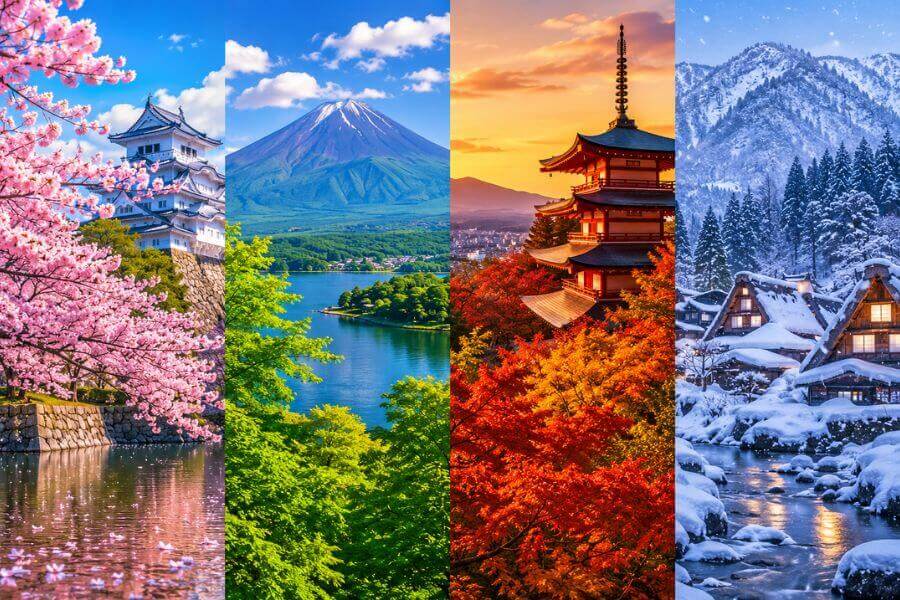
Japan is one of the few countries where every season feels completely different from the one before it. A place that looks soft and pink in spring can become deep green in summer, fiery red in autumn, and covered in snow during winter. Because Japan stretches from the snowy north to the subtropical south, you can experience an incredible variety of seasonal changes throughout the year.
If you love nature, photography, culture, or simply seeing destinations transform before your eyes, Japan offers some of the most dramatic seasonal scenery anywhere in the world. From cherry blossoms that last only a few weeks to mountain landscapes buried under meters of snow, each season creates unforgettable moments.
In this guide, you’ll discover the 10 most dramatic seasonal changes you can witness in Japan and why each one deserves a place on your travel bucket list.
Quick Summary Table 📋
| Rank | Seasonal Change | Best Time | Why It’s Dramatic |
|---|---|---|---|
| 1 | Cherry Blossoms to Green Landscapes | March-May | Entire cities change color within weeks |
| 2 | Autumn Leaves in Kyoto | October-December | Forests become red, orange, and gold |
| 3 | Snow Monsters of Tohoku | January-February | Trees transform into giant ice sculptures |
| 4 | Lavender Fields of Hokkaido | June-July | Purple flower oceans replace spring greenery |
| 5 | Mount Fuji’s Seasonal Appearance | Year-round | Changes dramatically with each season |
| 6 | Rice Paddy Transformations | April-September | Fields evolve from water mirrors to golden waves |
| 7 | Summer Festival Landscapes | July-August | Streets completely transform with celebrations |
| 8 | Japanese Alps Seasonal Contrast | All year | Mountains shift from snow to vibrant green |
| 9 | Coastal Winter Seas and Summer Beaches | Year-round | Same coastline offers opposite experiences |
| 10 | Seasonal Gardens of Kanazawa | Four seasons | Carefully designed beauty changes constantly |
How We Ranked These Seasonal Changes 🔍
We ranked these experiences based on several important factors:
- Visual impact and how dramatic the transformation appears
- Uniqueness compared to other destinations around the world
- Accessibility for travelers
- Seasonal contrast between different times of year
- Photography opportunities
- Cultural significance in Japan
- Overall visitor experience
- Natural beauty and memorability
1. Cherry Blossoms to Lush Green Landscapes 🌸
Nothing represents seasonal change in Japan more dramatically than the transition from cherry blossom season to early summer greenery.
During spring, parks, rivers, temples, and city streets become covered in delicate pink and white blossoms. The scenery feels almost magical. Families gather for picnics, photographers fill every viewpoint, and entire neighborhoods seem transformed overnight.
What makes this change so dramatic is how quickly it happens. Within just a few weeks, the falling petals disappear and are replaced by rich green leaves. Areas that looked soft and pastel suddenly become vibrant and full of life.
If you visit the same location in April and then again in June, it can feel like two completely different places.
2. Autumn Leaves in Kyoto 🍁
Kyoto is famous year-round, but autumn may be its most dramatic season.
As temperatures cool, temple gardens, mountain forests, and historic streets become covered in brilliant shades of red, orange, yellow, and gold. The contrast between colorful leaves and traditional wooden temples creates some of Japan’s most iconic scenery.
Many visitors who see Kyoto in both summer and autumn are surprised by how different it feels. Green hills become fiery landscapes, and famous temples gain an entirely new atmosphere.
The transformation unfolds gradually over several weeks, allowing travelers to witness nature’s colorful masterpiece at different stages.
3. The Snow Monsters of Tohoku ❄️
One of Japan’s most unusual winter phenomena occurs in the mountains of northern Japan.
Strong winds carrying moisture from the sea freeze onto trees. Layer after layer of ice and snow builds up until the trees are no longer recognizable. Instead, they resemble giant frozen creatures standing across the mountainside.
During the summer, these mountains are covered in ordinary green forests. By winter, they look like scenes from another planet.
The contrast between the seasons is so extreme that many first-time visitors can hardly believe they are looking at the same location.
4. Lavender Fields of Hokkaido 💜
Hokkaido experiences one of Japan’s most colorful seasonal transitions.
After a long, snowy winter and a fresh green spring, enormous lavender fields bloom across the countryside. Hillsides become covered in endless waves of purple flowers stretching toward the horizon.
The scent, color, and atmosphere create a completely different environment from the rest of the year.
When viewed from above, the landscape appears almost painted by hand. The dramatic shift from snow-covered farmland to vibrant flower fields makes this one of Japan’s most beautiful seasonal transformations.
5. Mount Fuji’s Ever-Changing Appearance 🗻
Mount Fuji looks different in every season.
Winter often showcases the mountain with a thick snow cap and crystal-clear skies. Spring surrounds it with cherry blossoms. Summer reveals green forests and hiking trails, while autumn adds colorful foliage around its base.
The mountain itself remains the same, but the environment around it constantly changes.
Photographers often spend years capturing Fuji throughout the seasons because each visit offers a completely different visual experience. It is one of the best examples of how a single landmark can transform throughout the year.
6. Rice Paddy Transformations 🌾
Rice fields undergo one of the most fascinating seasonal changes in Japan.
In spring, farmers flood the fields with water, creating giant mirrors that reflect the sky and surrounding mountains. These reflective landscapes are incredibly beautiful and often attract photographers.
As summer progresses, bright green rice plants begin to grow.
By autumn, the same fields become golden waves ready for harvest. What started as reflective pools transforms into rich agricultural scenery that symbolizes rural Japan.
Few landscapes change as dramatically over such a short period.
7. Summer Festival Landscapes 🎆
Japan’s summer festivals completely transform cities and towns.
Quiet streets suddenly become filled with lanterns, food stalls, traditional clothing, music, and fireworks. Public spaces that seem ordinary during the rest of the year become vibrant centers of celebration.
The atmosphere changes as much as the physical scenery.
Visitors often describe the summer festival season as seeing an entirely different side of Japan. Neighborhoods become brighter, louder, and more energetic than at any other time of year.
8. The Japanese Alps Through the Seasons ⛰️
The Japanese Alps offer one of the country’s most dramatic seasonal contrasts.
Winter brings deep snow, frozen peaks, and white valleys. Spring introduces melting rivers and fresh vegetation. Summer fills the mountains with green forests and colorful alpine flowers. Autumn paints entire slopes with vibrant colors.
Because of the elevation differences, seasonal transitions happen at different times throughout the mountains.
This creates a constantly changing scenery that attracts hikers, photographers, and nature lovers year-round.
9. Coastal Winter Seas and Summer Beaches 🌊
Japan’s coastlines experience remarkable seasonal changes.
During winter, powerful waves crash against rugged shorelines. The sea often appears darker and more dramatic. Strong winds create an atmosphere that feels wild and untamed.
By summer, many of these same coastal areas become bright beach destinations filled with swimmers, surfers, and families.
The contrast between the peaceful summer experience and the dramatic winter landscape makes coastal Japan fascinating in every season.
10. The Seasonal Gardens of Kanazawa 🌺
Kanazawa’s famous gardens showcase Japan’s appreciation for seasonal beauty.
Spring brings blossoms and fresh greenery. Summer introduces rich plant growth and vibrant colors. Autumn covers the gardens in warm shades of red and gold. Winter adds snow-covered branches and carefully maintained seasonal displays.
Garden designers intentionally create landscapes that look beautiful throughout the year.
As a result, visitors can return during different seasons and enjoy completely different experiences without ever leaving the same garden.
Conclusion ⭐
Japan’s seasonal changes are among the most dramatic and beautiful in the world. The country offers far more than famous cherry blossoms and autumn leaves. From frozen mountain forests and blooming lavender fields to golden rice paddies and vibrant summer festivals, every season reveals a different side of Japan.
The most rewarding approach is to view Japan not as a single destination but as a place that continuously transforms throughout the year. Whether you visit in spring, summer, autumn, or winter, you’ll discover landscapes, colors, and experiences that feel entirely unique to that season.
For travelers who appreciate nature and cultural traditions, witnessing these seasonal transformations is one of the greatest reasons to explore Japan again and again.
Frequently Asked Questions 🤔
Which season offers the most dramatic scenery in Japan?
Many travelers choose autumn because of the intense colors and widespread foliage. However, spring and winter are equally dramatic depending on your interests. Cherry blossoms create a short-lived spectacle, while winter transforms entire regions with snow and ice.
How many seasons should I experience to truly appreciate Japan?
Experiencing at least two contrasting seasons, such as spring and winter or summer and autumn, helps you understand how dramatically Japan changes throughout the year. Four-season visits provide the fullest experience.
Is Japan worth visiting during the rainy season?
Yes. The rainy season creates lush green landscapes, vibrant hydrangea blooms, and fewer crowds at many popular attractions. It offers a unique perspective that many visitors overlook.
Which region of Japan has the biggest seasonal differences?
Hokkaido and the Japanese Alps often show the strongest contrasts due to heavy snowfall in winter and vibrant greenery during warmer months.
Can you see seasonal changes even in major cities?
Absolutely. Cities such as Tokyo, Kyoto, and Osaka feature parks, rivers, temples, gardens, and seasonal events that make seasonal transitions highly visible despite their urban environments.