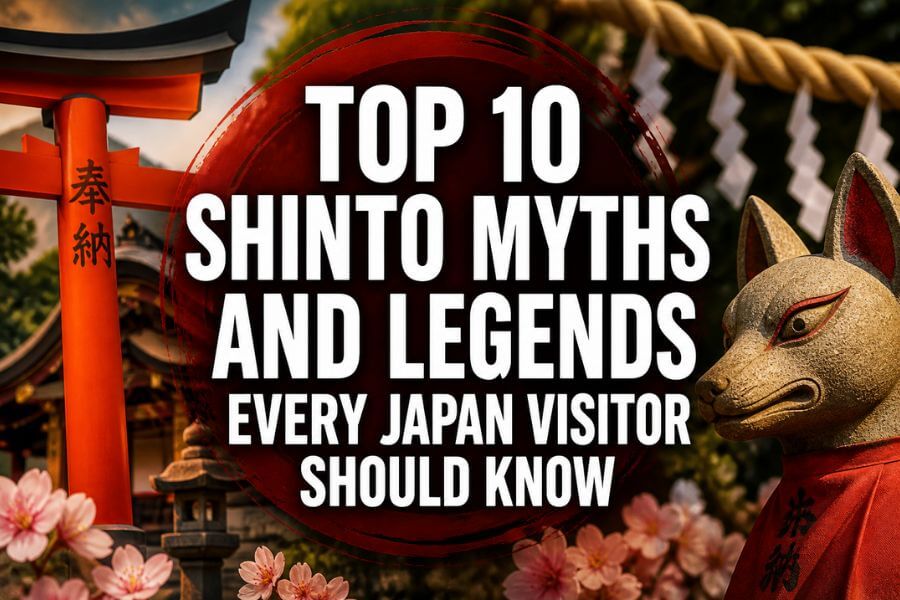
When you visit Japan, you will notice shrines, torii gates, and rituals everywhere. These are all part of Shinto, Japan’s oldest belief system. But Shinto is not just about traditions. It is also filled with fascinating myths and legends that shaped the country’s culture, values, and even its geography.
If you understand these stories, your trip becomes much more meaningful. You will not just see a shrine. You will understand why it exists. You will not just hear a name. You will know the story behind it.
In this guide, you will discover the top 10 Shinto myths and legends every visitor should know. These stories are easy to follow, but they carry deep meaning that still influences Japan today.
Quick Summary Table 🗾
| # | Myth or Legend | Key Theme | Why It Matters |
|---|---|---|---|
| 1 | Creation of Japan | Birth of islands | Explains Japan’s origin |
| 2 | Amaterasu and the Cave | Light and darkness | Symbol of hope and renewal |
| 3 | Susanoo and the Serpent | Hero vs monster | Courage and protection |
| 4 | The Sacred Mirror | Truth and reflection | Imperial symbol |
| 5 | Izanagi’s Purification | Life and rebirth | Origin of many gods |
| 6 | Okuninushi’s Journey | Love and trials | Patience and kindness |
| 7 | The White Rabbit of Inaba | Trickery and lesson | Compassion matters |
| 8 | Yamato Takeru | Warrior legend | Strength and tragedy |
| 9 | The Sun Goddess Lineage | Divine rulers | Link to the emperor |
| 10 | Spirits in Nature | Kami everywhere | Respect for nature |
How We Ranked These 🧭
To create this list, we focused on stories that will give you the best cultural understanding as a visitor. Here are the key factors we used:
- Cultural importance in Japan today
- Presence in shrines and tourist sites
- Ease of understanding for first-time visitors
- Influence on Japanese values and traditions
- Popularity in festivals, art, and history
1. The Creation of Japan by Izanagi and Izanami 🌊
This is the most important myth in Shinto. It explains how Japan itself was created.
You follow the story of two divine beings, Izanagi and Izanami. They were tasked with forming the world. Standing on a heavenly bridge, they stirred the ocean with a spear. Drops fell from the spear and formed the first island.
They later created more islands, which became Japan. But the story takes a darker turn. Izanami dies after giving birth to a fire god. Izanagi travels to the land of the dead to bring her back, but he fails.
This myth teaches you about life, death, and the natural balance of the world. When you visit shrines, you will often see references to these gods.
2. Amaterasu Hides in the Cave ☀️
Amaterasu is the sun goddess and one of the most important figures in Shinto.
In this story, her brother, Susanoo, behaves badly and causes chaos. Upset, Amaterasu hides inside a cave, and the world falls into darkness.
The other gods gather outside and perform a joyful dance. Curious, Amaterasu peeks out. They show her a mirror, and she is amazed by her own reflection. She steps out, bringing light back to the world.
This story is about hope. Even in darkness, light can return. When you visit shrines dedicated to Amaterasu, you are connecting with this powerful symbol.
3. Susanoo and the Eight-Headed Serpent 🐉
Susanoo is known for his wild personality, but he also becomes a hero in this legend.
He meets a family who must sacrifice their daughter to a giant eight-headed serpent. Susanoo agrees to help. He tricks the serpent by offering it strong sake. Once it falls asleep, he defeats it.
Inside the serpent’s tail, he finds a sacred sword. This sword later becomes one of Japan’s imperial treasures.
You will notice that this story reflects bravery and clever thinking. It is also one of the most exciting myths you can learn.
4. The Sacred Mirror and Imperial Treasures 🪞
The mirror used to lure Amaterasu out of the cave becomes one of Japan’s most important symbols.
It represents truth and wisdom. Along with the sword and a jewel, it forms the three imperial treasures.
Even today, these items are part of the emperor’s role. You may not see them in public, but their meaning is deeply respected.
When you visit major shrines, remember that these objects connect the modern world to ancient beliefs.
5. Izanagi’s Purification Ritual 💧
After escaping the land of the dead, Izanagi performs a cleansing ritual.
As he washes himself, new gods are born. One of them is Amaterasu, born from his eye.
This story explains why purification is so important in Shinto. When you visit a shrine, you will see water basins where you wash your hands and mouth.
This simple act connects you to an ancient story about renewal and balance.
6. Okuninushi’s Trials and Love Story 💖
Okuninushi is a god known for kindness and perseverance.
He faces many challenges, often caused by his jealous brothers. Despite this, he continues to act with compassion. He eventually wins the heart of a princess and becomes a ruler.
This story teaches patience and empathy. It shows that kindness can lead to success.
If you visit Izumo Taisha, one of Japan’s oldest shrines, you will find strong connections to this legend.
7. The White Rabbit of Inaba 🐇
This story is simple but powerful.
A rabbit tricks sharks into helping it cross the sea. Later, it is punished and left injured. Many pass by without helping, but Okuninushi shows kindness and heals it.
The lesson is clear. Compassion matters more than cleverness.
This story is often told to children, but it still carries meaning for adults. As a visitor, it reminds you to respect others and act with care.
8. Yamato Takeru’s Legendary Journey ⚔️
Yamato Takeru is a legendary warrior prince.
He goes on many missions to defeat enemies and expand his territory. Along the way, he uses clever disguises and strategies.
However, his story is also tragic. Despite his strength, he faces loss and hardship.
This legend reflects the balance between power and humility. It is often connected to historical sites you can visit across Japan.
9. The Divine Lineage of the Emperor 👑
Shinto myths explain that the Japanese emperor is descended from Amaterasu.
This belief gave the imperial family a divine connection. While modern Japan is very different, this idea still holds cultural importance.
When you visit places like Ise Grand Shrine, you will see how deeply this story is respected.
Understanding this myth helps you appreciate Japan’s history and traditions.
10. Kami in Nature 🌿
One of the most important Shinto ideas is that spirits, called kami, exist everywhere.
They can be found in mountains, rivers, trees, and even rocks. This belief shapes how people treat nature.
You will notice this when you visit forests, shrines, and sacred sites. There is always a sense of respect and calm.
This is not just a myth. It is a way of seeing the world that continues today.
Conclusion 🌏
When you explore Japan, these myths are not just stories. They are part of daily life, traditions, and the way people think.
By learning them, you gain a deeper connection to what you see around you. A shrine becomes more meaningful. A ritual feels more personal. Even nature itself takes on a new significance.
These legends help you understand Japan beyond the surface. They show you a world where gods, spirits, and humans are closely connected.
So as you travel, take a moment to remember these stories. They will make your experience richer and more memorable.
Frequently Asked Questions ❓
What is Shinto in simple terms?
Shinto is Japan’s traditional belief system. It focuses on worshiping kami, which are spirits found in nature and important places. It does not have a single founder or holy book, making it different from many other religions.
Do Japanese people still believe in these myths today?
Many people do not take the stories literally, but the values and traditions remain strong. These myths still influence festivals, rituals, and cultural practices across Japan.
Can tourists visit Shinto shrines?
Yes, you are welcome to visit most shrines. You should follow basic etiquette, such as bowing at the entrance and washing your hands at the purification fountain.
Are Shinto myths similar to other mythologies?
Yes, they share similarities with myths from other cultures, such as creation stories and hero tales. However, Shinto places a stronger focus on nature and harmony.
Which myth is most important to understand before visiting Japan?
The story of Amaterasu is one of the most important. It explains the importance of light, balance, and the connection to the imperial family, making it very relevant to Japanese culture.